The Army’s TITAN program shifts from prototyping to production
The US Army has taken a significant step toward operationalizing one of its most closely watched battlefield intelligence programs, awarding production contracts worth a combined $192 million to Palantir and Anduril for the Tactical Intelligence Targeting Access Node, or TITAN. The move pushes the system out of its experimental phase and into procurement, with eight systems scheduled for delivery over the next 18 months.
According to the Army announcement reported by Breaking Defense, Palantir received a $127 million award as the prime contractor, while Anduril was awarded $65 million to develop much of the system’s ruggedized hardware. The production package covers four advanced and four basic TITAN variants, reflecting the Army’s intent to field the technology across different echelons and mobility profiles rather than as a one-size-fits-all platform.
The contract matters because TITAN is not a niche sensor or a standalone vehicle kit. It is designed as a next-generation ground system that gathers intelligence from joint and national assets on Earth and in space, then helps disseminate that information to the battlefield quickly enough to affect targeting decisions. In practical terms, the Army is betting that future combat effectiveness will depend on compressing the time between sensing a target, validating it and passing that information to units that can act on it.
What TITAN is supposed to do
The Army describes TITAN as a mobile intelligence node that synthesizes information from multiple sources into a common operational picture. That includes data from assets beyond the immediate tactical formation, which is one reason the program is positioned as a bridge between high-end intelligence collection and frontline targeting needs.
Col. Jonathan Lipscomb, the Army’s project manager for intelligence systems and analytics, said the system enhances target recognition and geolocation speed and reduces sensor-to-shooter timelines through automated target nominations while fusing the intelligence picture. The emphasis on automation is notable. The Army is not just buying another terminal or transportable server stack; it is investing in software-enabled workflows that can help soldiers move faster through the find-fix-finish chain.
That focus aligns with the service’s broader modernization push, which has increasingly centered on integration across sensors, shooters and command systems. TITAN sits in the middle of that effort. Its value is not merely in collecting more data, but in making disparate streams usable under battlefield time pressure.
Two variants for different missions
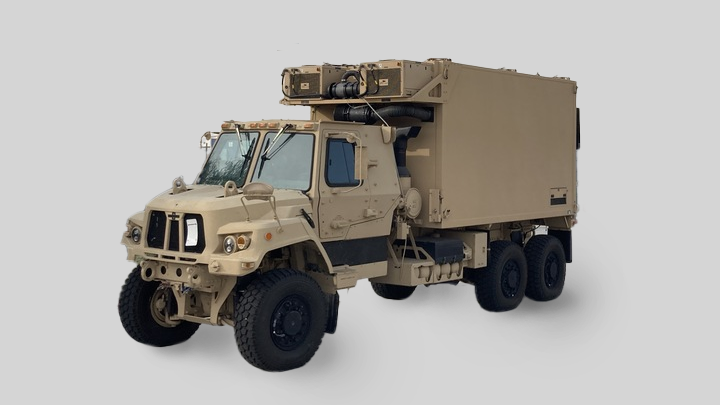
The initial production lot includes both advanced and basic TITAN configurations. The distinction is not cosmetic. The Army plans to mount the basic variant on the Joint Light Tactical Vehicle and the Infantry Squad Vehicle-Utility, giving division-level users a more mobile system that can move with lighter formations. The advanced variant is intended as a corps-level, military intelligence brigade theater-level and multi-domain command asset mounted on the Family of Medium Tactical Vehicles.
Those deployment choices say a great deal about how the Army sees the system. A lighter configuration supports tactical maneuver and forward employment, while the heavier advanced version suggests a more expansive role in processing and distributing intelligence across larger formations. The Army also appears to expect these assets to be scarce and therefore valuable. Units are to receive only two basic systems and one advanced system, a distribution model that underscores both TITAN’s importance and its vulnerability if targeted.
The implication is straightforward: TITAN is being built as a high-value battlefield brain, not an abundant commodity platform. That raises the stakes for survivability, mobility and resilience, particularly in conflicts where electronic warfare, long-range fires and contested logistics are constant risks.
Why the program’s field testing mattered
TITAN’s production award did not emerge from a vacuum. The Army has been experimenting with prototypes for several years and sent what it called pre-prototypes to the Pacific and Europe in 2022 for testing. That timeline reflects a deliberate approach in which the service used soldier feedback to refine the concept before committing to production dollars.
One of the more revealing details from the report is that operational testing exposed environmental weaknesses. Early assessments from a deployment in the Philippines found that humidity created problems the Army had not encountered in the Middle East. That kind of result is exactly why prototype programs exist. A battlefield intelligence node that performs well in one climate but degrades in another is not ready for broad deployment, especially as the Army reorients toward theaters with very different operating conditions.
Lipscomb said Army leaders believe those climate concerns were resolved through more rigorous environmental engineering. Even so, the episode is a reminder that digital warfare systems still depend on very physical realities: heat, moisture, dust, power stability, mobility constraints and maintenance demands. Advanced software and analytics are only as useful as the hardware packages that keep them functioning in the field.
Why Palantir and Anduril matter here
The contractor lineup also reflects a wider shift in the US defense industrial base. Palantir became the prime contractor in 2024 after taking part in the prototyping phase, while Anduril is responsible for a substantial share of the ruggedized hardware. Both companies represent a newer generation of defense suppliers that have built their reputations around software integration, autonomy, rapid development and closer alignment between commercial technology practices and military procurement needs.
The Army’s decision to move this program forward with those firms suggests confidence not only in TITAN itself but in a procurement model that leans on defense-tech entrants for mission systems once dominated by more traditional prime contractors. That does not eliminate the role of established defense manufacturing, but it does show how software-centric companies are moving deeper into core operational architecture.
Several takeaways stand out from the production decision:
- The Army is prioritizing faster intelligence-to-targeting workflows as a central battlefield requirement.
- TITAN is being designed for both mobile division use and larger theater-level intelligence missions.
- Prototype feedback, including failures in humid environments, directly shaped the production-ready system.
- The program highlights the growing influence of software-led defense firms in major Army procurements.
The next 18 months will determine whether TITAN can make the transition from promising prototype to durable field capability. For now, the production award marks a clear inflection point. The Army is no longer just exploring how a multi-source, software-heavy intelligence node might work. It is paying to build, integrate and deliver the first operational systems, with the expectation that faster target recognition and geolocation will become a concrete battlefield advantage rather than a modernization slogan.
This article is based on reporting by Breaking Defense. Read the original article.
Originally published on breakingdefense.com