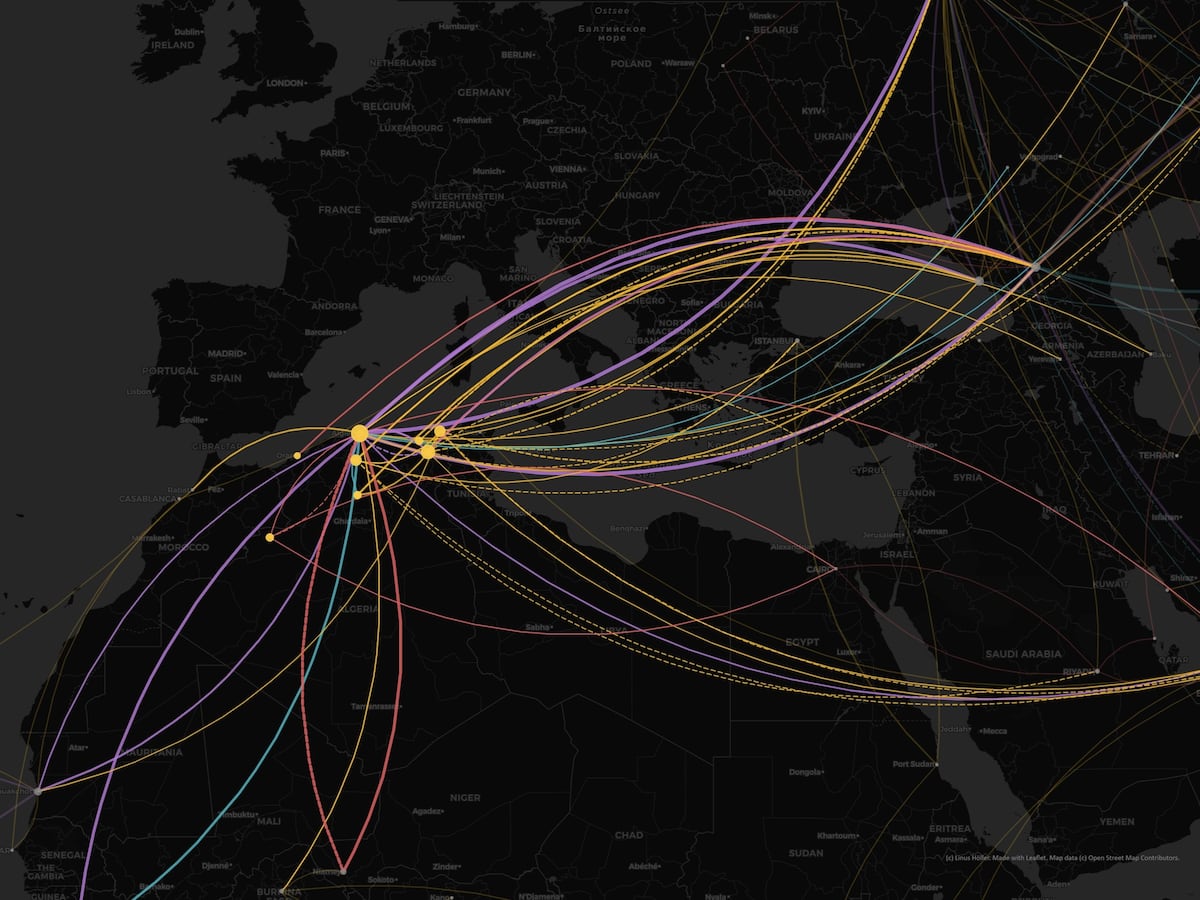
A dense air bridge with strategic implications
A Defense News investigation has identified Algeria as a significant hub in a Russian military-linked cargo network, tracing at least 167 flights between Russia and Algeria from March 2025 through April 2026. The reporting suggests the routes likely supported deliveries of modern Russian warplanes and related equipment while also helping Moscow project influence deeper into Africa.
The findings matter because they connect logistics, arms exports, and regional power projection in a single operating picture. Algeria has long been an important customer for Russian weapons, but the volume and pattern of the reported flights indicate a more active relationship at a time when Russia’s broader military-export business has been under pressure since the invasion of Ukraine.
According to the investigation, many of the cargo flights linked Russian airfields associated with United Aircraft Corporation, the state-owned manufacturer of military jets, with Algerian air bases. Several of those flights also roughly coincided with sightings of new Russian-made warplanes flying over Algeria, adding circumstantial weight to the claim that at least part of the traffic was tied to aircraft deliveries.
Why Algeria matters now
The strategic importance of Algeria in this context comes from both geography and demand. On the geography side, the country sits on Europe’s southern flank and offers a position from which airlift operations can extend farther into Africa. On the procurement side, Algeria remains one of Russia’s most important defense customers.
The report notes that Algeria is currently receiving Su-57 fifth-generation stealth fighters and Su-35 fighters from Russia. It already operates about 60 Su-30 multirole fighters and around 40 MiG-29 air-superiority fighters. That makes Algeria not just a buyer of Russian systems, but a state with an existing fleet, training structure, and maintenance ecosystem built around them.
This continuing demand is especially notable because Russia’s export business has faced strain from war, sanctions, and the competing pressure of supplying its own armed forces. In that environment, a customer willing to keep placing large aircraft orders becomes more valuable both economically and politically.
What the flight data suggests
The investigation describes a pattern consistent with more than routine cargo traffic. Flights were reportedly tracked to Algerian sites including Oum El Bouaghi Air Base, Ain Oussera Air Base, and Annaba Air Base. The links to manufacturing-related Russian airfields, combined with the timing of visible aircraft activity in Algeria, point toward a supply chain connected to combat aviation.
One outside analyst cited in the report said the explanation that these flights were tied to new-generation weapons deliveries was “pretty reasonable.” That phrasing is important. The available evidence supports a strong inference, but the reporting as presented does not claim direct confirmation for each individual shipment.
Even with that caveat, the pattern is hard to dismiss. Military aircraft deliveries require more than handing over finished jets. They can involve associated equipment, parts, support systems, and personnel movements. A steady stream of flights over more than a year fits the idea of a sustained logistics effort rather than isolated transfers.
A shadow network under pressure
The Algeria findings are part of a broader Defense News “Shadow Airlines” investigation into government-affiliated operators, front companies, and Soviet-era freight aircraft used to move Russian weapons and influence. Since sanctions intensified after the invasion of Ukraine, such aviation networks have grown in importance for Moscow.
That broader context matters because it shows how logistics itself has become a geopolitical tool. When formal trade and transportation routes become more constrained, states rely more heavily on semi-opaque systems that can keep strategic goods moving while reducing visibility and friction.
For Russia, air cargo is not just a technical support function. It is one of the mechanisms by which military relationships are maintained abroad. The reported Algeria network illustrates how that mechanism can serve both commercial arms transfers and wider regional influence at the same time.
What this means for Europe and Africa
For European observers, the report adds another layer to the security picture on the Mediterranean’s southern edge. Algeria’s military modernization has its own national logic, but the extent of Russian-linked airlift traffic suggests a relationship with wider implications than bilateral procurement alone.
For African security dynamics, Algeria’s role as a possible logistics platform matters because it could extend Russia’s reach beyond direct customer relationships. If a partner state functions as a stable transit and operating node, that can multiply the effect of Russian transport networks across the region.
The source text does not claim a full map of downstream missions, and it would be premature to treat every route as evidence of a unified Africa-wide strategy. Still, the scale of the traffic indicates that Algeria is more than a passive recipient of hardware. It appears to be part of a broader operating structure.
The larger takeaway
The headline number of 167 flights is significant not just because it is large, but because of what it implies about endurance. Sustained military-linked logistics are harder to fake than political messaging. They reveal continuing relationships, continuing demand, and continuing capacity to move strategic cargo despite sanctions and wartime disruption.
The investigation does not prove every detail of Russia’s intentions, but it does establish a persuasive outline: Algeria has become one of the important hubs in Moscow’s cargo network, and that role likely supports both aircraft deliveries and a wider projection of Russian power.
At a time when military influence is often discussed through weapons systems, troop movements, and diplomatic alignments, the report is a reminder that airlift networks deserve equal attention. They are the infrastructure that turns geopolitical ambition into sustained presence. In this case, they also show how an old defense partnership is being repurposed for a more contested era.
This article is based on reporting by Defense News. Read the original article.
Originally published on defensenews.com