A question that shapes who benefits from biomedical innovation
Clinical trials occupy a dual role in medicine. They are the scientific machinery through which new drugs, devices and diagnostics are validated, and they are also, for many patients, the earliest practical route to therapies that are not yet part of routine care. That combination is what gives a new Nature Medicine commentary its edge: its central question is whether building more clinical trial capacity actually broadens healthcare access, or simply concentrates opportunity in the places that already have the most.
The piece, titled "Does expansion of clinical trial capacity improve healthcare access?", was published online on 25 September 2026. It is filed under clinical trials, drug development, drug regulation, health policy, institutions, pharmaceutical innovation, and systems and market dynamics — a reminder that trial infrastructure is never purely a scientific matter. It is also an industrial, regulatory and equity question.
The argument in brief
The accessible summary of the commentary makes two linked points. First, clinical trials are essential for patient access to biomedical innovation. Second, China has seen rapid expansion of trials over the past decade — a genuine increase in national capacity. The authors do not stop at celebrating that growth. They add a qualification: the expansion has been concentrated in top-tier institutions, and it therefore needs careful management if it is to improve equitable access.
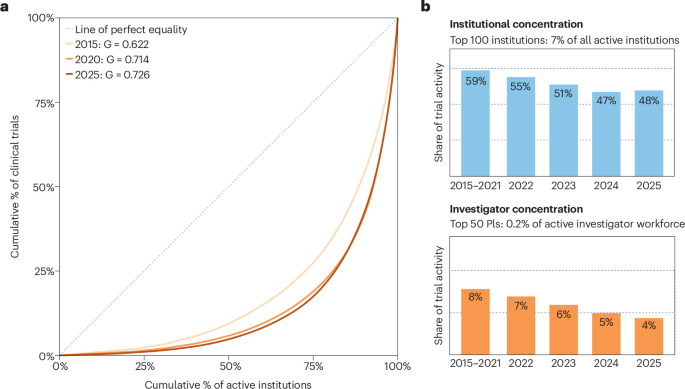
That framing matters. Rapid capacity growth and equitable capacity growth are not the same thing, and the commentary treats the gap between them as a policy problem rather than an inevitable side effect. A figure accompanying the article, described as showing the structural concentration of clinical trial activity in China, appears to anchor the argument visually.
Who is behind the analysis
The byline is notably broad, with multiple ORCID identifiers attached to a long list of contributors. The named authors include Yang Liu, Yuzi You, Cheng Li, Chenghao Ge, Yale Jiang, Sen Liu, Yusu Jian, Xin Wang, Yunhe Qin, Jianhua Jiang, Ying Gong, Haiyan Li, Jian Wu, Feng Qian, Fanpu Kong, Tien Yin Wong and Xiaoyuan Chen, along with additional co-authors. A roster of this size and disciplinary range is consistent with the subject: assessing trial capacity requires input from clinicians who run studies, researchers who analyze research systems, and specialists who understand regulation and health policy.
Why capacity and access can diverge
The commentary's caution rests on a straightforward intuition. If trial sites cluster at a limited number of leading hospitals, then the patients who can realistically enroll are the ones who can reach those hospitals — or who are already being treated there. Volume of trials, in other words, is a measure of research activity, while access is a measure of who can participate in that activity and benefit from it.
The commentary does not stop at diagnosis. It signals that managing the distribution of trial capacity deliberately, rather than letting it accumulate wherever infrastructure and expertise are thickest, is the route to more equitable outcomes. What that management looks like in practice is the harder question, and the publicly available preview does not lay out a detailed prescription.
Reading the reference list as a map
The works cited offer a sense of how the authors position China's experience. They span oncology research published in JAMA Oncology, a Nature Medicine piece on equity, a Nature Reviews Drug Discovery article, a 2019 joint announcement from China's National Medical Products Administration and National Health Commission on regulations governing drug clinical trial institutions, a critical care analysis in CMAJ, a study in JCI Insight, an oncology review in Annals of Oncology, and a 2012 National Academies workshop summary on developing clinical trials infrastructure in the United States.
That spread is telling. It suggests the commentary treats trial capacity as a systems question with international parallels, not a purely national story. The American infrastructure discussion from 2012 and the Chinese regulatory announcement from 2019 are, in different ways, attempts to answer the same underlying problem: how to build research capacity that serves a population rather than a handful of centers.
The dimensions that careful management would need to touch
The commentary's short summary states the need for careful management without enumerating the levers. Drawing on the questions its framing raises, several areas would plausibly matter:
- Geographic distribution. Where trial sites are physically located determines who can enroll without relocating or travelling long distances.
- Institutional concentration. When a small set of top-tier hospitals hosts a large share of studies, the learning, funding and prestige that accompany trials flow to the same places repeatedly.
- Regulatory design. Rules governing which institutions may run drug trials shape how far capacity can spread beyond established centers.
- Patient awareness and referral. Trials only improve access if patients and their physicians know they exist and can reach them.
- Measurement. Tracking who enrolls — and who does not — is necessary to know whether growth is translating into equity.
These are the practical questions that sit underneath the commentary's single-sentence conclusion. The article's own framing implies that without attention to distribution, expansion can be real and still leave access uneven.

What the preview does and does not settle
It is worth being precise about what is verifiable here. The article is a comment piece in Nature Medicine, published online on 25 September 2026, with a subscription paywall. The freely available preview supplies the title, the author list, the abstract-level summary, the figure description and the reference list. It records the article as having roughly 90 accesses and one Altmetric mention at the time of capture.
What the preview does not supply is the full argument: the specific data behind Figure 1, the proposed remedies, or the authors' detailed assessment of how Chinese trial regulation has shaped site distribution. Any evaluation of the commentary's recommendations would require the full text, and readers should treat the summary as a thesis statement rather than a complete analysis.
Why the question reaches beyond China
The commentary's title is deliberately general, and the underlying tension is not unique to one country. Health systems everywhere face a version of the same trade-off: research excellence tends to concentrate where expertise, funding and patient volume already concentrate, while the populations most in need of new options often live further from those centers. Expanding trial capacity is a genuine achievement. Whether it narrows or widens disparities depends on decisions about placement, regulation and outreach that are made alongside the growth.
For patients, the stakes are concrete. A trial can mean earlier access to a promising therapy, closer monitoring, or an option when standard treatment has been exhausted. For health systems, trials bring investment, trained staff and research culture. The commentary's contribution is to insist that these benefits be asked a follow-up question: who gets them?

The bottom line
China's clinical trial expansion over the past decade represents a substantial increase in national research capacity, and the commentary acknowledges that plainly. Its warning is about distribution. Because growth has clustered in top-tier institutions, the link between more trials and better healthcare access is not automatic — it has to be managed deliberately. The commentary reframes expansion as a starting point rather than an answer, and in doing so turns a research-metrics story into a question about equity that regulators, hospital leaders and trial sponsors will have to answer with more than volume figures.
This article is based on reporting by Nature Medicine. Read the original article.
Originally published on nature.com