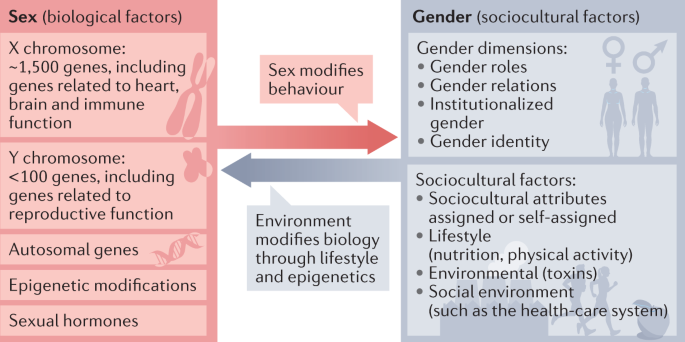
Cardiovascular medicine has spent decades refining risk scores, drug regimens and device protocols around a statistical average patient who does not actually exist. A new Perspective published in Nature Medicine argues that the field's next major redesign should be organized around a variable that has long been treated as a footnote: sex. Published online on 25 September 2026, the article pulls evidence from preclinical laboratories and clinical practice into a single argument — that differences between female and male biology are not a niche subfield of cardiology, but a structural fact that should shape how studies are designed, how trials are run and how patients are ultimately treated.
The piece is a Perspective rather than a report of new data, which matters for how it should be read. It does not present a single experiment or a fresh cohort. Instead, it synthesizes what is already known across two domains that rarely speak to each other with enough rigor, and then makes a case about what the field should do next.
Why sex belongs at the center of cardiovascular research
The central claim of the Perspective is straightforward: understanding sex differences in cardiovascular disease is not an optional refinement to be layered on after the science is settled. It is a prerequisite for getting the science right in the first place. When sex is treated as a secondary variable — something to be checked after the primary analysis — the resulting picture of disease mechanism, risk and treatment response is incomplete by construction.
That framing has consequences well beyond the laboratory. Cardiovascular conditions remain among the most studied and most heavily treated in all of medicine, which means that any systematic blind spot in how sex is handled propagates across diagnostics, prescribing habits, clinical guidelines and, eventually, patient outcomes. A field this large cannot afford a default assumption that is quietly wrong for a substantial share of the people it serves.

Connecting the lab bench to the clinic
What distinguishes the Perspective is its insistence on connecting preclinical and clinical evidence rather than treating them as separate conversations with separate literatures. Mechanistic work in cells and animal models supplies the biological reasoning that explains why a difference exists. Clinical observation supplies the evidence that the difference matters for real patients. Neither is sufficient alone.
Read in isolation, preclinical findings can look like curiosities with no clear route to the bedside. Read in isolation, clinical patterns can look like statistical noise or artifacts of sampling. Read together, they form a chain of reasoning that can guide where researchers look next and which questions are worth funding. The Perspective's argument is essentially that this chain is currently broken at too many points, and that repairing it requires deliberate effort rather than hoping the two domains will converge on their own.
Building that bridge also changes what counts as a good study. If sex differences are a core part of the research question, then study design, sample composition, endpoint selection and analysis plans all have to account for them from the outset — decisions that are far harder to retrofit after data collection has finished.
What a redesigned field would look like
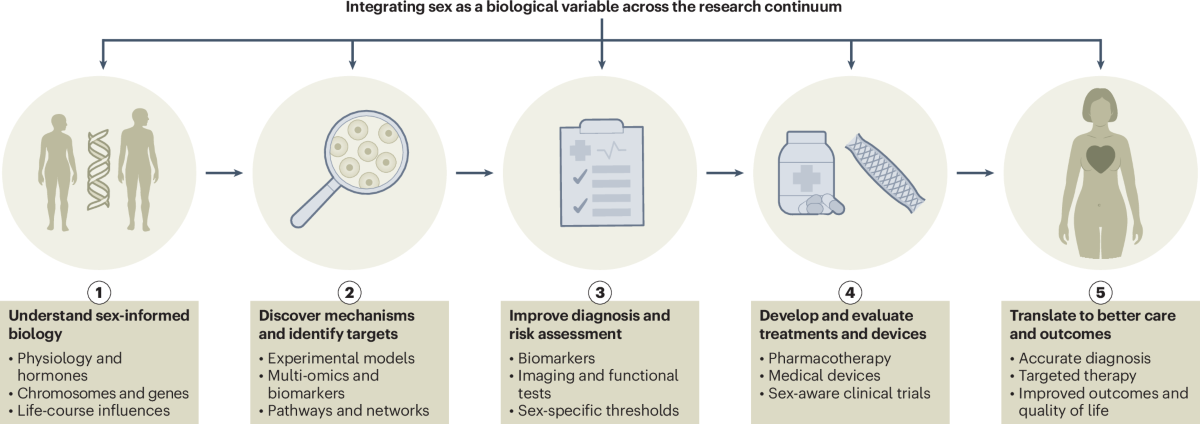
The Perspective points toward a cardiovascular enterprise in which sex is embedded throughout the research and care pipeline. In practical terms, that implies a set of shifts in how the field operates:
- Preclinical work that treats sex as a designed variable rather than a nuisance to be averaged away, so mechanistic findings reflect more than one biological pathway.
- Clinical studies built to detect and interpret sex differences instead of being statistically underpowered to see them.
- Evidence synthesis that carries laboratory and clinical findings forward together, so that mechanistic insight and patient-level observation reinforce each other.
- Translation into practice that reflects what the combined evidence actually shows, rather than defaulting to generalizations drawn from narrower populations.
None of these steps is exotic. Each is a matter of institutional choice — about funding priorities, journal expectations, training and the questions researchers are rewarded for asking.

The obstacles are structural, not scientific
The Perspective's call is ambitious precisely because the barriers are not primarily technical. They are embedded in how research communities are organized, how specialties divide labor, and how evidence is validated and communicated. Preclinical and clinical researchers often work within different incentive structures, publish in different venues and are evaluated by different criteria. Bridging them requires sustained institutional pressure, not just individual enthusiasm.
There is also a legacy problem. Decades of cardiovascular research were conducted under assumptions that are now being questioned, and the resulting literature is unevenly informative. Correcting that record means acknowledging the gaps rather than reading old results as though they were neutral with respect to sex.
What to watch
The value of a Perspective of this kind is measured over years, not news cycles. If its argument gains traction, the signals will show up in study protocols that specify sex-based analyses up front, in review processes that ask why a question was framed the way it was, and in clinical guidance that reflects evidence drawn from more representative populations.
Cardiovascular disease is too widespread, and its treatments too consequential, for the field to keep building on a foundation that fits only part of the population. The Perspective's contribution is to insist that fixing this is not a matter of adding a chapter to existing knowledge — it is a matter of redesigning the structure that produces that knowledge in the first place. The full article is available through Nature Medicine.
This article is based on reporting by Nature Medicine. Read the original article.

Originally published on nature.com