Resistance exercise changed the composition of weight loss
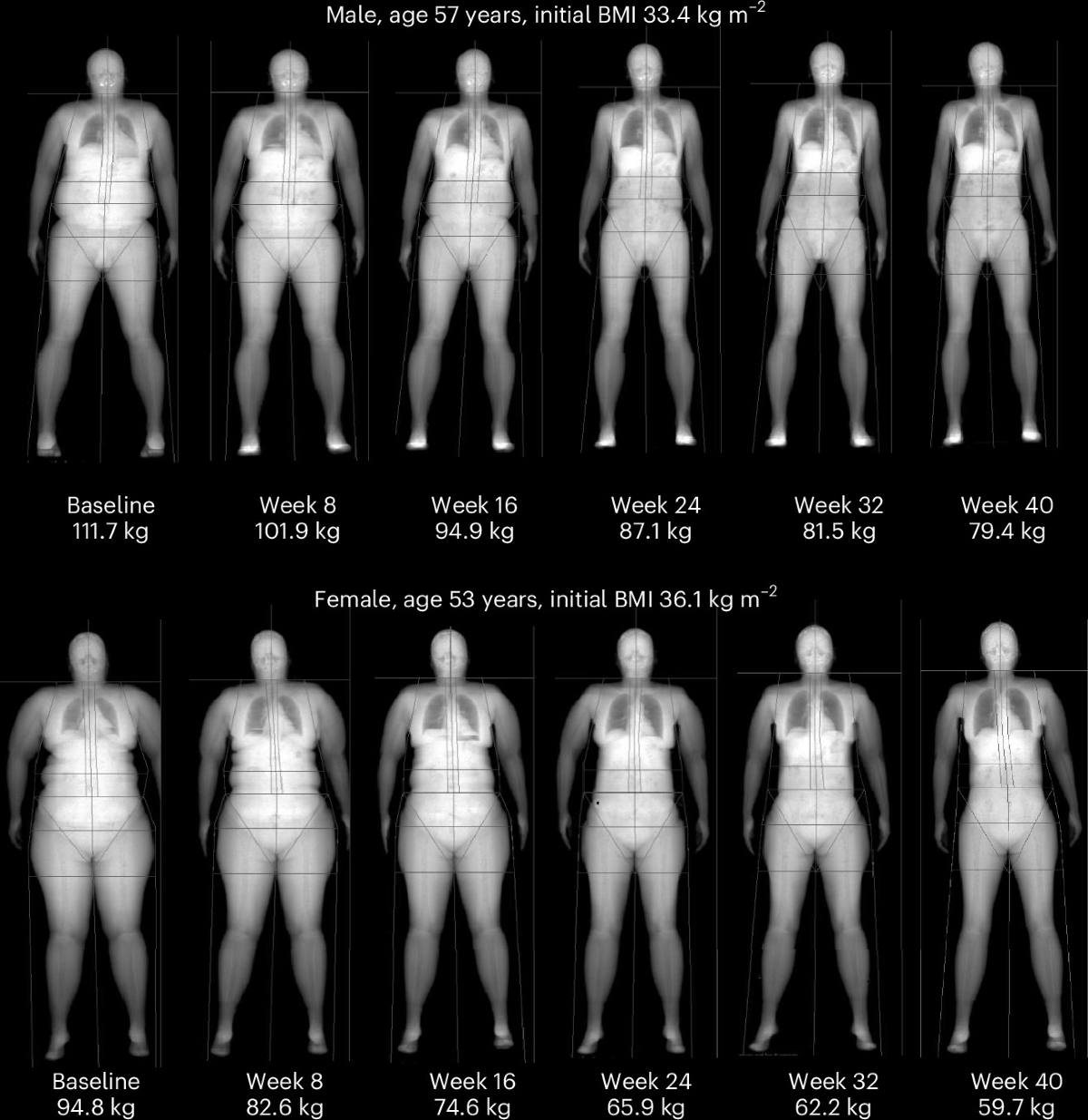
Tirzepatide produced substantial weight loss in adults with overweight or obesity in a 40-week randomized trial, but adding regular resistance exercise helped participants retain more lean soft tissue while losing a similar amount of total weight and fat.
The study, published in Nature Medicine, enrolled 120 adults receiving tirzepatide and assigned them either to usual activities or to resistance exercise three times a week. Both groups achieved nearly identical weight loss: 22.61 kilograms in the tirzepatide-only group and 22.28 kilograms in the tirzepatide-plus-exercise group. The difference was not statistically significant.
Total fat loss was similarly close. Participants taking tirzepatide alone lost an average of 17.19 kilograms of fat mass, compared with 17.98 kilograms for those who also completed resistance training. In other words, the exercise program did not appear to reduce the treatment’s effect on weight or fat loss.
The meaningful difference was in lean soft tissue, a measure that includes much of the body’s non-fat mass. Participants taking tirzepatide without the exercise program lost 4.67 kilograms of total lean soft tissue mass. Those in the resistance-exercise group lost 3.57 kilograms, a between-group difference of 1.09 kilograms that was statistically significant.
The research addresses a practical issue for incretin-based obesity treatments. These medicines can lead to large reductions in body weight and fat, but weight loss can also include lean tissue. Preserving lean mass matters because skeletal muscle contributes to physical function and strength.
Strength moved in opposite directions
The study’s muscle-strength findings reinforced the body-composition result. Participants in the tirzepatide-only group saw declines in upper- and lower-body strength measures. Bench press strength fell by 4.09 kilograms, lat pulldown by 4.42 kilograms and knee extension by 4.42 kilograms.
Participants who combined tirzepatide with resistance training instead increased strength in all three measures. Bench press rose by 4.68 kilograms, lat pulldown by 8.58 kilograms and knee extension by 5.88 kilograms. Each comparison with tirzepatide alone was statistically significant.
The trial does not suggest that resistance exercise prevented all loss of lean tissue. Lean mass declined in both groups over the 40 weeks. Rather, it indicates that structured training attenuated that loss and was associated with better performance on the tested strength measures.
That distinction is important in interpreting the findings. Scale weight is useful for tracking overall change, but it does not show how much of that change comes from fat versus lean tissue. In this trial, participants in both groups had very similar changes on the scale, while their changes in lean mass and strength differed.

A highly adhered-to exercise intervention
The resistance-training regimen was scheduled three times each week, and reported adherence was 91%. That level of participation shows the program was feasible for this study population under the trial’s conditions, though it does not establish that the same adherence would occur across all real-world care settings.
Most participants also tolerated up-titration of tirzepatide to 15 milligrams weekly, according to the authors, who reported that the medicine was safe in the study. The trial was registered with the Australian New Zealand Clinical Trials Registry.
The results support a simple but consequential clinical message: the health effects of pharmacological weight loss may depend in part on what accompanies it. A program built around medication, nutrition and progressive resistance exercise may lead to a different physical outcome than medication with usual activity alone, even where weight loss is similar.
What the trial can and cannot answer
This was a two-arm trial over 40 weeks, not a comparison of different exercise types, frequencies or intensities. It establishes that the specific thrice-weekly resistance-exercise approach tested alongside tirzepatide was associated with less lean-tissue loss and stronger muscle performance than usual activities in this group.
It does not establish a single universal prescription for every person receiving tirzepatide. Individual exercise plans may need to account for baseline fitness, injuries, medical conditions, access to equipment and supervision. The source also does not provide evidence that resistance exercise eliminates every potential consequence of lean-mass loss.
Still, the result provides unusually direct randomized evidence for pairing resistance training with tirzepatide therapy. For patients and clinicians focused only on total kilograms lost, the trial is a reminder that the composition and functional consequences of weight loss can be just as important as the total.
This article is based on reporting by Nature Medicine. Read the original article.

Originally published on nature.com