A new way to describe treatment response in ulcerative colitis
Ulcerative colitis treatment is often shaped by a difficult uncertainty: two patients with similar diagnoses may respond very differently to the same medicine. A new analysis published in Nature Medicine proposes a way to classify those differences by tracking patients’ own reports of how their symptoms change over time.
The researchers analyzed patient-reported outcomes from a phase 3b comparative trial involving 768 people with ulcerative colitis treated with either vedolizumab, an anti-integrin therapy, or adalimumab, an anti-tumor necrosis factor therapy. They identified four distinct response-trajectory groups for each treatment. Rather than treating response as a single endpoint, the approach captures the course patients experience during therapy.
The work is intended to address a central barrier to precision medicine in ulcerative colitis: predicting and explaining why a therapy works for some people but not others. The authors describe the resulting framework as a response-trajectory-based taxonomy, though they stress that its clinical use will require prospective validation.
Validation links trajectories with longer-term outcomes
The team tested the vedolizumab trajectory groups in a second phase 3 trial that included 576 participants. In that analysis, the patient-reported patterns were linked to long-term disease complications.
That connection matters because patient-reported outcomes can convey more than whether a person reaches a threshold at one scheduled assessment. A trajectory may show rapid improvement, delayed improvement, incomplete benefit, or persistent lack of benefit. If such patterns reliably correspond to later outcomes, they could help researchers and clinicians think about therapy response earlier and with more detail.
The study does not establish that the taxonomy should now be used to direct routine patient care. Instead, it provides evidence that these patterns can be identified in trial data and that they may carry clinically relevant information.

Vascular inflammation emerges as a possible explanation
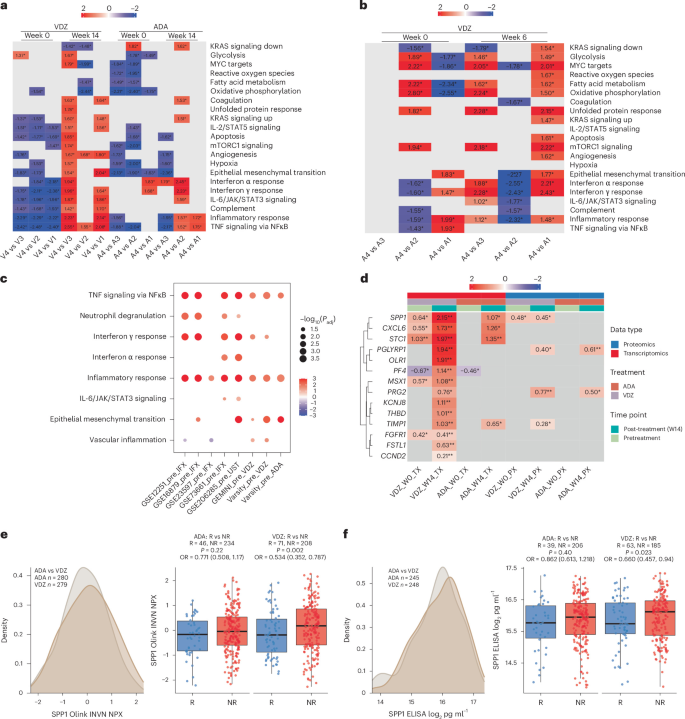
To investigate why some people did not respond to vedolizumab, the researchers combined several molecular approaches: bulk transcriptomics, single-cell transcriptomics, spatial transcriptomics and proteomics. Their analysis associated vedolizumab nonresponse with vascular inflammation.
In particular, the study identified interactions between SPP1-positive macrophages and endothelial cells as associated with nonresponse. Macrophages are immune cells, while endothelial cells line blood vessels. The findings point to a vascular and immune-cell interaction that may be relevant when vedolizumab does not produce the hoped-for result.
This is an association from the researchers’ analysis, not proof that the identified cellular interactions cause treatment failure. Even so, it offers a mechanistic lead for a field that has often lacked a clear explanation for divergent responses to therapies.
Real-world data raise a combination-therapy question
The researchers also examined two separate real-world cohorts of people with ulcerative colitis, containing 4,981 and 3,854 patients. In those cohorts, people using renin-angiotensin system inhibitors alongside vedolizumab were associated with fewer long-term complications. The same association was not reported for anticytokine therapies.
Renin-angiotensin system inhibitors are medicines that can modulate vascular inflammation. Their association with improved long-term outcomes in the vedolizumab group fits the study’s molecular findings, but it does not demonstrate that the medicines caused the improvement. Observational real-world data can reveal useful signals while still being affected by differences between patient groups and treatment decisions.
The authors say the results point toward prospective validation and toward possible applications in selecting vedolizumab combination therapy. That is a research direction, rather than a recommendation for patients to alter medication regimens.

Why the findings matter
The study’s broader contribution is its effort to connect patient experience, clinical outcomes and biological mechanisms. A response category based on changing symptoms may be more informative than a simple responder-versus-nonresponder label, particularly in a chronic disease where treatment benefit can unfold differently across individuals.
For ulcerative colitis research, the framework suggests a path toward more tailored studies: identify response patterns, determine their biological correlates, and test whether a targeted strategy improves outcomes for a defined group. The next step is to test the taxonomy prospectively before it can be considered for clinical decision-making.
- Researchers identified four patient-reported treatment-response trajectories in ulcerative colitis trials.
- Vedolizumab nonresponse was associated with vascular inflammation and interactions involving SPP1-positive macrophages and endothelial cells.
- Real-world cohort findings support further study but do not prove benefit from combination treatment.
This article is based on reporting by Nature Medicine. Read the original article.
Originally published on nature.com