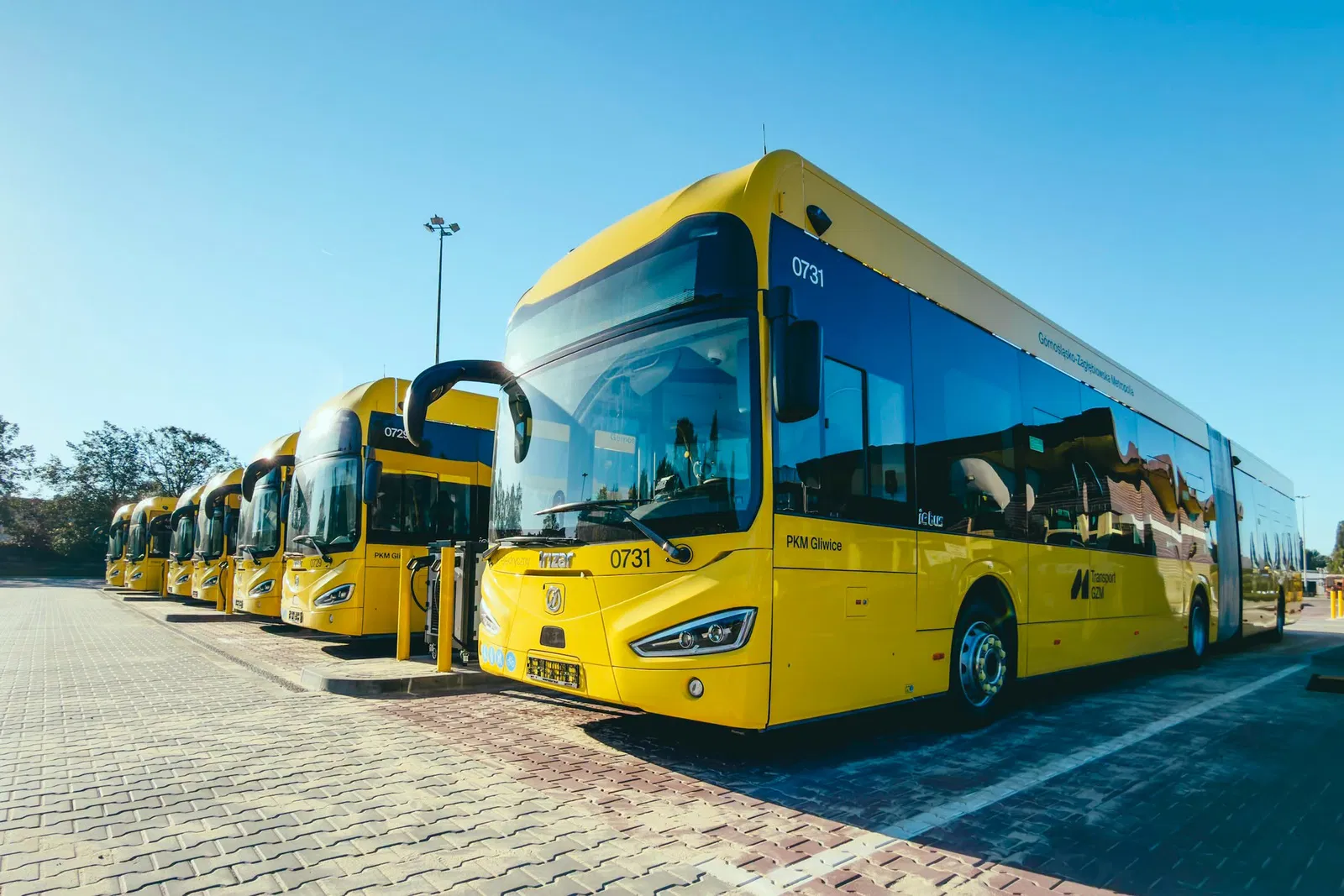
Irizar e-mobility has completed the delivery of 31 battery-electric buses to Górnośląsko-Zagłębiowska Metropolia (GZM), the metropolitan authority that coordinates public transport across Poland's Upper Silesian urban area. The Spanish manufacturer's vehicles are now in service with four municipal operators, adding a sizeable zero-emission block to the region's transit fleet.
GZM presented the new Irizar ie buses in July, after technical acceptance of the vehicles had been completed earlier in the year. The buses sit within Zielony Transport GZM — "Green Transport GZM" — a programme that combines the replacement of older vehicles with zero-emission models and the build-out of the depot infrastructure required to operate them.
A 31-Bus Fleet Distributed Across Four Operators
The order was shaped around the differing operating requirements of the depots that received it. Of the 31 vehicles, 16 are articulated buses measuring 18 metres and 15 are standard 12-metre buses, allowing each operator to take the vehicle type that best fits its routes rather than a uniform batch.
- PKM Katowice received nine 18-metre articulated buses
- PKM Gliwice received seven 18-metre articulated buses
- PKM Sosnowiec received eight 12-metre buses
- PKM Świerklaniec received seven 12-metre buses
The articulated buses went to the two larger allocations — Katowice and Gliwice — while the shorter vehicles were split between Sosnowiec and Świerklaniec. That distribution reflects the fact that a single metropolitan programme is serving four separate municipal operators, each with its own network characteristics and depot constraints. The Irizar ie models now cover all four service areas.
Charging Hardware Bundled Into the Order
Irizar's scope extended well beyond supplying rolling stock. The project included 20 depot charging units together with the electrical infrastructure needed to install and commission them, an arrangement that puts the responsibility for vehicle and charger compatibility in one place.
- 18 dual chargers rated at 80 kW
- One triple charger rated at 120 kW
- One charger rated at 180 kW
A contract amendment signed in April 2026 formally incorporated 19 chargers into the agreement alongside the buses and support services. The 18 dual-rated 80-kW units account for the bulk of the depot charging capacity, with the two higher-powered units likely reserved for faster top-ups where schedules demand them.
Building the charging estate into the bus contract matters because depot power supply, grid connections and civil works are frequently the slowest parts of a fleet electrification project. By packaging them with the vehicles, GZM and Irizar set up a single delivery timeline covering both the buses and the equipment they depend on.
A PLN133.7 Million Project Under the National Recovery Plan
The project carries a value of PLN133.7 million, or roughly $36 million. According to industry reports, more than 91 percent of eligible costs are being covered through Poland's National Recovery Plan, the funding mechanism the country is using to channel post-pandemic recovery money into infrastructure and clean transport.
That level of subsidy support is central to the economics of the order. It means the bulk of the eligible expenditure — spanning vehicles, charging equipment and associated installation work — is carried by national recovery funding rather than purely by the metropolitan authority's own budget or by the individual operators.

Warranty, Service and Training Included
GZM's contract with Irizar also covers warranty and post-warranty servicing, technical support and operator training. The April 2026 amendment that formally added the chargers also confirmed the buses and these support services as part of the same commercial package.
Inclusion of post-warranty service is significant for a fleet introducing a new vehicle type across four depots. Maintenance staff at PKM Katowice, PKM Gliwice, PKM Sosnowiec and PKM Świerklaniec need familiarity with high-voltage drivetrains and depot charging equipment, and training forms part of what the manufacturer is delivering alongside the hardware.
Part of a Much Larger Regional Electrification Push
The Irizar delivery is one component of a broader electrification effort in the GZM region. According to GZM, projects backed through the National Recovery Plan are bringing 73 battery-electric buses to four municipal operators. Of that total, 42 are supplied by Solaris and 31 by Irizar, and the same projects include 45 charging units.
The programme does not stop there. Another stage of Green Transport GZM calls for 24 additional battery-electric buses together with 16 chargers, extending the replacement of older vehicles and the supporting infrastructure further across the metropolitan network.
Hydrogen Buses Run Alongside Battery-Electric Ones
GZM is not committing to a single zero-emission drivetrain. Eight hydrogen buses have already been delivered through its separate Hydrogen GZM project, giving the region operational experience with fuel-cell vehicles at the same time as it scales up battery-electric fleets.
That two-track approach means the metropolitan authority is testing how each technology performs against different route lengths and depot arrangements, while the National Recovery Plan funding stream supports both.
What the Delivery Signals
The Irizar order illustrates a pattern increasingly common in European public transport procurement: vehicles, depot chargers and the electrical infrastructure to support them are tendered as a single package, with service, warranty support and operator training attached. For a network the size of GZM, coordinating 31 buses across four operators would be considerably harder if charging equipment were sourced separately on a different schedule.
It also shows how concentrated the funding picture remains. With more than 91 percent of eligible costs covered through the National Recovery Plan, the pace of fleet renewal in Upper Silesia is tied closely to the availability of that national programme. The same mechanism is behind the Solaris order, the 45 charging units across the wider projects and the further tranche of 24 buses and 16 chargers still to come.
Finally, the mix of suppliers and technologies is notable. Irizar and Solaris are both delivering battery-electric buses into the same metropolitan programme, while hydrogen buses already operate under a parallel project. GZM is effectively running three procurement and technology tracks at once, and the 31 Irizar buses now in service represent the most recent milestone in that effort.
This article is based on reporting by CleanTechnica. Read the original article.
Originally published on cleantechnica.com