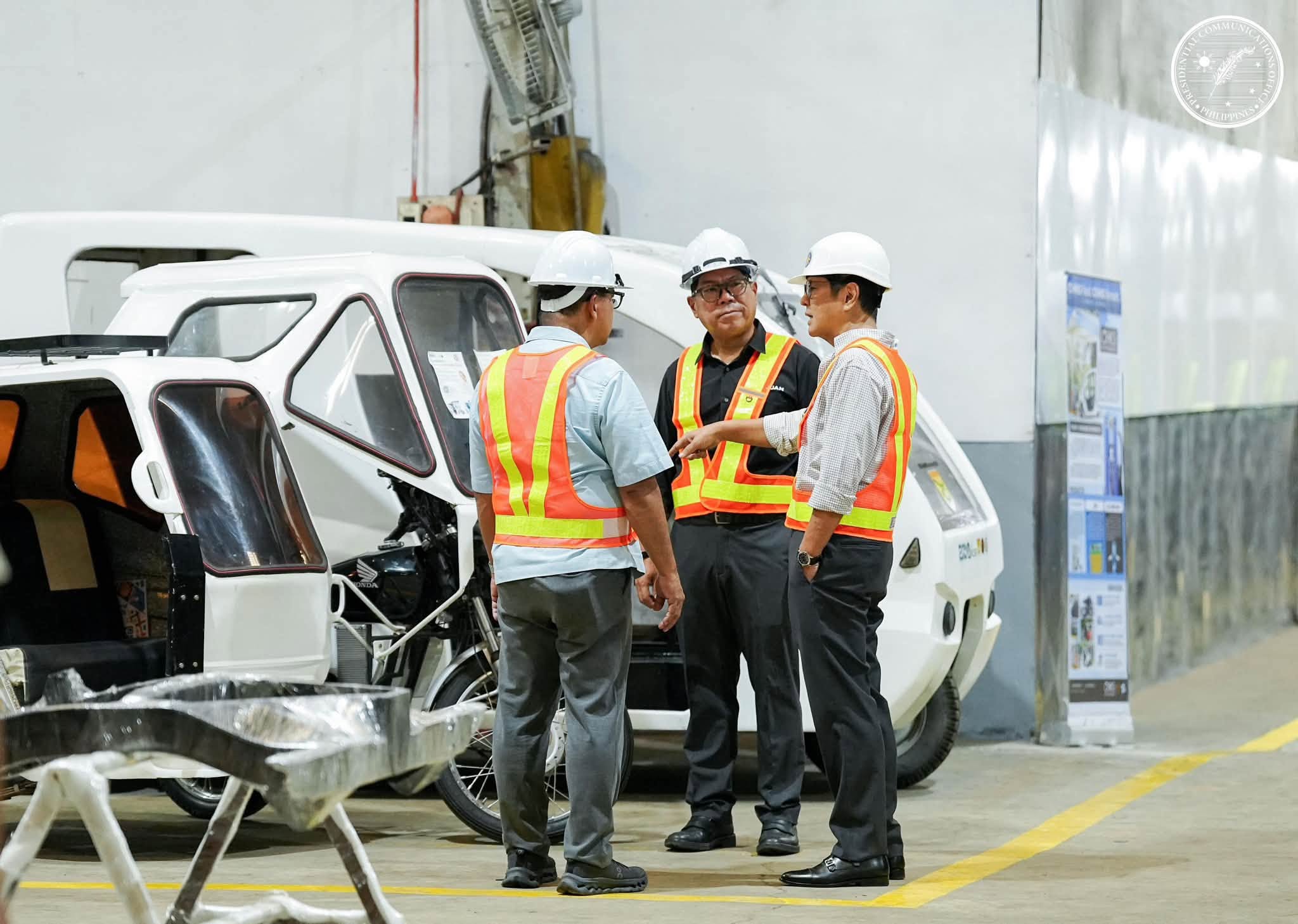
President Ferdinand Marcos Jr. is pushing for electric tricycles and jeepneys to be manufactured inside the Philippines, with his administration looking to connect local companies to electric vehicle technology developed by Philippine universities and research institutions rather than relying on imported units.
Marcos Makes the Case at a Caloocan Factory
The president raised the idea during an Aug. 25 visit to MD Juan Enterprises Inc. in Caloocan City, where he discussed the company's plans to move into electric vehicle manufacturing. Photographs from the visit show Marcos alongside Rommel Juan, chairman of the Electric Vehicle Association of the Philippines, and Department of Science and Technology Secretary Renato Solidum Jr.
According to DOST, the government is examining how to supply the equipment and technology needed to build electric tricycles locally, with electric jeepneys also part of the plan. The approach amounts to a state-assisted industrial effort: instead of importing finished vehicles and the know-how that comes with them, the objective is to build domestic capability around designs and drivetrains that already exist in Filipino laboratories and campuses.
That distinction matters for how the program is likely to be judged. A pure import strategy would add electric vehicles to Philippine roads quickly but would leave assembly, component sourcing, and engineering work elsewhere. A locally rooted strategy is slower and riskier, yet it keeps more of the value chain inside the country and gives universities a commercial outlet for research they have already funded.
A Market That Has Changed Since 2013
MD Juan is not a newcomer to the segment. Solidum said the company produced electric tricycles in 2013 and 2014 before abandoning the line because demand was too weak to justify continuing. What has shifted, he indicated, is the underlying economics. Higher fuel costs have strengthened the case for electric mobility, and public interest in electric transportation has grown considerably since the earlier attempt.
The same manufacturer that struggled to find buyers a decade ago is now being encouraged to try again under very different conditions. That history also explains part of the government's caution: officials are not treating the market as guaranteed, but as one where cost, fuel prices, and consumer appetite will ultimately determine whether locally built electric tricycles and jeepneys can compete.
Universities as Technology Suppliers
Central to the strategy is a matchmaking role for the national government. Solidum said the administration wants companies such as MD Juan to work with universities and research institutions that have already developed electric vehicle technologies, effectively turning academic research into production-ready inputs for local industry.
One of those institutions is Cagayan State University, whose ElectroMobility Research and Development Center has built an electric tricycle as well as a system for converting conventional tricycles to electric propulsion. The CSU technologies were presented at the Sustainability Expo 2026 on Aug. 5 at the SMX Convention Center Aura in Taguig City, and the university is now making the vehicles available to interested investors for mass production.
The conversion system could prove as consequential as the new vehicle itself. Retrofitting an existing tricycle to run on electricity offers a route for operators who already own units, potentially spreading electrification across fleets without requiring every driver to purchase a brand-new vehicle. For manufacturers, a conversion kit is also a lower-risk product line than full vehicle assembly, since it builds on machines that are already on the road.
The P600,000 Prototype and the Road to Lower Prices
The seven-seater CSU electric tricycle currently costs about P600,000, or roughly $10,400, to build. Solidum acknowledged that the figure looks steep for a vehicle of this class, but he attributed much of it to the early stage of development rather than to the hardware itself.
"The reason why it is pricey is because of the R&D expense," he told the Daily Tribune, explaining that once commercial production begins, the research and development cost drops out of the calculation and only the cost of materials and labor remains. In other words, the price of a prototype reflects the years of engineering behind it, while the price of a production unit reflects only what it takes to build one.
Why Volume Matters
Solidum added that production volume and greater mechanization could push costs down further by reducing the number of labor hours required to assemble each vehicle. That is a familiar pattern in manufacturing: fixed costs spread across more units, and repetitive tasks handed to machines rather than done by hand. Whether Philippine assembly lines can reach the volumes needed to achieve those savings is the open question the program now faces.
Fitting Into a Broader Clean Energy Direction
The electric tricycle and jeepney push fits into a wider pattern of renewable and clean energy emphasis that Marcos has continued to advance. Public transport is often the hardest part of a country's vehicle fleet to electrify, because operators work on thin margins and depend on daily revenue, yet it is also where electrification can deliver the most visible benefits in fuel savings and urban air quality.
Tricycles and jeepneys carry a large share of Philippine daily trips, which makes them a logical place to start building domestic electric vehicle capacity. If local manufacturers can supply them affordably, the result would be a fleet that is cheaper to operate, an industrial base that can serve other vehicle segments, and a set of university research programs with a real market for their output.

Key Takeaways
- Marcos called for local production of electric tricycles and jeepneys during an Aug. 25 visit to MD Juan Enterprises Inc. in Caloocan City, where he discussed the company's electric vehicle manufacturing plans.
- DOST Secretary Renato Solidum Jr. said the government is looking at providing the equipment and technology needed to produce electric tricycles domestically, with electric jeepneys also planned.
- MD Juan previously built electric tricycles in 2013 and 2014 but stopped when demand failed to materialize; higher fuel costs and growing interest in electric transport have changed the market since.
- Cagayan State University's ElectroMobility Research and Development Center has developed an electric tricycle and a system for converting conventional tricycles to electric propulsion, presented at the Sustainability Expo 2026 in Taguig City.
- The seven-seater CSU electric tricycle costs about P600,000 ($10,400) to build, a figure DOST expects to fall once research and development costs are removed and production volume rises.
The government has not yet detailed timelines, production targets, or the scale of support that manufacturers and universities might receive. What is clear is the direction: Marcos wants electric tricycles and jeepneys carrying Filipino passengers to be built with Filipino engineering, and he is asking universities and manufacturers to make that happen together.
This article is based on reporting by CleanTechnica. Read the original article.
Originally published on cleantechnica.com