When a Nuclear Reactor Goes Dark, It Is Not Truly Asleep
Shutting down a nuclear reactor halts the fission chain reaction almost instantly, yet the core does not cool down on the same timescale. Fission products built up during months or years of operation keep decaying, releasing energy that has to go somewhere. Immediately after a shutdown, that residual output stands at a few percent of the reactor's full thermal power — a small fraction, but one still measured in megawatts for a commercial-scale plant. It then tapers off gradually over hours and days rather than seconds.
For decades, the industry managed this leftover heat with pumps, motors, diesel generators and grid electricity. That arrangement works reliably — until the power sources behind it disappear. When the Fukushima Daiichi plant lost both off-site power and its backup generators in 2011, circulation stopped and three cores melted. The lesson the nuclear community drew was not that machinery is unreliable, but that a safety system resting on active equipment and external power carries a single point of failure that can be severed from the outside.
What "Gravity-Driven" Safety Actually Means
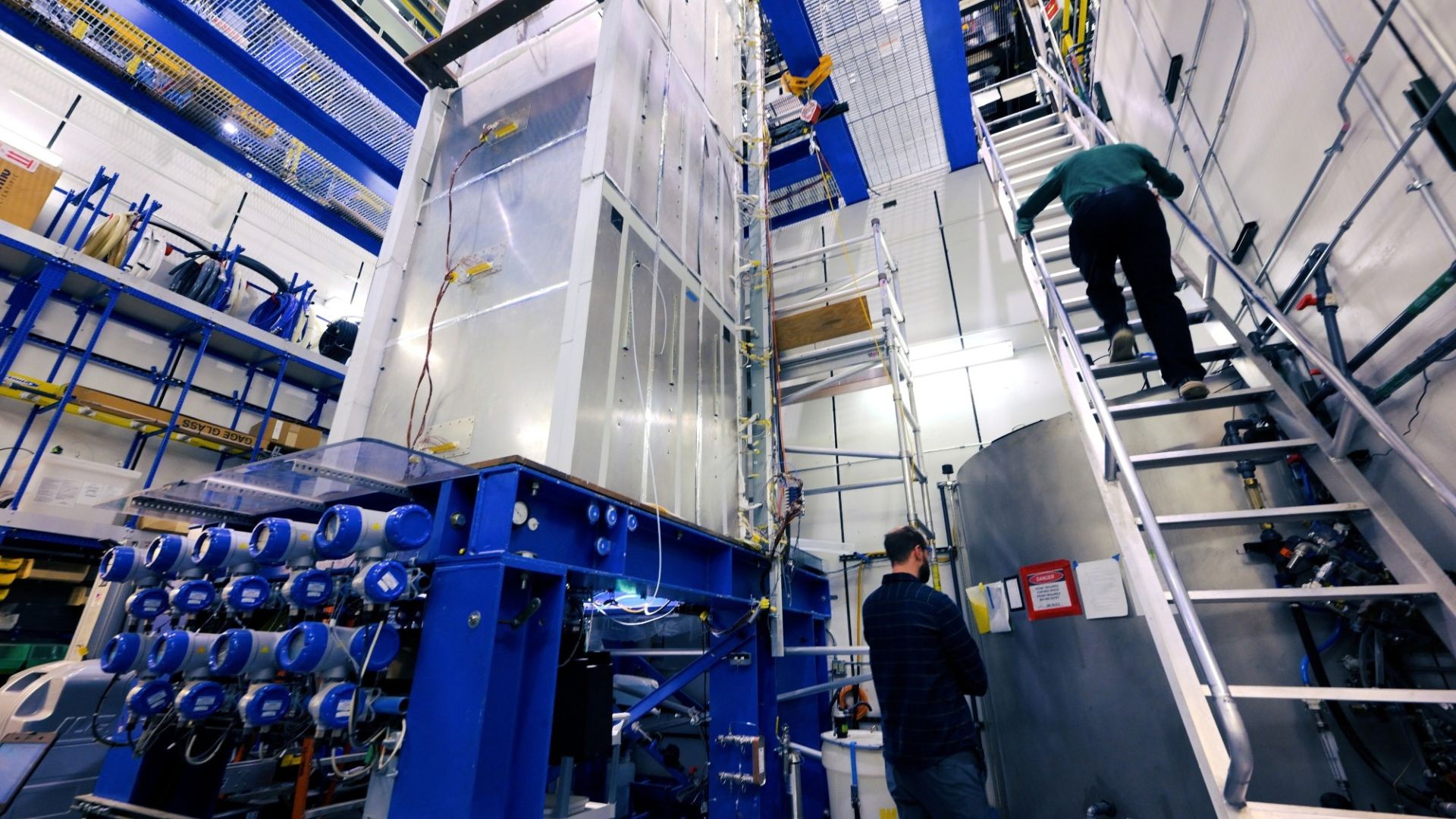
Passive safety systems flip that logic. Rather than adding components, they remove them. Researchers at Argonne National Laboratory are evaluating designs in which forces already present inside a reactor — gravity, buoyancy and thermal expansion — do the work of moving coolant through the core and toward a heat sink.
The concept is easier to describe than to certify. In a gravity-driven loop, heated coolant becomes less dense than the fluid around it and rises, drawing cooler material in behind it. No impeller spins, no valve has to be commanded open, and no operator has to diagnose a problem correctly within the first few minutes of an accident sequence. The driving head comes from the height difference between the hot leg and the cold leg of the loop, which means the geometry of the plant itself becomes a safety feature.
Variations on the theme include natural-circulation loops, where coolant cycles between the core and an elevated heat exchanger or tank; heat pipes that move energy by phase change without any pumped flow; and large thermal masses such as pools or graphite blocks that absorb heat long enough for slower processes to take over.

The Physics: Why Buoyancy Is Enough — and Where It Isn't
Natural circulation is not exotic. It is the same mechanism that drives weather and keeps a pot of water mixing on a stove. In a reactor, though, the margin for error is narrow. The flow rate that buoyancy can sustain depends on the density difference across the loop, the height of that loop, and the pressure losses the fluid encounters along the way. Pipe friction, bends, and the tight passages between fuel pins all resist the motion.
Designers therefore care intensely about what happens at low power and low pressure, when the density contrast is weakest and the loop has the least driving force. They also watch for thermal stratification, the tendency of hot fluid to sit in a stagnant layer instead of circulating, and for the possibility that a loop could stall entirely under certain conditions. A passive system that works beautifully at 100% power but stalls during a cold, low-pressure cooldown is not a safety system at all.
Why Advanced Reactors Make the Problem Harder
The next generation of reactors does not simply repeat the light-water designs of the last sixty years, and that changes the decay heat problem in ways that demand fresh analysis:

- Different coolants. Liquid metals, molten salts and helium gas have thermal properties far removed from water, changing how quickly heat can be lifted away from fuel and how much buoyancy a given temperature difference produces.
- Higher power densities. Compact cores pack more energy into less volume, which means any loss of cooling escalates faster.
- Higher temperatures. Advanced designs often run hotter to improve efficiency or enable industrial heat applications, narrowing the window between normal operation and material limits.
- Novel geometries. Integral designs that place the primary loop inside a single vessel, or pool-type layouts, create new paths for heat to travel and new questions about how flow behaves when it is no longer confined to familiar plumbing.
- Smaller, factory-built units. Many advanced concepts are designed for modular manufacturing and remote siting, which raises the value of safety that does not depend on a large, well-staffed grid connection.
Modeling Before Metal Is Bent
Evaluating passive decay heat removal is fundamentally a simulation-driven exercise, and that is where an institution like Argonne contributes most directly. Before a vendor commits to a physical design, engineers need confidence that a buoyancy-driven loop will establish flow promptly, remain stable, and deliver enough heat to its sink under every credible accident scenario.
Codes, Correlations and Validation
That confidence is built by coupling detailed thermal-hydraulic models with experimental data. Modern system codes aim to capture two-phase flow, phase change, conjugate heat transfer between fluid and structure, and the radiation of heat across gaps and cavities. Each of those phenomena resists simple mathematical treatment, so the models lean on empirical correlations derived from laboratory loops and separate-effects tests.
The hard part is scale. A bench-scale experiment may demonstrate that natural circulation initiates as predicted, yet the same physics in a full-height, full-pressure facility can behave differently because buoyancy depends on vertical distance. Scaling laws help bridge the gap, but they only work if the underlying phenomena are correctly identified in the first place. That is why validation against real hardware remains the pivot point on which any passive safety claim ultimately rests.
Open Questions and the Long Road to Licensing
Regulators face an awkward problem with systems that have no switch. Traditional licensing logic asks whether a safety component will start when commanded. A gravity-driven system is never commanded; it simply responds. That shifts the analysis toward demonstrating that nothing — debris, gas binding, freezing, stratification, or an unexpected bypass path — can prevent the loop from doing its job when needed.
Among the questions engineers and reviewers must settle: How long must passive cooling be sustained before active measures or natural cooldown take over? What happens if the system is called upon years into a plant's life, after corrosion or deposition has altered its surfaces? How is performance verified during operation, given that a genuinely passive system may sit idle indefinitely? Each of these sits at the intersection of physics, materials science and regulatory practice.

What Passive Safety Buys Beyond the Plant Fence
The stakes extend well past the reactor vessel. A design whose decay heat removal depends on gravity and stored thermal mass is harder to disable from outside, requires less emergency planning infrastructure, and is less vulnerable to the kind of cascading grid failure that turns a manageable incident into a catastrophe. For advanced reactors proposed for remote industrial sites, mining operations, or regions with fragile transmission networks, that independence may matter more than any incremental gain in fuel efficiency.
None of this makes passive systems a cure-all. They still require careful engineering, rigorous testing and honest accounting of their limits. But they represent a genuine philosophical shift: instead of asking how quickly machinery can respond to disaster, researchers are asking how to design a reactor that never needs machinery to respond at all. Argonne's evaluation work sits squarely in the middle of that shift, converting an appealing idea into numbers, correlations and evidence that a regulator can scrutinize.
This article is based on reporting by Interesting Engineering. Read the original article.
Originally published on interestingengineering.com