Robotaxi expansion is moving from pilots to city-by-city rollouts
Robotaxi projects backed by Volkswagen, Mercedes, Waymo, and Rimac-backed Verne are pushing into European cities this year, according to Automotive News. The expansion shows that autonomous ride services are continuing to move forward in Europe even though two of the sector’s hardest problems remain unresolved: whether enough consumers will embrace the model, and whether operators can bring costs down far enough to make the business durable.
The available source text is concise, but the core development is significant. Autonomous ride services are no longer framed only as distant technology ambitions or tightly bounded test programs. Multiple companies are now lining up launches in Europe, suggesting that urban deployment is becoming a strategic priority for both automakers and autonomous mobility firms.
Who is pushing into Europe
The companies cited in the candidate material span different parts of the mobility ecosystem. Volkswagen and Mercedes bring established automotive scale and regulatory experience. Waymo contributes one of the most recognized autonomous driving brands. Verne, backed by Rimac, adds another player seeking to establish a foothold in a field that still lacks a clear global winner.
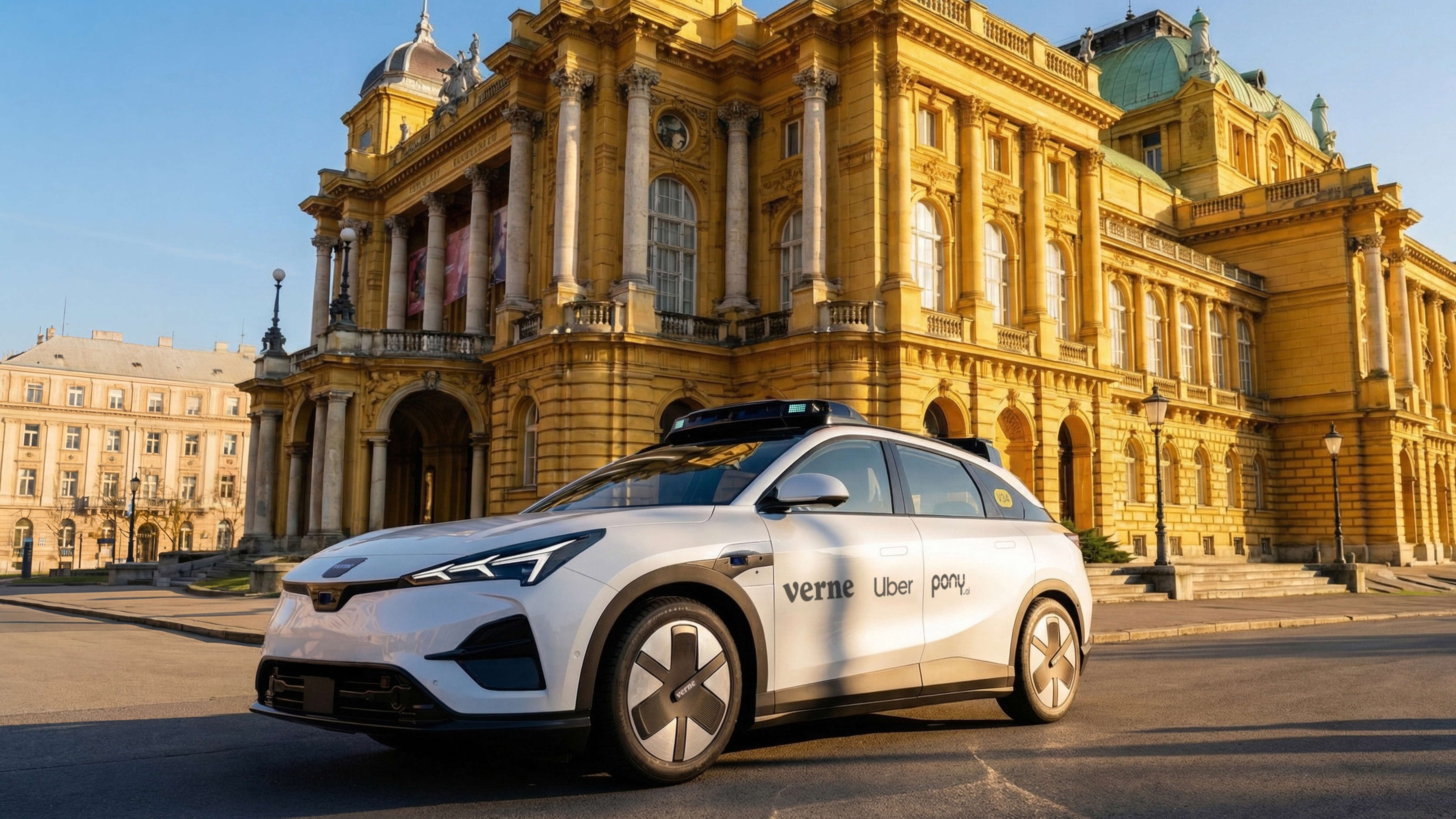
The source text also notes that Pony.ai’s seventh-generation autonomous driving system has been deployed in the Arcfox Alpha T5 robotaxi for on-road testing in Zagreb, Croatia. That detail illustrates how international and multi-layered the robotaxi supply chain has become. Vehicle platforms, autonomous systems, fleet operators, and mobility partners may all come from different companies and different countries.
It also highlights that Europe’s robotaxi push is not confined to one flagship city. The sector is expanding through a patchwork of launches, testing programs, and partnerships spread across urban markets with different regulatory cultures and transit needs.

The unresolved economics
The strongest caution in the source material concerns cost reduction. That has been a central issue for robotaxi efforts for years. Running an autonomous ride service requires expensive sensors, high-performance computing, mapping, validation, remote support, fleet operations, and maintenance. Even when a vehicle no longer needs a conventional driver, the supporting system around it can remain costly.
That is why the sector’s progress is so often measured in two separate ways: technical capability and economic viability. A robotaxi service may prove that autonomous operation is possible in a specific urban area, yet still struggle to create a scalable business if each ride depends on a costly operating stack.
The European rollouts matter because they will test not only technology in new environments but also whether operators can refine deployment models in ways that lower cost over time. That could involve better fleet utilization, improved hardware efficiency, more mature software, or route and service-area strategies that focus on the most manageable commercial conditions.
The consumer acceptance question
The other unresolved issue is public adoption. Even if autonomous systems meet regulatory and technical standards, consumers still have to trust the service enough to use it regularly. That trust is influenced by safety performance, ride quality, pricing, service availability, and the broader public narrative around autonomy.
Europe presents a particularly interesting test because it contains a mix of dense historic city layouts, varied transit habits, and diverse public attitudes toward technology and regulation. A model that works in one city may not transfer neatly to another. That makes each launch more than a local event. It becomes part of a broader experiment in how autonomous mobility fits into different urban systems.
The source text’s explicit reference to “adoption uncertainty” is therefore important. It signals that the industry itself cannot assume demand will automatically follow deployment. Consumers may be curious about robotaxis without making them a habit. Conversely, regular use may grow if services are reliable, competitively priced, and integrated into everyday mobility patterns.
Why automakers are still pressing ahead
Despite those uncertainties, major companies continue to invest because robotaxis still represent a potentially transformative mobility platform. For automakers, the opportunity is not just to sell vehicles but to participate in recurring transport services. For technology firms, autonomous mobility offers a path to monetizing advanced driving systems in the real world.
Europe is also a strategically important proving ground. Urban centers there offer high-density use cases where shared autonomous mobility could be commercially attractive if the operational model works. At the same time, the region’s regulatory frameworks may help establish credible deployment standards that influence other markets.
Another reason companies are still moving is that waiting has its own cost. Autonomous driving leaders want data, operating experience, regulatory relationships, and brand positioning. Even limited launches can provide those assets. A city-by-city rollout strategy lets firms learn while expanding rather than waiting for a single decisive breakthrough.
A market still in formation
The current European push should be understood less as proof that the robotaxi market has arrived and more as evidence that the market is being actively constructed. Companies are placing bets on where they can operate, which partnerships matter, and how quickly costs might fall. Consumers, regulators, and cities will help determine whether those bets pay off.
The supplied material does not claim that the adoption problem is solved or that cost barriers have disappeared. In fact, it emphasizes the opposite. That makes the moment more interesting, not less. Expansion under uncertainty is often when an industry’s real shape begins to emerge.
If services from players such as Waymo, Mercedes, Volkswagen, and Verne gain traction, Europe could become one of the defining arenas for next-stage autonomous mobility. If they stumble, it will reinforce the argument that technical demonstrations and sustainable urban ride services are still very different things. Either way, the sector is entering a phase where launches matter more than promises, and cities are becoming the place where robotaxi ambition faces its most consequential tests.
This article is based on reporting by Automotive News. Read the original article.
Originally published on autonews.com