A binary black hole system offered astronomers a rare before-and-after view of feeding and ejection
Astronomers have reported new observations of the binary black hole system Swift J1727.8−1613 that show a black hole not only consuming material from its companion star, but later expelling some of that matter back into space. The findings, recently published in the Monthly Notices of the Royal Astronomical Society, add fresh evidence to a long-running question in astrophysics: what exactly happens to matter after a black hole feeds?
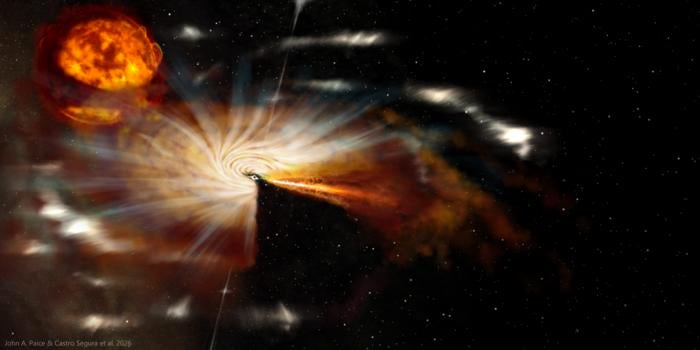
The work was led by researchers at the University of Warwick and relied on observations from the European Southern Observatory’s Very Large Telescope. The team focused on an eruption seen in 2023 from Swift J1727.8−1613, a system in which a black hole and a normal star orbit each other. In this pairing, the black hole pulls in material from the star. That process can generate bright, violent events that make otherwise invisible black holes easier to study.
What makes the new result important is timing. Rather than capturing only a single moment, the astronomers used repeated observations over time, allowing them to reconstruct a sequence from intake to ejection. That temporal view is what turns a dramatic event into a more informative physical story.
Not everything that goes in stays in
According to the supplied report, Swift J1727.8−1613 contains a black hole estimated to be about 10 times the mass of the Sun. During the observed episode, the object fed on material stripped from its companion star. But instead of acting like a one-way sink for everything available, the system also produced outflows in the form of winds and jets.
That detail matters because black holes are often described in simplified terms as places from which nothing escapes. In strict terms, that is true once matter crosses the event horizon. But in real astrophysical systems, a great deal happens outside that boundary, in the surrounding disk and in the energetic environment created by infalling gas. The new observations reinforce that distinction. The black hole may capture material, but the feeding process itself can also drive part of that material outward before it is fully swallowed.
The article’s description is vivid: the black hole appears to have become effectively overfilled and then expelled leftovers. While that is a simplification, it captures the broader scientific point. Accretion is not merely a one-directional drain. It can be turbulent, inefficient, and capable of launching matter back into space through multiple channels.
Why Swift J1727.8−1613 is useful
The system appears to be smaller and less active than some other black holes that astronomers study. That relative modesty may actually be an advantage. In very extreme systems, the physics can be harder to disentangle because the environment is so energetic and complex. A less active object can provide a cleaner view of how feeding and ejection interact.
In this case, the researchers argue that Swift J1727.8−1613 helps show that black holes may operate more like digesting engines than endless pits. Matter can pile up, conditions can change, and some of the inflowing material can be redirected outward. The observed winds and jets therefore become diagnostic tools: they reveal how energy and matter move through the system, and they may help researchers understand when a black hole retains material versus when it rejects it.
That distinction is central to broader black hole science. Jets and winds influence the environment around compact objects, shaping nearby gas and redistributing energy. Understanding the balance between accretion and outflow is important not only for small stellar-mass black holes like Swift J1727.8−1613, but also for the supermassive black holes that affect entire galaxies.
The value of watching the sequence unfold
One of the strongest aspects of the finding is methodological. Black holes cannot be directly imaged in ordinary visible light because they do not emit light from within the event horizon. Researchers therefore infer their behavior from the material around them. That means changes over time are often just as important as snapshots.
By using the Very Large Telescope for multiple observations, the team could track the aftermath of the 2023 eruption rather than rely on a single frame. The report says this approach allowed the astronomers to watch the sequence from consumption to eruption. That is critical for testing ideas about cause and effect. If winds and jets persist after a feeding event, they may provide clues about pressure, heat, magnetic effects, or disk instability in the material circling the black hole.
The source text also notes that the eruptions lasted for extended periods. That persistence suggests the ejection was not a trivial flare or a brief observational artifact. Instead, it points to an active physical response within the system, one that continued after the initial intake of matter.
What the findings do and do not show
The observations strengthen the case that some black holes expel a portion of the matter associated with feeding events. They also support the idea that smaller, less active systems can illuminate the mechanics of accretion and outflow in especially useful ways. But the supplied source does not claim that the underlying mechanism is fully solved. The broader processes governing black hole formation, evolution, and end states remain open scientific questions.
That nuance is important. A single system does not provide a universal rule for every black hole. Nor does observing winds and jets answer every question about how these objects behave. What it does provide is a more detailed case study, one grounded in time-resolved observations of a real eruption. In fields where the central object cannot be observed directly, those case studies carry real weight.
A step toward a fuller picture
Black holes remain some of the most compelling objects in astronomy precisely because they combine extreme gravity with incomplete understanding. Researchers know they can tear material from nearby stars, heat gas to extraordinary temperatures, and launch energetic outflows. The hard part is fitting those behaviors into a complete physical picture.
Swift J1727.8−1613 appears to move that effort forward by showing a black hole in the act of taking in matter and then pushing some of it back out. That does not make black holes less extreme. It makes them more dynamic. Instead of simple cosmic traps, they emerge as systems where intake, buildup, and release can all matter to the final outcome.
For astronomers, that is the real value of the new observations. They sharpen the distinction between the black hole itself and the violent machinery around it. And in doing so, they offer a clearer view of how one of the universe’s most elusive phenomena actually behaves when it feeds.
- Swift J1727.8−1613 is a binary system where a black hole feeds on a companion star.
- Very Large Telescope observations tracked a 2023 eruption over time.
- The team observed winds and jets ejecting some material after the feeding event.
- The findings support the view that black hole accretion can involve both intake and expulsion.
This article is based on reporting by Universe Today. Read the original article.
Originally published on universetoday.com