Starship’s biggest redesign yet cleared its first major test
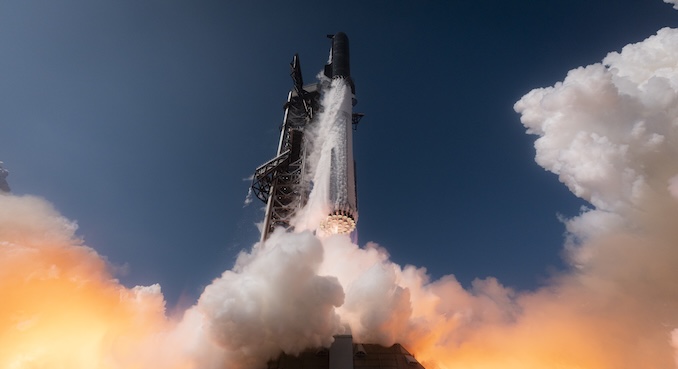
SpaceX launched the first flight of its redesigned Starship Version 3 on May 22 from Starbase in Texas, sending the 407-foot rocket on a suborbital mission that tested upgraded engines, revised control systems, and operational changes aimed at improving reliability and safety. The mission reached space and deployed 22 Starlink internet satellite simulators, a notable step for a vehicle that remains central to the company’s ambitions in low Earth orbit, lunar transport, and eventually Mars.
The launch also showed how much engineering risk remains. One of the Super Heavy booster’s 33 methane-fueled Raptor 3 engines shut down early during ascent, and additional engines did not operate as expected during an attempt to guide the booster back toward its planned splashdown area in the Gulf off Texas. On the upper stage, one of the three vacuum-optimized Raptor engines shut down early during the climb to space.
Even with that loss, the flight computer extended operation of the remaining five upper-stage engines long enough to compensate for the shortfall and keep the vehicle on what the report described as an acceptable suborbital trajectory. That detail matters: it suggests the upgraded system was able to absorb at least one major propulsion fault without ending the mission before the in-space test objectives began.
In-space operations were the strongest part of the mission
Once in space, Starship appeared to perform more cleanly. The vehicle deployed 22 Starlink simulator payloads from an upgraded dispenser, giving SpaceX another on-orbit test of how the system could support future large-scale satellite deployment. Two of the simulators carried cameras that returned views of Starship from outside the vehicle. SpaceX plans to use similar imagery on later missions to inspect the health of the spacecraft’s heat shield.
That combination of payload deployment and external imaging turned the mission into more than a propulsion test. It became a systems-level rehearsal for a spacecraft expected to handle frequent launches, carry large payload masses, and survive increasingly demanding reentry profiles. For a program that has often produced dramatic failures during development, demonstrating meaningful work in space remains an important benchmark.
The launch still exposed the core challenge facing Starship
The broad headline from the flight is mixed but familiar: the vehicle achieved enough to validate parts of the redesign, yet propulsion reliability remains the central obstacle. Losing engines on both the booster and the ship during a single mission is not a minor anomaly when the long-term plan depends on rapid reuse, repeatability, and human-rating pathways for NASA and commercial missions.
SpaceX founder Elon Musk called the flight “epic” and congratulated the team, while NASA Administrator Jared Isaacman praised the launch as a step closer to the Moon and Mars. Those reactions reflect the strategic importance of Starship beyond SpaceX itself. NASA’s Artemis architecture depends heavily on the company’s ability to mature the system into a dependable transport platform.
The mission lifted off after a previous-day scrub caused by a minor pad-system issue, following earlier weather delays. The new launch pad and upgraded Version 3 design were both part of the test. The fact that SpaceX was able to get the vehicle off the pad, through ascent, into space, and through payload deployment gives the company useful data across a wide envelope. But the engine shutdowns are a reminder that the leap from impressive prototype flights to routine operations is still unresolved.
For now, the debut of Starship Version 3 looks like a partial success: enough progress to keep momentum, enough failures to guarantee intensive post-flight analysis, and enough evidence to show that SpaceX is still pushing the program through a development model built on rapid iteration rather than conservative certification-first pacing.
This article is based on reporting by Spaceflight Now. Read the original article.
Originally published on spaceflightnow.com