Starship’s next test is about system redesign as much as launch cadence
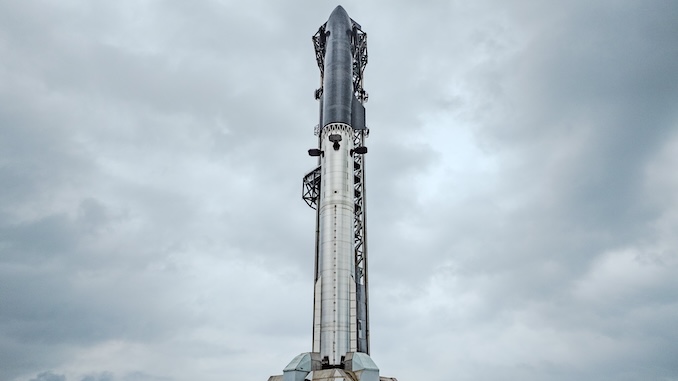
SpaceX is targeting no earlier than May 19 for Flight 12, the first launch of what it describes as Starship Version 3. The mission is significant not simply because it resumes the company’s heavy-lift test program, but because it bundles several major changes into a single flight: a new version of the vehicle, a new version of the engines and the first launch from Pad 2, an updated infrastructure complex built to support both launches and catches.
That combination makes Flight 12 less a routine iteration than a broad architecture test. SpaceX said the primary goal is to demonstrate the redesigned elements in flight for the first time, with changes aimed at enabling full and rapid reuse. In other words, this mission is intended to test whether years of development lessons can be converted into a more operationally credible Starship system.
What changes with Starship Version 3
The most visible hardware step is the introduction of Raptor 3 engines. The source text does not detail every engine modification, but the mission framing makes clear that propulsion is part of a larger redesign rather than a simple component swap. Starship V3 is also flying with new infrastructure assumptions. Pad 2 is not just another mount; it is described as an updated launch site with launch and catch capabilities, making the ground system part of the same reuse equation as the rocket itself.
SpaceX also completed an integrated tanking test ahead of launch, loading more than 5,000 metric tonnes of propellant onto the fully stacked Starship and Super Heavy V3 vehicles. That rehearsal matters because new launch systems often reveal problems in plumbing, timing and structural interactions well before liftoff. Completing the test does not guarantee success, but it suggests the company has advanced through a key systems validation step.

No catch attempt shows a more cautious test posture
Despite the focus on reuse, SpaceX is not planning to catch either stage on this mission. Instead, Booster 19 is expected to perform a controlled splashdown in the Gulf of Mexico roughly seven minutes after liftoff, while Ship 39 is planned to make its own water landing in the Indian Ocean a little more than an hour into flight. That choice is telling. SpaceX is effectively acknowledging that when multiple major redesigns are introduced at once, proving survivable flight behavior comes before pushing for recovery precision.
The flight profile remains suborbital, similar to previous Starship tests, but the absence of catch attempts should not be read as a retreat. It is a sign that Flight 12 is being used to gather data on integrated changes rather than to maximize spectacle. For a program still evolving its engine set, stage interfaces and pad architecture, that is a more credible test philosophy than trying to validate every objective at once.
Hot staging and payload experiments remain central
One of the more technically interesting changes is the integrated hot stage on the Super Heavy booster. According to the source material, this design exposes the forward dome of the booster’s fuel tank during hot staging. To protect the liquid methane tank from the upper stage engine plume, engineers added a nonstructural steel layer that works together with tank pressure as a thermal shield. That is a targeted engineering response to a known stress point in multi-stage rocketry and a reminder that reuse depends heavily on how vehicles survive separation and ignition environments.
SpaceX also plans to deploy 22 simulator Starlink satellites from the upper stage, about double the number used on previous flights. Two of those simulators will carry new capabilities and are expected to scan Starship’s heat shield and send imagery to operators. That payload experiment is strategically important. Reusability is not only about landing; it is also about inspection. If SpaceX can improve in-flight assessment of heat shield condition, it moves closer to faster turnaround and more reliable postflight diagnostics.
The broader importance of Flight 12
The mission arrives as SpaceX is preparing Starship for larger strategic roles, including support for future lunar ambitions referenced in the source text. But before any of that becomes operational, the company has to prove that its redesigns can survive real flight environments. Flight 12 therefore functions as a threshold test for a more mature Starship phase.
What makes this launch consequential is not a single headline feature. It is the fact that engines, vehicle structure, stage behavior, payload deployment and launch-site infrastructure are all being tested together as pieces of one reuse-centered system. If the mission performs well, SpaceX will have more than another test flight on the board. It will have evidence that Starship is progressing from iterative experimentation toward a more integrated operational architecture.
If it falls short, the results will still matter, because this is the kind of test that exposes where full-system ambitions remain fragile. Either way, May 19 is shaping up as a meaningful date in the company’s effort to turn Starship from a bold prototype family into a repeatable transportation platform.
This article is based on reporting by Spaceflight Now. Read the original article.
Originally published on spaceflightnow.com