NASA pushes a new wing concept toward real-world limits
NASA says a lightweight experimental wing built to explore future ultra-efficient aircraft has passed a major structural test campaign, offering fresh evidence that unconventional airliner designs may be more practical than they look. The agency recently completed a series of loading tests on a 15-foot research article known as SWEET-15, short for Structural Wing Experiment Evaluating Truss-bracing, and reported that the structure handled expected in-flight forces without issue.
The work does not signal a new aircraft entering service soon. What it does signal is that a key engineering concern around long, slender, heavily optimized wings can be addressed with modern materials and manufacturing methods. If that conclusion continues to hold up, it could support a future generation of commercial aircraft designed to burn less fuel by using lighter structures and more aerodynamically efficient wing layouts.
That makes the result important beyond a single lab test. Commercial aviation faces simultaneous pressure to cut fuel consumption, lower emissions, and improve operating economics. Wing design sits near the center of that challenge. Better aerodynamics can yield meaningful efficiency gains, but only if the structure can survive the loads encountered in flight and do so without erasing those gains through added weight.
What SWEET-15 is testing
The NASA test article is based on the agency’s earlier Transonic Truss-Braced Wing concept, a design that uses a long wing supported by an aerodynamic strut. In simple terms, that configuration allows the wing to stretch farther and remain thinner than more conventional layouts, improving aerodynamic efficiency while using the strut to help carry structural loads.
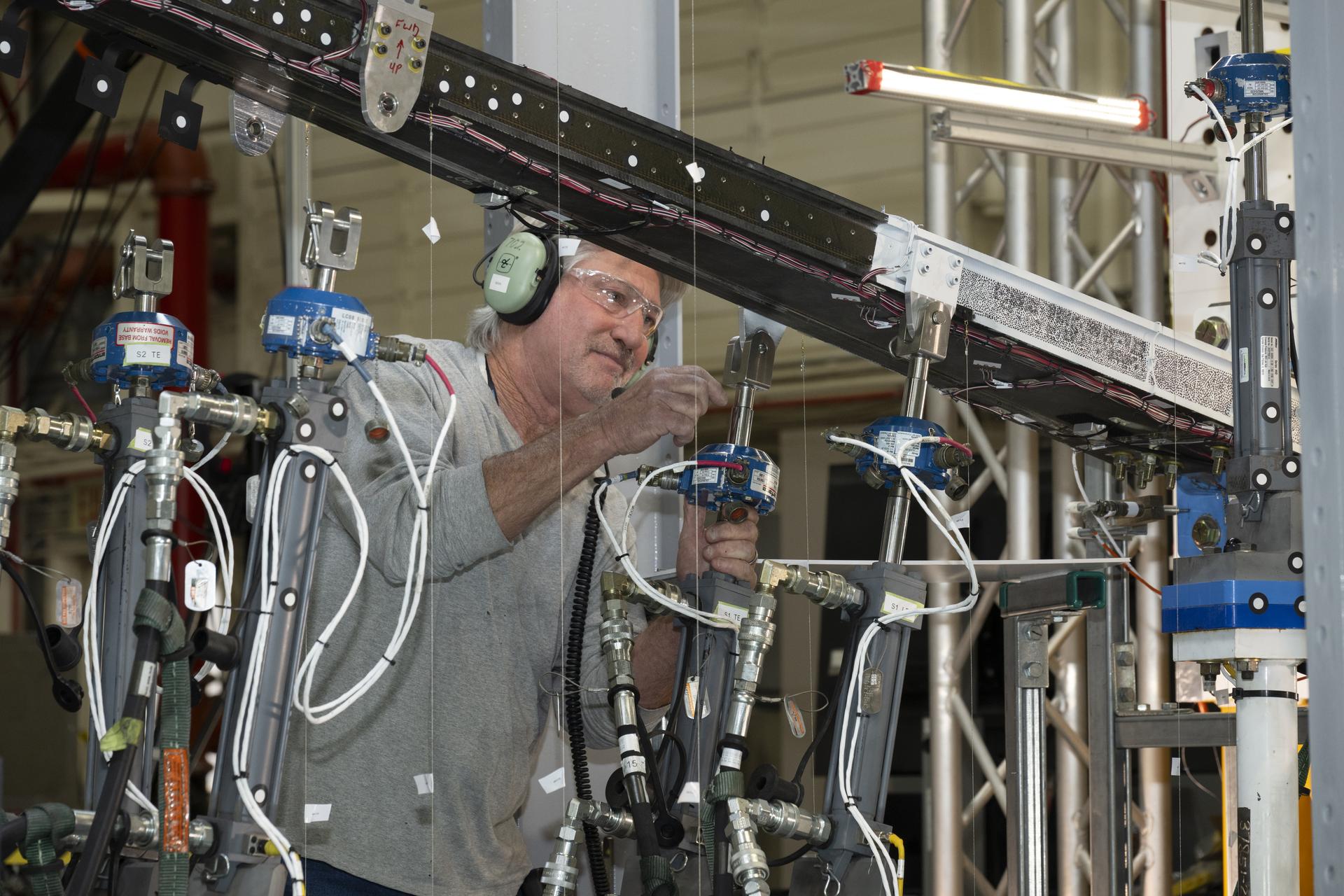
SWEET-15 was built not as a flyable aircraft but as a structural experiment focused on whether new lightweight construction methods can make that kind of wing viable. According to NASA, the project originated by combining five advanced composite manufacturing and assembly technologies that enabled the novel design. The article was designed and fabricated at NASA’s Langley Research Center in Virginia and then sent to Armstrong Flight Research Center in California for testing.
The central question was not whether the wing looked promising in simulation. It was whether it would behave as predicted when pushed by real loads. Long, narrow wings can deliver aerodynamic advantages, but they also raise concerns about bending, load transfer, connection integrity, and the overall response of lightweight composite assemblies.
Months of structural loading
At NASA Armstrong’s Flight Loads Laboratory, engineers spent several months intentionally bending the test wing to replicate and exceed the kinds of forces wings experience in flight. The setup included numerous strain and load sensors distributed throughout the structure, including fiber-optic strain sensors that allowed the team to measure how the wing responded as force increased.
This kind of test is a critical bridge between design theory and practical engineering. Computer models can predict where loads should concentrate, how much a wing should flex, and which joints might be vulnerable. But aerospace development depends on physical validation. If the hardware diverges significantly from the model, designers may need to revise the structure, alter manufacturing methods, or abandon assumptions that looked solid on paper.
NASA said that, in this case, the sensor data confirmed the predictions made by its computer models. That agreement matters almost as much as the raw structural result. A design program becomes much more credible when the modeling tools used to shape it are shown to align with measured behavior in a demanding physical test environment.
The key result
According to NASA’s initial findings, the wing withstood the anticipated in-flight forces without issue. The agency also said the outcome left researchers encouraged even when the wing was pushed beyond its intended limits. That suggests not only basic adequacy, but some degree of structural margin and resilience in the overall design approach.
For an experimental lightweight structure, that is a meaningful milestone. Ultra-efficient concepts often promise impressive aerodynamic benefits, yet practical deployment can stall when a structure proves too heavy, too delicate, too complex to assemble, or too uncertain under load. SWEET-15 appears to have cleared at least one of those hurdles by showing that a highly optimized wing can still perform as required in a rigorous test campaign.
NASA further said the results gave the team confidence in the new manufacturing approaches and in the methods used to connect wing parts. That point is easy to overlook but highly important. Novel aircraft are not only about shapes; they are also about how parts are made, joined, and scaled. If a concept depends on fabrication or assembly methods that cannot be trusted, the aerodynamic concept alone is not enough.

Why the aviation industry should care
The broader significance of SWEET-15 is that it helps reduce uncertainty around one path to more efficient commercial aircraft. Fuel burn in aviation is influenced by propulsion, operations, weight, and aerodynamics. Wing efficiency directly affects lift-to-drag performance, and a longer, slimmer wing can offer advantages if structural penalties are kept under control.
NASA’s work suggests that advanced composites and new assembly techniques may help close that gap. The agency’s description of the design as part of research into future ultra-efficient aircraft indicates that SWEET-15 is one element of a larger effort to mature technologies that could eventually feed into commercial transport design.
For airlines and manufacturers, even incremental efficiency improvements can matter at scale. A wing concept that saves fuel without introducing unmanageable structural complexity could influence future narrowbody or midsize aircraft programs. The test result does not guarantee adoption, but it gives designers more evidence to continue investing in this direction.
What this does and does not prove
The NASA announcement is encouraging, but it remains an early-stage research result rather than a final verdict on next-generation airliners. SWEET-15 is a 15-foot test article, not a full airplane. The source text does not claim certification readiness, production feasibility, or a timeline for commercial deployment.
What it does establish is narrower and still important: a truss-braced, lightweight wing structure built with advanced composite methods behaved as expected under demanding laboratory loads and survived anticipated flight-force conditions. That gives NASA and any eventual industry partners a stronger technical basis for further work.
In aerospace development, progress often comes through exactly these incremental validations. Before a concept becomes a product, it must survive scrutiny in modeling, materials, joints, manufacturing, and structural response. SWEET-15 appears to have advanced the state of confidence in all of those areas at once.
- SWEET-15 is a structural test article tied to NASA’s broader ultra-efficient aircraft research.
- NASA said the wing handled expected in-flight forces and produced data that matched computer predictions.
- The result strengthens confidence in both the truss-braced concept and the lightweight manufacturing methods behind it.
This article is based on reporting by NASA. Read the original article.

Originally published on nasa.gov