The critical test comes at the end of the mission
When Artemis II returns from its flight around the moon, the mission’s defining moment may not be the lunar flyby but the violent minutes that follow reentry. NASA says it is confident the Orion capsule’s heat shield will protect the four-person crew as the spacecraft slams into Earth’s atmosphere at roughly 24,000 miles per hour and endures temperatures near 5,000 degrees Fahrenheit.
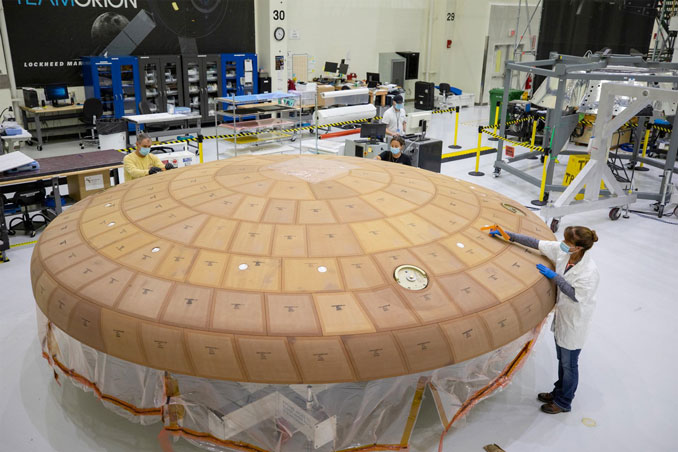
That confidence matters because the heat shield is also the most scrutinized system on the mission. Artemis I, the uncrewed 2022 test flight, exposed unexpected problems when the Avcoat material on Orion’s heat shield developed sub-surface cracks and gas pockets that blew away chunks of the outer char layer. The damage was not catastrophic, but it was significant enough to force years of analysis, testing, and redesign decisions before NASA was willing to fly astronauts.
Why Artemis I created concern
The issue was not simply that the shield eroded. Heat shields are designed to ablate. The problem was that the erosion did not match predictions. According to the source material, engineers eventually concluded that the damage was most likely tied to the material’s lack of permeability during a particular phase of reentry. External temperatures had dropped while internal layers remained extremely hot, generating gas that could not escape properly. That trapped gas then contributed to the loss of outer protective material.
For a crewed lunar mission, that kind of mismatch between model and reality is unacceptable until it is understood. Artemis II therefore became not just the next mission in NASA’s return-to-the-moon program, but a validation effort for whether Orion could safely bring humans home from deep space speeds.

Why NASA is still flying the same basic shield
NASA has already decided that later Artemis missions will use a different heat shield design. The complication is timing. The Artemis II shield, which is identical to the one used on Artemis I, was already installed. Replacing it would have delayed the mission by 18 months or more, according to the source material.
Instead, NASA chose to proceed with the existing configuration after what it described as nearly two years of testing, analysis, and review. The agency says the data support flight, especially with a modified reentry trajectory intended to eliminate the temperature conditions believed to have contributed to the earlier problem.
Amit Kshatriya, NASA’s associate administrator, said the agency has high confidence not only in the heat shield but also in the parachutes and recovery systems that will bring the capsule safely to splashdown in the Pacific. That statement underscores that NASA sees reentry as a whole-system problem, not a single-component question.
The human stakes are obvious
The Artemis II crew includes Reid Wiseman, Victor Glover, Christina Koch, and Canadian astronaut Jeremy Hansen. Their mission carries symbolic weight as the first crewed lunar return effort in decades, but symbolism does not soften the engineering realities of coming home from deep space. Reentry from a lunar mission is much harsher than return from low Earth orbit, and the margin for error is correspondingly smaller.
That is why NASA’s confidence claim matters. The agency is effectively saying that even after Artemis I exposed an unexpected vulnerability, the evidence now supports flying people through the same basic thermal protection design with procedural adjustments. That is a defensible engineering position only if the testing and analysis were deep enough to explain the prior anomaly and bound the risk tightly.
What this means for the Artemis program
The reentry question also extends beyond one mission. Artemis II is not just transporting four astronauts around the moon. It is carrying the credibility of the broader Artemis architecture. A clean return would validate NASA’s decision to fly with the installed shield and strengthen confidence in the program’s ability to keep moving. A serious failure or even a major anomaly would reverberate far beyond a single spacecraft.
That is why the heat shield issue has drawn such close attention. Space programs can tolerate delays and cost overruns more easily than they can absorb high-profile doubts about crew safety. The source material makes clear that NASA understands this and has tried to make its case through accumulated flight data, ground testing, and detailed analysis rather than simple reassurance.
Confidence, but not complacency
The most credible reading of NASA’s position is not that the problem vanished, but that it has been studied enough to make the remaining risk acceptable for Artemis II. That is a meaningful distinction. Spaceflight confidence is never the same thing as certainty, especially during high-energy reentry.
Still, NASA’s willingness to proceed says a great deal. The agency believes the heat shield, parachutes, and recovery system can do their job, and it believes the modified trajectory closes off the specific condition that likely contributed to Artemis I’s unexpected damage.
If Artemis II splashes down safely after its lunar mission, those hard final minutes will likely be remembered as the point when NASA proved Orion could carry people beyond Earth orbit and bring them back. For now, the agency is asking the public, and more importantly the crew, to trust the engineering. Soon, the atmosphere will provide the verdict.
This article is based on reporting by Spaceflight Now. Read the original article.
Originally published on spaceflightnow.com