NASA extends its commercial Moon delivery strategy
NASA has selected Intuitive Machines for a $180.4 million mission to deliver science and technology payloads to the lunar South Pole region in 2030, expanding the agency’s use of commercial landers to support Artemis exploration. The award was announced under NASA’s Commercial Lunar Payload Services initiative, or CLPS, a program built around purchasing end-to-end delivery services from private companies rather than flying every robotic mission itself.
The Houston-based company will be responsible for transporting seven payloads to the Moon, five of them funded by NASA. According to the agency, the package is designed to improve understanding of the chemical composition and structure of lunar regolith as well as the radiation environment in and around the South Pole. Those are not abstract science goals. NASA said the work is intended to help build a sustainable human presence for later Artemis missions.
The award also reinforces a broader pattern in NASA’s Moon strategy. Instead of treating robotic lunar landings as isolated demonstration flights, the agency is using recurring commercial deliveries to test technologies, characterize the landing environment, and gather operational data in places astronauts are expected to visit. In NASA’s framing, these missions are part of the path toward a long-term human return to the Moon and, eventually, preparation for Mars.
What Intuitive Machines is being asked to deliver
The total payload mass for the rovers and instruments is 165 pounds, or 75 kilograms, according to NASA. Intuitive Machines is tasked with managing the full delivery service to the surface, targeted for the South Pole region. NASA noted that this is the company’s fifth CLPS contract and said Intuitive Machines has already delivered payloads to the Moon twice through its IM-1 and IM-2 missions.
The delivery includes both mobility systems and instruments aimed at answering practical exploration questions. NASA’s description makes clear that the mission is not focused on a single measurement. Instead, it combines hardware meant to observe landing effects, examine the regolith, and study the radiation environment in an area central to future Artemis planning.
Joel Kearns, deputy associate administrator for exploration in NASA’s Science Mission Directorate, said the investigations are meant to support long-term sustainability while deepening understanding of the lunar surface and testing technologies for later human activity near the South Pole. Adam Schlesinger, who manages the CLPS initiative at Johnson Space Center, said regular deliveries are meant to improve knowledge of the exploration environment and accelerate progress toward a durable human presence on the Moon.

Why the South Pole matters
NASA’s announcement underscores how much strategic weight the South Pole now carries in lunar planning. The agency is not describing the region simply as another destination for a science lander. It is treating it as an operational environment that must be measured, modeled, and understood before crewed missions can become routine.
That helps explain the choice of payloads. The mission is expected to produce data on regolith composition and structure and on local radiation conditions, both central issues for any future campaign that expects people and hardware to operate there for extended periods. Regolith behavior shapes landing safety, surface mobility, and equipment durability. Radiation conditions affect both mission design and long-term human operations.
NASA’s language also points to a more cumulative style of lunar exploration. Rather than waiting for large flagship missions to answer every question, the agency is using smaller, more frequent commercial flights to build a layered understanding of the terrain and hazards. That approach shifts some of the Moon program’s momentum onto the cadence of private-sector deliveries.
Payloads built around landing, surface science, and mobility
Among the payloads NASA highlighted is Stereo Cameras for Lunar Plume Surface Studies, or SCALPSS. The instrument uses stereo imaging photogrammetry, active illumination, and ejecta impact detection sensors to record how a lander’s engine plume interacts with the regolith during descent. NASA said SCALPSS previously flew on Intuitive Machines’ IM-1 mission and on Firefly Aerospace’s Blue Ghost Mission 1, where it captured what the agency described as first-of-its-kind imagery.
That data has direct operational value. NASA said the resulting high-resolution stereo imagery will help create models to predict regolith erosion and ejecta characteristics, especially as larger and heavier spacecraft begin landing near other hardware on the Moon. For a future lunar surface that may host repeated robotic and human operations, understanding how landing plumes reshape the ground is increasingly important.
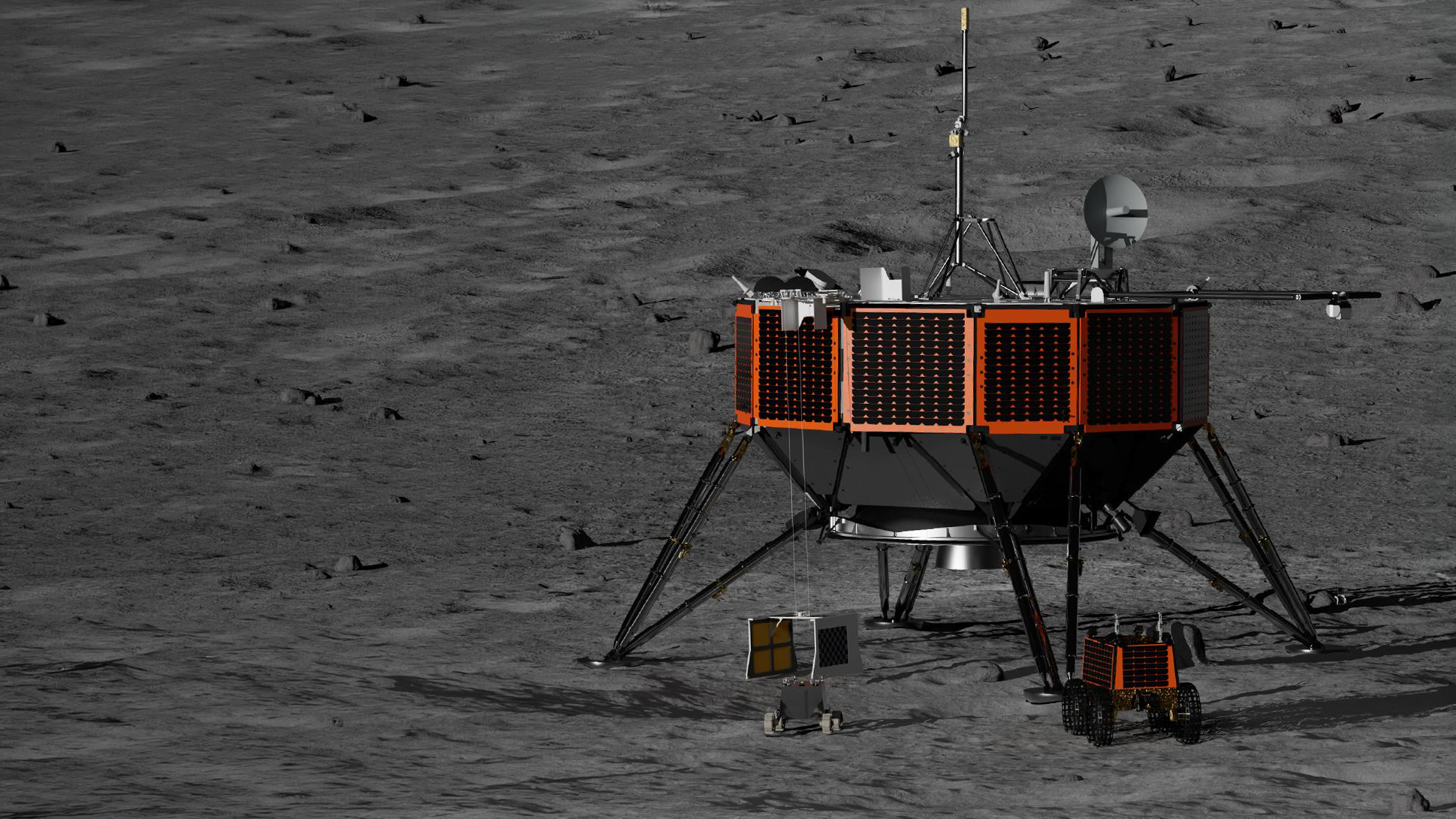
The mission will also include rovers shown in NASA’s rendering: a Honeybee Robotics lunar rover and the Australian Space Agency’s Roo-ver lunar rover. Their presence signals another priority embedded in CLPS missions, namely to expand what can be done after landing. Surface mobility allows instruments to sample beyond a single touchdown point and can help map local conditions with more flexibility than a fixed payload bay.
A commercial model with strategic consequences
CLPS was designed to let NASA buy transportation while broadening the industrial base for lunar missions. This award shows that the agency is still leaning into that model even as it raises the stakes of what those deliveries need to accomplish. The South Pole is not a low-consequence proving ground. It is a region NASA sees as central to the future architecture of Artemis.
For Intuitive Machines, the contract adds another major assignment in a market where reliability, cadence, and mission scope are becoming more important than one-off demonstrations. For NASA, the award is another sign that commercial lunar logistics are being treated as infrastructure for exploration, not as a side experiment.
If the mission flies as planned in 2030, it will carry a relatively small mass by terrestrial standards. But the scientific and operational role assigned to it is larger than the number suggests. NASA is using the flight to answer practical questions about the surface, the environment, and the mechanics of working near the Moon’s South Pole. In the agency’s current lunar strategy, that kind of knowledge is not secondary to Artemis. It is part of what makes Artemis possible.
This article is based on reporting by NASA. Read the original article.
Originally published on nasa.gov