Wildfires Push NASA to Reroute a Core Piece of Deep-Space Communications
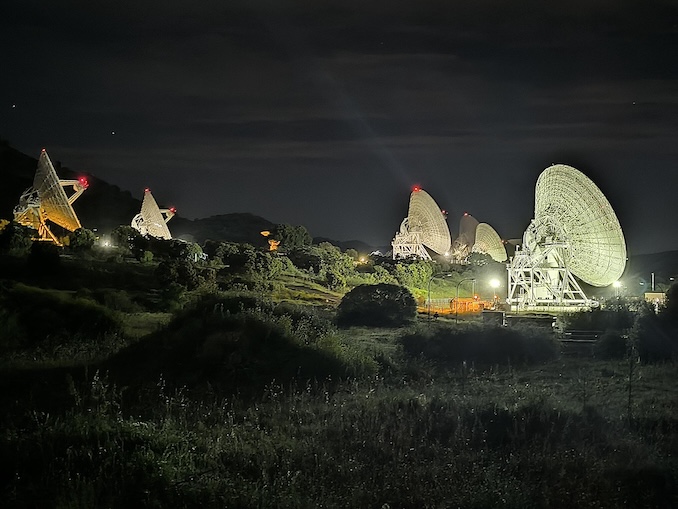
NASA evacuated its Madrid Deep Space Communications Complex on Friday as wildfires spread near the Spanish capital, temporarily forcing the agency to clear one of the three ground hubs that keep continuous contact with spacecraft operating far beyond Earth orbit. The agency said personnel were safe and that the site would be inspected for damage only when conditions allowed.
The Madrid facility is not a routine outpost. It is one of just three major installations in NASA’s Deep Space Network, alongside stations in Goldstone, California, and Canberra, Australia. Together, those sites provide the round-the-clock global coverage needed to send commands to distant spacecraft and receive their faint return signals. Any disruption at one location matters because the network is designed around geographic spacing, with each complex covering spacecraft as Earth rotates.
According to the supplied source text, local reporting in Spain said about 90 workers were evacuated from the site. Images shared publicly appeared to show smoke and flames in the area around the large tracking antennas. NASA said it was monitoring the fire in coordination with local authorities and the U.S. Embassy.
The immediate operational impact appears to have been contained. NASA said support for mission operations was shifted to the Goldstone complex in California, allowing spacecraft communications to continue without interruption. That handoff is important because the Deep Space Network is not simply a relay for one or two missions. It underpins communications for a wide range of deep-space operations, including probes traveling through the outer solar system and science missions whose data links are already constrained by distance, power, and antenna availability.
Why the Madrid Site Matters
The Deep Space Network works because its three primary stations are positioned roughly 120 degrees apart around the globe. That arrangement gives NASA a way to maintain contact with spacecraft as Earth turns. When one station is unavailable, the other sites can absorb some of the load, but the network does not have abundant slack. Capacity has been a growing concern in recent years as more missions compete for time on the system’s antennas.
The Madrid installation, located at Robledo de Chavela about 60 kilometers west of the Spanish capital, includes giant radio antennas built to communicate with probes operating at extreme distances. The source text notes that each of the three global sites contains 70-meter antennas weighing roughly 2,970 U.S. tons. Those dishes are central to receiving weak signals from spacecraft whose transmissions can take minutes or hours to arrive and may be barely distinguishable from background noise.
The station’s role becomes even more significant for older and farther missions. The source material highlights prior work at the Madrid complex involving Voyager 1, where multiple antennas were combined in an “arraying” test to strengthen reception of the spacecraft’s very weak signal. That example illustrates a broader reality: for some missions, especially those operating at the edge of technical reach, loss of ground capacity can narrow margins quickly.
NASA has not said that communications were degraded, and its statement emphasized continuity. Still, the evacuation is a reminder that even highly specialized space infrastructure is exposed to the same climate and disaster risks affecting power grids, transport systems, and communities on the ground.
Operational Resilience Meets Physical Vulnerability
One reason the evacuation stands out is that the Deep Space Network is built for resilience in the communications sense but remains physically tied to fixed terrestrial assets. The network can reroute support between continents, but it cannot simply replace a damaged 70-meter antenna on short notice. A wildfire near one of the three sites is therefore more than a local emergency. It is a stress test for a system with little true redundancy.
The source text says NASA had not yet surveyed the Madrid site for damage as of the evacuation. That leaves open key questions about whether flames, smoke, heat, or power disruptions affected equipment, support buildings, or access roads. Even if the antennas themselves remain unharmed, recovery can depend on the condition of the broader facility and the safety of staff returning to work.
Spain’s wider wildfire situation adds to the seriousness. The supplied report says more than 25,000 people had been evacuated across the country and more than 20,000 were under lockdown. In that context, the NASA site is part of a much larger civil emergency rather than an isolated industrial incident.
For mission operators, the ability to transition support to California without a service break is the practical headline. For the space sector more broadly, the episode reinforces an uncomfortable lesson: critical infrastructure for exploration is only as secure as the terrestrial systems and environmental conditions that sustain it.
A Warning for the Future of Space Infrastructure
The evacuation near Madrid comes at a time when demand on deep-space communications is increasing. Space agencies and commercial operators are sending more spacecraft farther from Earth, while legacy missions continue to require support. That means every major antenna site is becoming more valuable, not less.
The incident also highlights a planning challenge. Space policy often focuses on launch capacity, satellite manufacturing, and mission funding, but ground systems can be a hidden bottleneck. A deep-space mission is only as effective as its ability to stay in contact with Earth. Antenna availability, maintenance schedules, and environmental disruptions all influence that outcome.
If the Madrid complex escapes serious damage, the event will still likely be studied as a near-miss. It shows the value of geographic distribution and contingency procedures, but also the limits of a network built around a small number of irreplaceable facilities. As wildfires intensify in many regions, agencies may face more pressure to harden sites, improve emergency planning, and expand communications capacity before the next crisis tests the system again.
For now, NASA’s message is that spacecraft support remains uninterrupted and the Madrid site will be assessed when it is safe. That is the best short-term result available in a situation where the danger is still unfolding on the ground.
This article is based on reporting by Spaceflight Now. Read the original article.
Originally published on spaceflightnow.com