Starship’s latest flight showed progress, but not a clean finish
SpaceX’s 13th test flight of Super Heavy-Starship added another mixed but meaningful result to the company’s campaign to mature the largest rocket system ever built. The two-stage vehicle lifted off from Starbase, Texas, at 5:51 p.m. EDT on July 24 and completed most of the mission profile SpaceX was chasing. The Super Heavy booster separated on schedule and returned toward the Gulf Coast, while the Starship upper stage continued on a successful sub-orbital hop toward the Indian Ocean.
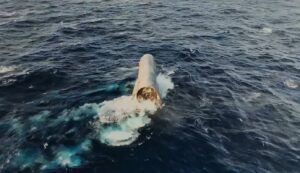
The headline outcome, however, was not a flawless recovery. According to the reported flight sequence, the booster made an on-target but hard splashdown after too few engines restarted during its final descent. That meant the test advanced several objectives at once, while also leaving SpaceX with another concrete propulsion issue to solve before the system can move closer to routine operations.
For a program built around iteration, this was the kind of flight that matters. It did not end with a dramatic in-flight loss, and it did not deliver the polished landing sequence SpaceX ultimately wants either. Instead, it exposed the next layer of technical work in a visible way: the rocket flew, staged, and reached its planned upper-stage profile, but booster recovery margins remained short.
A better launch after recent delays
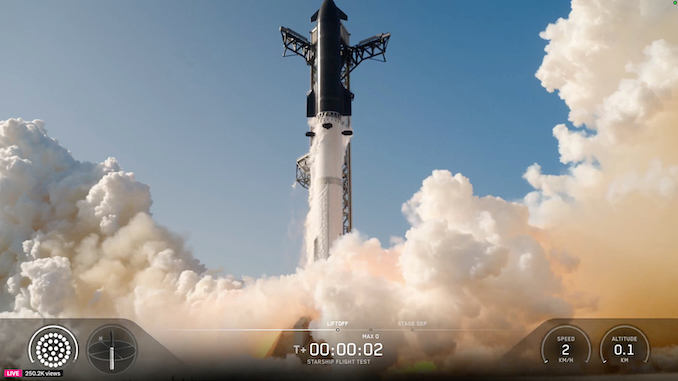
The July 24 flight came after a previous attempt on July 16 was halted at the last second when four Raptor engines failed to start properly. SpaceX then reset for another attempt on July 23, only for low clouds to force a 24-hour delay. On the successful launch day, weather conditions improved and all 33 Raptor engines on the first stage ignited normally.
That clean engine start was significant on its own. With a rocket this large, a nominal liftoff is not a trivial box to check. Super Heavy-Starship stands 397 feet tall and launches with roughly 16 million pounds of thrust, making every ignition sequence a major systems test involving engine startup logic, ground infrastructure, and tightly choreographed timing between the booster and upper stage.
By clearing the pad cleanly and climbing away through a mostly clear sky, the vehicle gave SpaceX a stronger starting point than the previous scrubbed attempt. It also suggested the company had addressed the immediate cause of the July 16 abort well enough to proceed into a full-duration ascent test.
Booster descent revealed the main shortfall
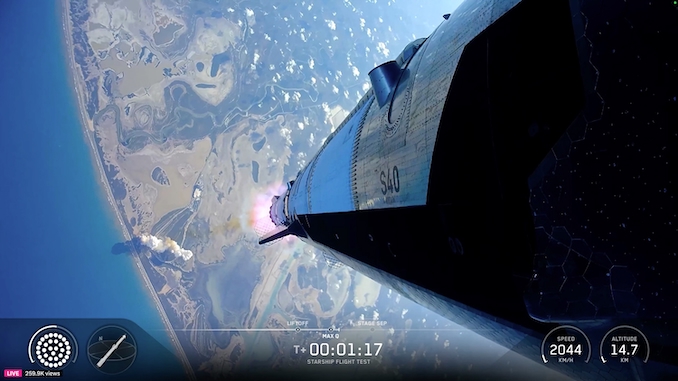
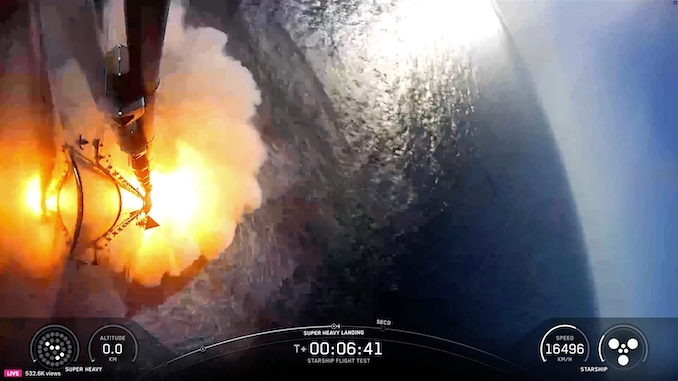
The most important problem emerged after stage separation. SpaceX’s third-generation Super Heavy booster appeared to perform as planned during ascent and through the flip maneuver that set it up for a tail-first descent. But the final braking phase did not develop the thrust needed for a gentler touchdown.
As the booster dropped toward the Gulf, only 10 of 13 engines reportedly restarted. By the moment of splashdown, only five appeared to be running. The result was a higher-than-expected impact velocity and what was described as a hard splashdown.
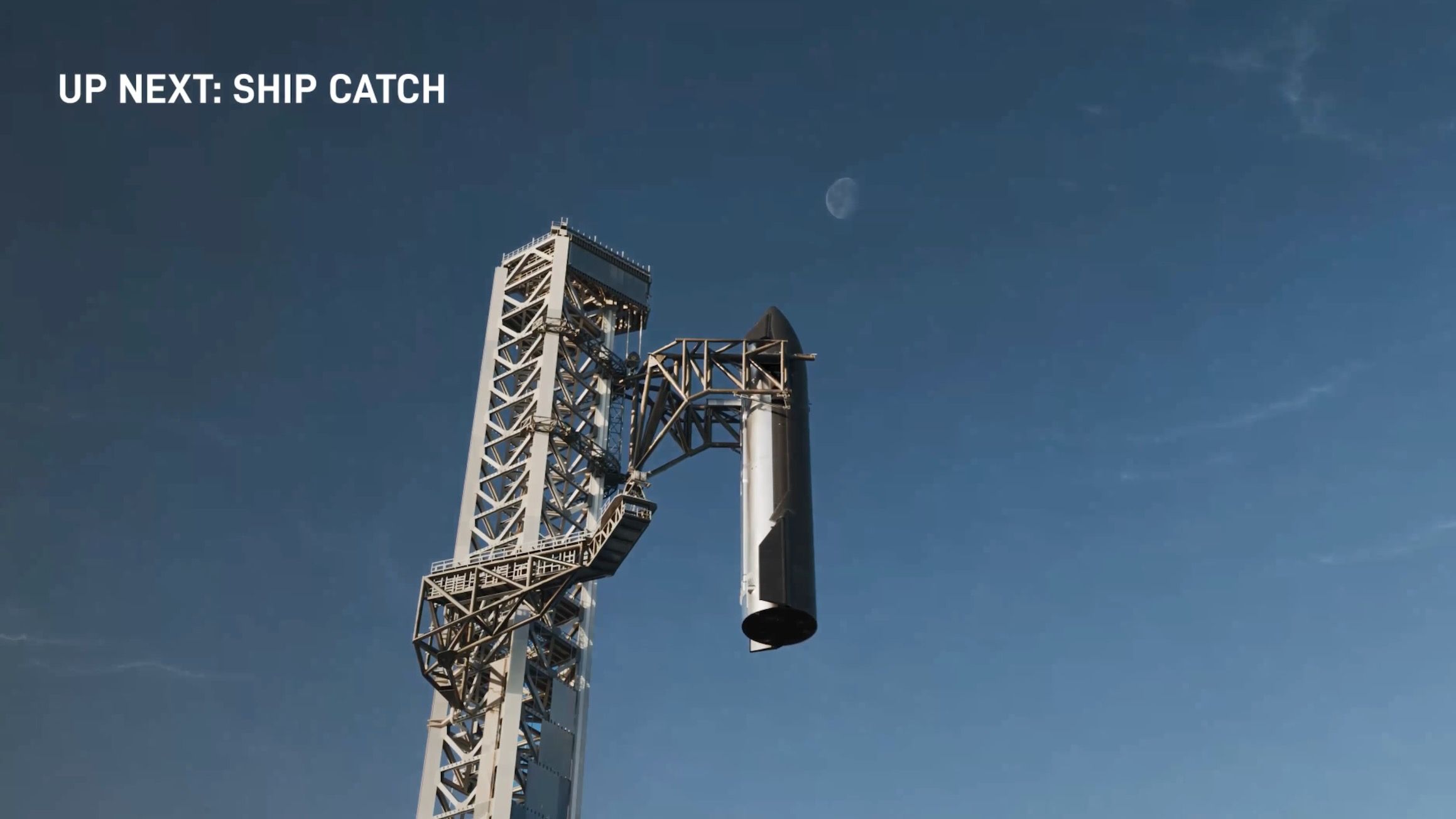
That matters because booster recovery is central to SpaceX’s long-term case for Starship. The system is designed not merely to survive flight, but to return rapidly and repeatedly. In its intended operational concept, Super Heavy does not splash down at all. It flies back to the launch site, where giant mechanical arms on the tower, often called chopsticks, are meant to catch the stage out of the air.
For these initial version 3 flights, SpaceX had already chosen Gulf splashdowns as a safety precaution instead of attempting a tower catch. This test helps explain why that caution remains necessary. A slow, controlled final descent depends on reliable engine relights, and this flight showed that the relight sequence still needs work before a return-to-launch-site attempt would carry acceptable risk.
The upper stage met a more encouraging set of goals
If the booster raised fresh questions, the Starship upper stage supplied the more encouraging half of the mission. The upper stage completed its climb to space with all six Raptor engines operating smoothly, then continued on a successful sub-orbital path toward the Indian Ocean.
That performance matters because the third-generation Starship configuration is meant to build on lessons from the previous V3 test in May. On that earlier flight, the booster missed its landing target and the upper stage suffered an early engine shutdown on the way to space. This time, the upper stage avoided that kind of conspicuous engine trouble and carried out its planned hop.
For SpaceX, that is more than a symbolic improvement. Starship’s future roles, from satellite deployment to deep-space transport ambitions, depend on a vehicle that can complete ascent cleanly and operate predictably after separation. A successful sub-orbital hop does not prove full mission readiness, but it does show the company is making progress in parts of the flight envelope that had previously exposed weaknesses.
Why this flight still counts as a milestone
The temptation with Starship tests is to sort them too simply into success or failure. That framing misses the point of how SpaceX develops hardware. The company treats each launch as a chance to retire a set of risks, uncover a new set, and feed those results into the next build. By that standard, flight 13 looks like a useful, if incomplete, milestone.
The launch demonstrated a normal liftoff after a recent engine-start abort. It delivered a better third-generation flight than the one in May. It showed the upper stage could complete its spacebound segment without the earlier shutdown problem. And it narrowed the main near-term challenge to a more specific issue: booster engine relight performance during descent.
That kind of refinement is essential for a system as ambitious as Starship. The rocket is not just trying to reach space; it is trying to do so with full and rapid reusability. Every phase of the mission has to work repeatedly, and partial success in one phase does not offset weakness in another. The hard splashdown is therefore not a footnote. It is the evidence SpaceX needs to determine what must change next.
What comes next for Starship
The immediate consequence of this test is likely a detailed review of why eight of 13 engines did not restart properly during the booster’s terminal descent sequence. Whether the cause lies in ignition conditions, engine hardware behavior, software timing, or the dynamics of the descent itself, the issue is now one of the clearest blockers between Starship’s present state and more ambitious recovery attempts.
At the same time, SpaceX can take useful confidence from the upper stage result and from the fact that the integrated system once again completed a demanding launch sequence without catastrophic loss. For a rocket intended to support much more than demonstration flights, that matters. Progress in launch reliability and upper-stage performance gives the program something solid to build on, even as recovery performance remains uneven.
The larger picture is unchanged: Starship is still in development, still visibly experimental, and still moving forward through a sequence of imperfect tests. Flight 13 did not deliver the clean ending SpaceX wants. But it did move the program further into the regime where remaining problems are narrower, more specific, and more actionable. For an experimental heavy-lift vehicle, that is real progress, even when the landing is harder than planned.
This article is based on reporting by Spaceflight Now. Read the original article.

Originally published on spaceflightnow.com