A Cosmic Lighthouse Near a Supermassive Black Hole
At the center of our Milky Way galaxy, roughly twenty-six thousand light-years from Earth, sits Sagittarius A*, a supermassive black hole with the mass of four million suns. It is one of the most studied objects in modern astrophysics, yet the region surrounding it continues to yield surprises. The latest comes from researchers at Columbia University and the Breakthrough Listen project, who have identified a candidate pulsar spinning at extraordinary speed in the immediate vicinity of our galaxy's central black hole.
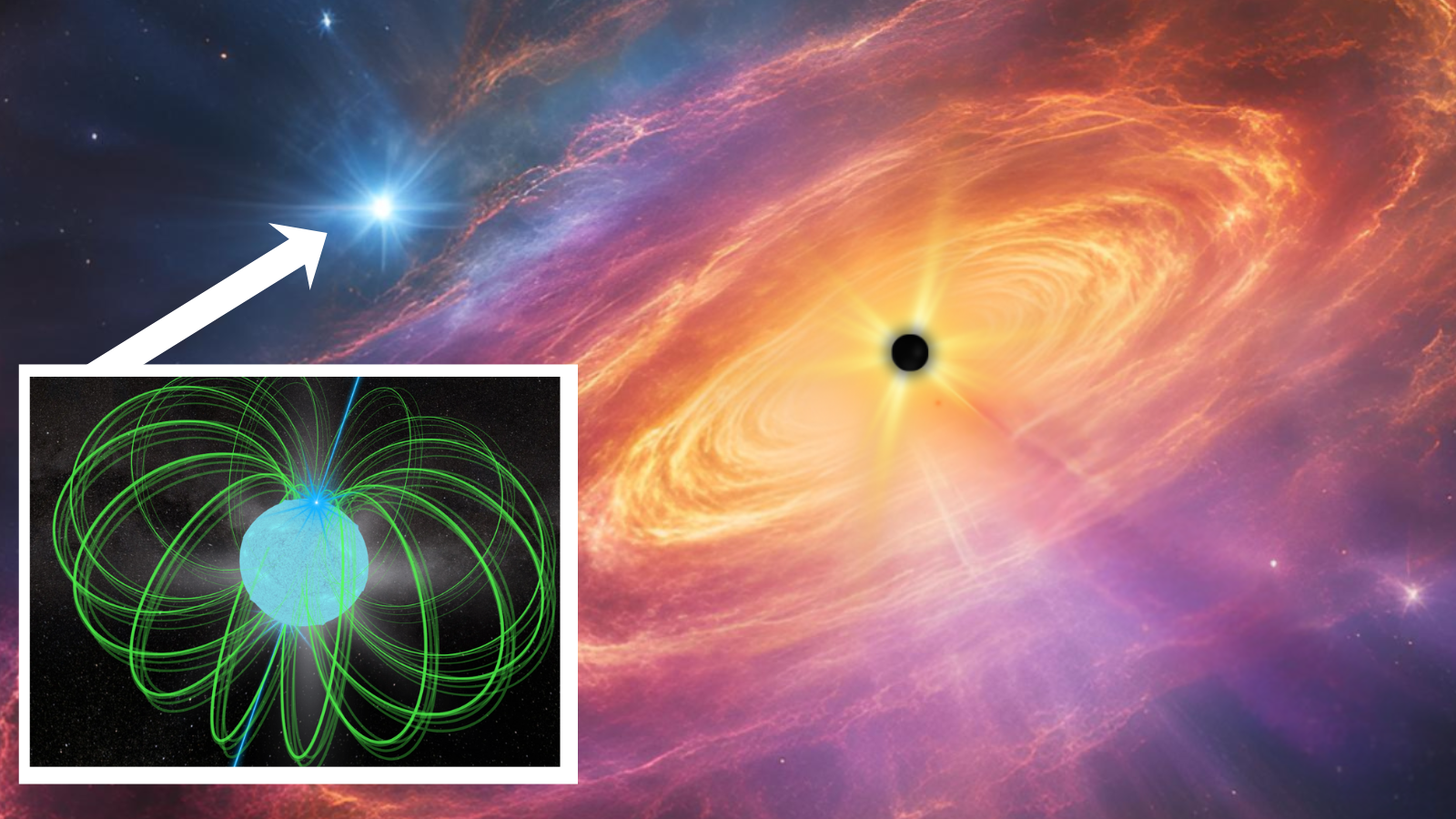
The detection, published in The Astrophysical Journal, describes an 8.19-millisecond pulsar candidate, meaning if confirmed, this neutron star would complete a full rotation roughly 122 times per second. Pulsars are the ultradense remnants of massive stars that have ended their lives in supernova explosions, compressing their remaining mass into a sphere typically just twenty kilometers across while generating intense magnetic fields and emitting focused beams of radio waves that sweep across space like the beam of a lighthouse.
Finding one so close to Sagittarius A* has been a decades-long goal of radio astronomy, and this detection could mark a turning point in our understanding of both our galaxy's core and the fundamental physics governing space and time.
The Breakthrough Listen Galactic Center Survey
The discovery emerged from the Breakthrough Listen Galactic Center Survey, one of the most sensitive radio searches ever conducted for pulsars in the dynamically complex central region of the Milky Way. Breakthrough Listen, a scientific research program aimed at finding evidence of civilizations beyond Earth, has repurposed some of its extraordinary observational capabilities to probe the galactic center for rapidly spinning neutron stars.
The galactic center is an exceptionally difficult environment for radio observations. Interstellar gas and dust scatter radio waves, a phenomenon known as scattering broadening, which smears out the precise timing signatures that define pulsars. Additionally, the intense gravitational environment near Sagittarius A* introduces relativistic effects that further complicate detection. These challenges explain why, despite theoretical predictions that hundreds or even thousands of pulsars should inhabit this region, only a handful of candidates have ever been identified nearby.
The team employed advanced signal processing techniques to cut through the noise, analyzing data from multiple observing sessions to build confidence in their detection. The 8.19-millisecond period places this object in the category of millisecond pulsars, which are among the most stable natural clocks in the universe.

Why This Matters for General Relativity
Albert Einstein's general theory of relativity, published over a century ago, remains our best description of gravity and the geometry of spacetime. It has been confirmed by every experiment ever devised to test it, from the bending of light around the sun to the detection of gravitational waves from merging black holes. Yet certain regimes remain poorly tested, particularly the extreme gravitational conditions near supermassive black holes.
A pulsar orbiting Sagittarius A* would function as a natural precision clock embedded in the most intense gravitational field accessible to observation. By tracking the exact arrival times of its radio pulses over months and years, astronomers could measure the curvature of spacetime around the black hole with unprecedented accuracy. Any deviations from general relativity's predictions would signal new physics, potentially pointing toward a quantum theory of gravity that has eluded physicists for decades.
The precision measurements enabled by such a system would also allow scientists to determine the spin rate and exact mass of Sagittarius A* to new levels of accuracy, test the cosmic censorship conjecture which states that singularities must always be hidden behind event horizons, and search for exotic effects predicted by alternative theories of gravity.
The Magnetic Dead Star Possibility
What makes this particular detection especially intriguing is the possibility that the object is not merely a pulsar but a magnetar, a neutron star with a magnetic field roughly one thousand times stronger than an ordinary pulsar. Magnetars are among the most extreme objects in the known universe, capable of producing bursts of X-rays and gamma rays powerful enough to be detected across the galaxy.
The galactic center is already known to host one confirmed magnetar, SGR J1745-2900, discovered in 2013. The potential presence of a second magnetic neutron star in this region raises questions about the formation and survival of these objects in the extreme tidal environment near a supermassive black hole. Understanding how magnetars form and persist near Sagittarius A* could provide insights into the stellar population dynamics of galactic nuclei, a field with implications for understanding galaxy evolution across the cosmos.
If the candidate is indeed a magnetar, its rapid spin rate would place it among the fastest-rotating magnetars ever detected, adding another layer of scientific interest to an already remarkable discovery.
The Path to Confirmation
The research team is careful to emphasize that this remains a candidate detection, not a confirmed discovery. Pulsar searches are plagued by false positives from terrestrial radio interference, instrumental artifacts, and natural astrophysical phenomena that can mimic periodic signals. The galactic center's extreme scattering environment adds additional uncertainty.
To encourage the broadest possible scrutiny, Breakthrough Listen has made all of the observational data publicly available, allowing research teams around the world to conduct independent analyses. Additional follow-up observations are already underway using multiple radio telescopes, aiming to re-detect the signal and characterize its properties more precisely.
Confirmation would require detecting the pulsar in multiple independent observations, measuring its period with sufficient precision to rule out alternative explanations, and ideally observing changes in its signal that would indicate orbital motion around Sagittarius A*. This last step would be the most scientifically valuable, as it would immediately enable the general relativistic tests that make this discovery so eagerly anticipated.
A Window Into the Galaxy's Most Extreme Environment
The central parsec of the Milky Way is one of the most extreme astrophysical environments known. Stars orbit the supermassive black hole at thousands of kilometers per second. Clouds of hot gas spiral inward, occasionally producing flares visible across the electromagnetic spectrum. The density of stars is millions of times higher than in our solar neighborhood.
Understanding this environment is not merely of local interest. Supermassive black holes reside at the centers of most galaxies, and the physical processes occurring near Sagittarius A* are replicated on far grander scales in active galactic nuclei and quasars across the universe. Every insight gained from studying our own galactic center contributes to a broader understanding of how black holes interact with their surroundings and shape the galaxies that host them.
A confirmed pulsar in this region would provide a persistent, precise probe of these conditions, offering a continuous stream of data about the gravitational field, magnetic environment, and matter distribution near the black hole. It would be, in the words of one researcher, like placing a precision laboratory instrument at the edge of a cosmic abyss.

What Comes Next
The astronomical community is watching this candidate with intense interest. If confirmed, it would immediately become one of the most scientifically valuable objects in the sky, attracting observation time from radio telescopes worldwide. The implications for fundamental physics, astrophysics, and our understanding of the Milky Way's structure would be profound.
For now, the data is being analyzed, the follow-up observations are being planned, and the scientific community is exercising the cautious optimism that characterizes the best science. The Milky Way may indeed be hiding a remarkable secret at its heart. The work of confirming it has only just begun.
This article is based on reporting by Space.com. Read the original article.
Originally published on space.com