A New Map of the Invisible Universe
Astronomers have unveiled the results of a colossal observational campaign that fundamentally changes our picture of the cosmos. Using the Low-Frequency Array (LOFAR), a network of thousands of radio antennas spread across Europe, an international team has cataloged 13.7 million radio sources — making this the largest radio survey of the sky ever assembled.
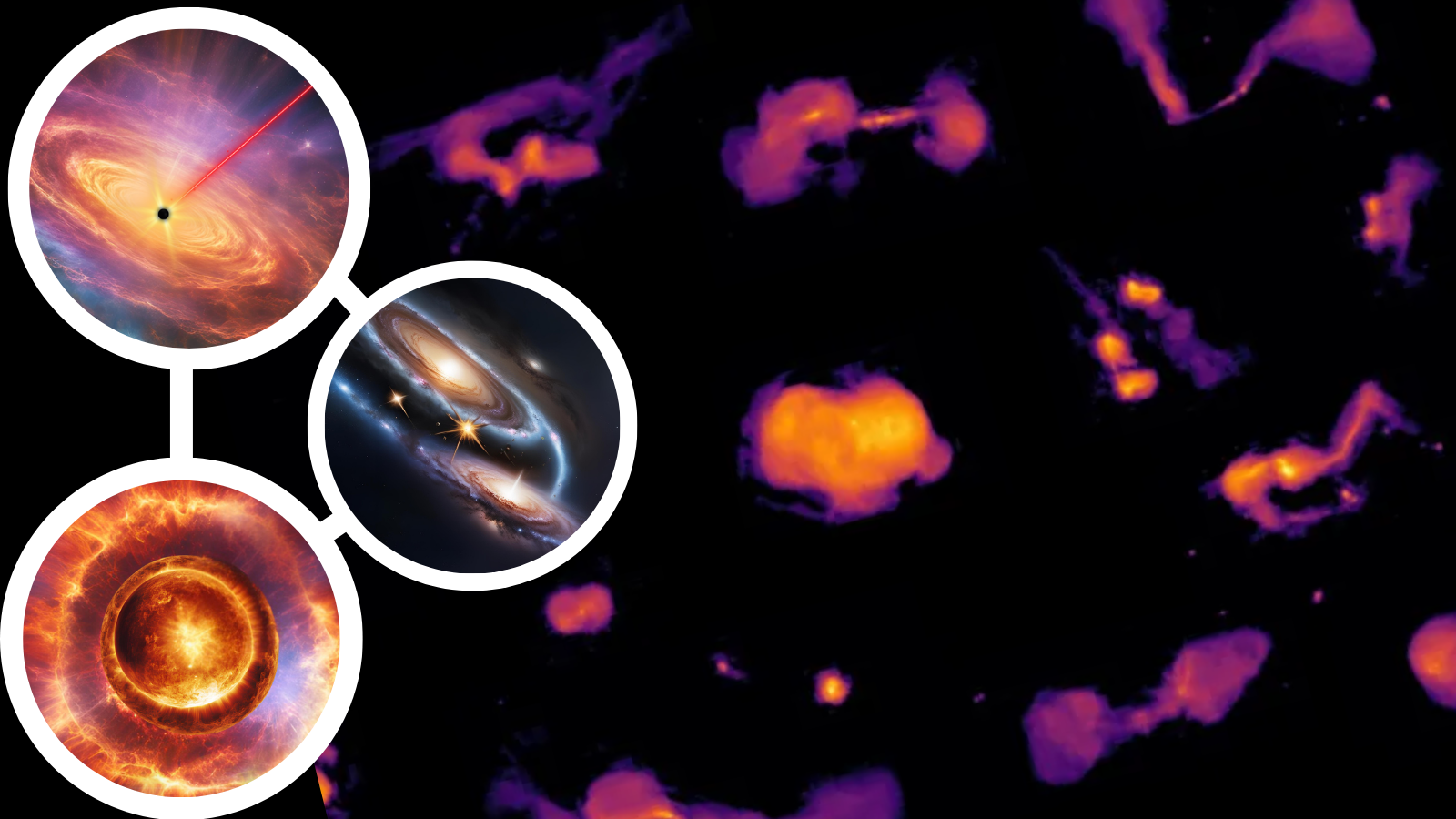
The survey captures a staggering variety of cosmic phenomena: supermassive black holes hurling jets of plasma millions of light-years into intergalactic space, galaxies caught in the act of merging, the ghostly remnants of ancient supernova explosions, and entire galaxy clusters shimmering with radio emission from heated gas trapped in their gravitational wells.
What makes this achievement particularly remarkable is the frequency range. LOFAR operates at very low radio frequencies, between 120 and 168 megahertz — wavelengths that reveal physical processes largely invisible to optical telescopes or even higher-frequency radio dishes. At these frequencies, the sky lights up with synchrotron radiation from electrons spiraling through magnetic fields, offering a direct probe of cosmic magnetism and high-energy particle acceleration.
How LOFAR Works
Unlike a traditional radio telescope with a single large dish, LOFAR achieves its extraordinary sensitivity through interferometry — combining signals from thousands of small, relatively inexpensive antennas distributed across the Netherlands and partner stations in Germany, France, the UK, Sweden, Poland, Ireland, Latvia, and Italy. The longest baselines stretch over 2,000 kilometers, giving the array angular resolution comparable to that of a space telescope.
The core of the array sits in a remote area of the northeastern Netherlands called the Drentse Aa, chosen for its unusually low levels of radio frequency interference. From there, data streams at rates that rival those of the world's largest particle physics experiments, requiring dedicated supercomputing facilities to process the raw signals into sky images.
Each pointing of LOFAR captures a field of view several degrees across — far wider than typical radio telescopes — allowing the survey to cover the entire northern sky efficiently. The resulting data set contains petabytes of information that will keep astronomers busy for years to come.

Black Holes and Active Galaxies
Among the survey's most spectacular findings are millions of active galactic nuclei, or AGN — galaxies harboring supermassive black holes that are actively consuming surrounding matter. As material spirals into these black holes, it generates twin jets of relativistic plasma that can extend far beyond the host galaxy itself.
LOFAR's low-frequency sensitivity is uniquely suited to detecting the oldest, most extended jet structures. High-frequency radio emission fades relatively quickly as electrons lose energy, but the low-frequency glow persists far longer, revealing fossil jets and lobes that record hundreds of millions of years of black hole activity. The survey has uncovered thousands of previously unknown giant radio galaxies, some with structures spanning millions of light-years.
These observations are critical for understanding how supermassive black holes influence their host galaxies and the broader cosmic environment. The energy deposited by AGN jets is thought to regulate star formation in massive galaxies and heat the gas in galaxy clusters, making them key players in the evolution of cosmic structure.
Merging Galaxies and Cosmic Collisions
The survey also provides an unprecedented census of galaxy mergers. When galaxies collide, the resulting gravitational chaos can trigger bursts of star formation and funnel gas toward central black holes, igniting AGN activity. LOFAR can detect the radio emission associated with both processes, making it an ideal tool for studying how galaxy interactions shape the cosmic landscape.
Particularly exciting are the detections of radio emission from galaxy clusters themselves. The hot gas trapped in these massive structures — the largest gravitationally bound objects in the universe — produces diffuse radio emission known as radio halos and radio relics. These features trace shock waves and turbulence generated during cluster mergers, events that release energies rivaled only by the Big Bang itself.
The new survey has dramatically expanded the known population of these cluster radio sources, providing fresh constraints on the magnetic fields and particle acceleration mechanisms operating in the largest structures in the cosmos.
Supernova Remnants and Stellar Death
Closer to home, the survey has cataloged thousands of supernova remnants within our own Milky Way. These expanding shells of debris from exploded stars are major sources of cosmic rays — the high-energy particles that constantly bombard Earth's atmosphere. By mapping their radio emission at low frequencies, LOFAR provides new information about the strength and structure of the Galactic magnetic field and the mechanisms that accelerate particles to near-light speeds.
The survey has also detected radio emission from previously unknown remnants, expanding our inventory of these important objects and helping astronomers better understand the rate and distribution of stellar explosions in the Milky Way.
Looking Ahead
The current release represents only the second major data release from the LOFAR Surveys Key Science Project. Future releases will go deeper and cover more sky, with the eventual goal of a complete census of the low-frequency radio sky visible from Europe. Meanwhile, the planned Square Kilometre Array (SKA), currently under construction in Australia and South Africa, will extend this kind of survey to the entire sky with even greater sensitivity.
For now, the 13.7 million-source catalog stands as a monument to what modern radio astronomy can achieve. It is not just a map — it is a new way of seeing the universe, one that reveals the violent, magnetic, and energetic processes that shape galaxies and the cosmic web across billions of years of cosmic history.
This article is based on reporting by Space.com. Read the original article.
Originally published on space.com