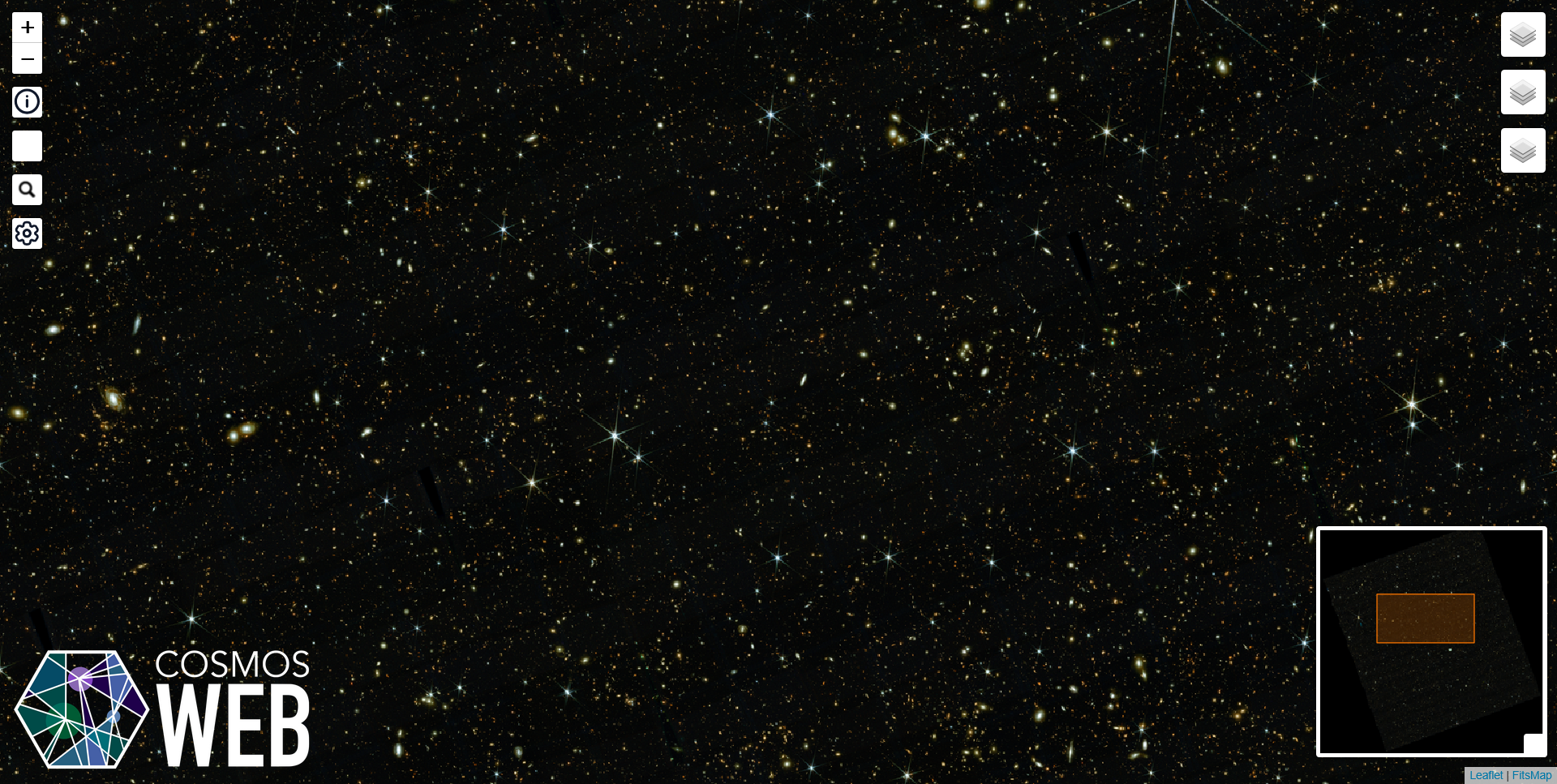
JWST pushes the cosmic web into sharper focus
Astronomers working with data from NASA’s James Webb Space Telescope have assembled what they describe as the most detailed map yet of the cosmic web, the vast network of galaxy-rich filaments and sparsely populated voids that shapes the large-scale structure of the universe. The work comes from a team led by researchers at the University of California, Riverside, and uses observations from COSMOS-Web, the largest of Webb’s Cycle 1 General Observation programs.
The cosmic web is central to modern cosmology because it records how matter gathered and organized over cosmic time. For decades, scientists have tried to understand how this structure emerged from the early universe and evolved into the galaxy distribution seen today. That effort has been limited by both instrumentation and the difficulty of observing extremely distant, faint, and dust-obscured objects. Webb’s sensitivity and resolution have now extended that picture much deeper into time.
According to the source material, the new map traces galaxies and filamentary structures back to roughly 1 billion years after the Big Bang, a period when the universe was emerging from the so-called Cosmic Dark Ages. That makes the result important not just as a prettier map, but as a dataset that can be used to test ideas about how galaxies formed, how matter clustered, and what role dark matter played in shaping early structure.
Why COSMOS-Web matters
COSMOS-Web was designed as an unusually ambitious observing campaign. The program used 152 wide-field observations over 255 hours, combining Webb’s Near-Infrared Camera and Mid-Infrared Instrument in parallel. Its stated goal was to follow galaxy evolution from the Epoch of Reionization to the present while also probing the role of dark matter.
That scale matters because the cosmic web is not a local or small-scale phenomenon. To identify filaments, voids, and the relationship between them, astronomers need broad sky coverage as well as the ability to detect faint objects at great distances. Earlier observatories helped establish the broad outline, but Webb can see objects that were either too faint, too dusty, or too early in cosmic history to map clearly before.
The result is a view that links the familiar present-day universe to a much earlier era. Instead of studying only isolated early galaxies, researchers can begin to place them inside a larger environmental context. That helps address a long-standing question in cosmology: not only when galaxies formed, but where they formed within the web-like scaffolding of the universe.
What the new map changes
The practical significance of the map is that it gives researchers a more direct way to compare theory and observation. Simulations of cosmic structure formation predict how matter should assemble into filaments and clusters over time. Observational maps test those predictions. The farther back those observations reach, the more stringent the test becomes.
Because COSMOS-Web reaches into the early universe, it may help refine models of how quickly structure emerged after the Big Bang. It also improves the ability to study populations of galaxies that previous surveys missed, especially those obscured by dust. Webb’s infrared instruments are especially well suited to that task.
The source notes that the broader COSMOS effort began in 2002 with Hubble imaging of a much larger area of sky. COSMOS-Web can be seen as a major extension of that long-running project: not replacing earlier surveys, but deepening and expanding them with a different class of observatory. That continuity is useful because it ties the new map to years of accumulated multiwavelength data and interpretation.
For researchers, the map is likely to become a shared reference for future work on galaxy evolution and large-scale structure. For the wider public, it is another example of Webb shifting from headline-grabbing first images to foundational survey science. The telescope is no longer just producing isolated spectacles. It is building datasets that can anchor years of cosmological analysis.
A step toward a fuller history of structure
The biggest value of the new result is historical depth. Cosmology depends on reconstructing change across immense spans of time. A detailed map of the cosmic web near the dawn of mature galaxy formation provides a clearer bridge between the early universe and the structure seen today.
That does not mean the picture is complete. The cosmic web remains difficult to observe directly in all its components, and the interpretation of early structure still depends on careful modeling. But the new COSMOS-Web result gives astronomers a sharper, wider, and earlier baseline than they had before.
- The map was created using JWST data from the COSMOS-Web program.
- It traces galaxies and filaments back to about 1 billion years after the Big Bang.
- The survey used 152 wide-field observations over 255 hours with NIRCam and MIRI.
- The dataset is expected to support new work on galaxy evolution and dark matter’s role in structure formation.
In that sense, the milestone is less about a single image than about a new level of observational reach. The cosmic web has long been a theoretical and statistical framework. With Webb, it is becoming something astronomers can map in ever finer detail across a much larger fraction of cosmic history.
This article is based on reporting by Universe Today. Read the original article.
Originally published on universetoday.com