Juno is finding new uses for an instrument built for Jupiter
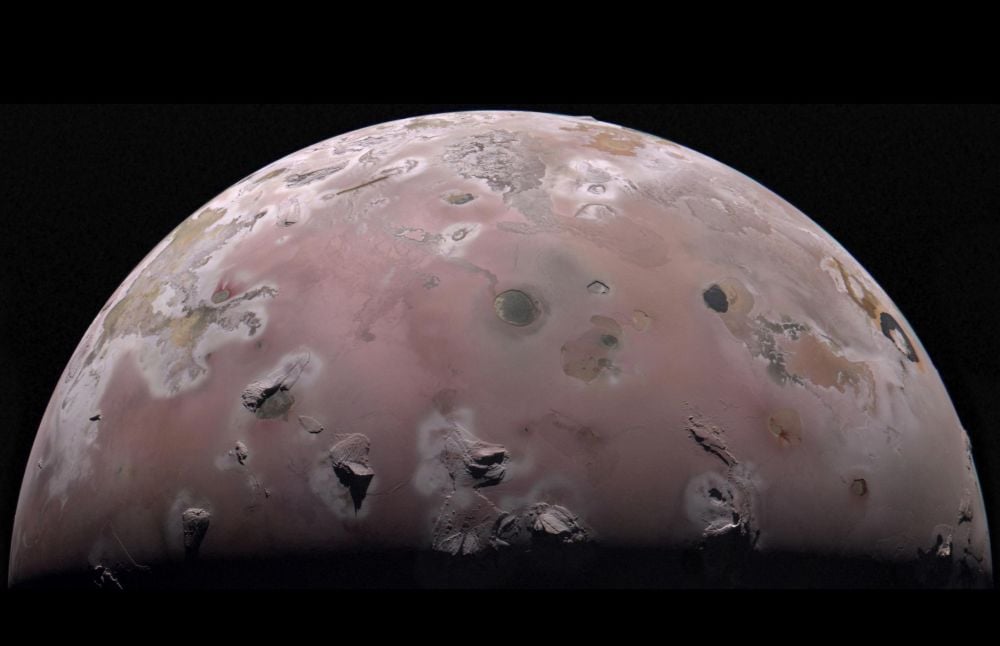
NASA’s Juno mission was designed to study Jupiter, but one of its instruments is now delivering a new look at one of the Solar System’s most extreme moons. During flybys of Io in December 2023 and February 2024, Juno used its Microwave Radiometer, or MWR, to measure heat several meters below the surface, according to the supplied source text.
That matters because Io is not just another rocky moon. It is the most volcanically active world known, with more than 400 volcanoes identified in the source material. Understanding how heat is stored and released beneath its surface can help scientists refine models of tidal heating, resurfacing, and volcanic behavior on a body that is constantly being flexed by Jupiter’s gravity and the gravitational pull of neighboring moons.
The new measurements are described in research published in Journal of Geophysical Research: Planets. The work is based on data gathered when Juno passed about 1,500 kilometers above Io’s surface. That is not as close as some historic flybys by NASA’s Galileo spacecraft, but Juno brought a different capability: the ability to sense temperatures below the visible surface layer rather than focusing only on infrared signals from the topmost skin.
Why subsurface heat matters on Io
Io’s geology is powered by tidal heating. As Jupiter’s gravity pulls on the moon and orbital interactions with Europa and Ganymede continue to stress it, Io’s interior is flexed again and again. That repeated deformation generates heat, which then drives intense volcanism and steady resurfacing.
Scientists have long known that Io is geologically restless, but subsurface temperature data can add something surface images and infrared maps cannot provide on their own. Heat a few meters down carries information about how energy is retained, how material properties vary from place to place, and how heat from deeper activity migrates upward.
The supplied source says Juno’s MWR could probe down to roughly six meters below the surface. That is shallow in planetary terms, but deep enough to reveal a thermal gradient. For a moon whose surface is repeatedly altered by eruptions, lava flows, and fallout from volcanic plumes, even that limited depth can help distinguish between short-lived surface effects and broader patterns in the underlying ground.
An atmospheric tool turned into a moon probe
The Microwave Radiometer was originally built for a very different job. Its primary mission was to probe deeply into Jupiter’s atmosphere. The source text says the instrument covers frequencies from 600 MHz to 22 GHz using six separate antennae, each tuned to a specific part of the microwave spectrum.
That design gave the Juno team an opportunity during the mission’s extended phase. If the radiometer could penetrate hundreds of miles into Jupiter’s cloud layers, researchers reasoned that it could also penetrate several meters into Io’s rocky surface. The extended mission turned that idea into a practical experiment.
This is one of the more interesting aspects of mature spacecraft operations: instruments built for one scientific problem can become unexpectedly useful elsewhere once engineers and scientists understand their limits well enough. In Juno’s case, a tool optimized for gas giant meteorology has become a way to investigate a volcanic moon’s near subsurface.
How Juno complements Galileo
NASA’s Galileo mission laid much of the groundwork for modern understanding of Io. According to the supplied source text, Galileo flew as low as about 100 kilometers above the surface and found extremely hot lava, active plumes, rapid resurfacing, and evidence for a differentiated metal core. Those observations established Io as a key laboratory for studying tidal heating and volcanic processes beyond Earth.
Juno does not replace that earlier work. It extends it in a different direction. The source material contrasts Galileo’s emphasis on surface infrared observations with Juno’s use of microwave measurements to peer below the surface. That distinction is important. Infrared is highly effective for identifying hot spots and mapping surface temperatures, but microwaves can sample material beneath the top layer, where heat may persist after the surface itself has cooled or been altered.
In other words, Juno is adding depth to the picture, even if only by a few meters. On a world where the boundary between surface and subsurface can be reshaped by repeated eruptions, that added depth can improve interpretations of where heat is concentrated and how volcanic terrain evolves over time.
What the new study could help answer
The source text does not provide the paper’s full quantitative conclusions, so any detailed interpretation beyond that would go beyond the evidence supplied here. Even so, the described measurements point to several scientific questions that this kind of dataset can help address.
- How unevenly heat is distributed beneath Io’s surface.
- Whether some regions retain warmth longer than surface observations alone would suggest.
- How strongly near-surface temperatures vary with local geology or volcanic history.
- Whether tidal heating signatures can be inferred indirectly through thermal patterns close to the surface.
Those questions matter because Io is often used as a benchmark for understanding geologic activity under extreme gravitational stress. Results from Io can inform not only models of other moons in the outer Solar System, but also broader ideas about how heat and internal energy shape planetary bodies over time.
A productive extended mission
There is also a programmatic lesson in this result. Juno entered the Jovian system in 2016 to study the planet itself, yet the mission’s extended phase has continued to produce valuable science on the Galilean moons. Io, Europa, and Ganymede are all scientifically compelling, but Io stands out because it is visibly active on a planetary scale.
Using existing hardware in new ways is often what makes extended missions so valuable. Spacecraft that survive their prime missions can become more than single-purpose probes. They turn into adaptable platforms for opportunistic science, especially when mission teams are willing to test instruments against targets they were never explicitly built to study.
That is the framework in which these Io measurements should be understood. Juno was not launched as a dedicated Io geophysics mission. Yet by rethinking what the Microwave Radiometer could do, researchers opened a new observational window onto a moon that remains one of the most dynamic objects in the Solar System.
Why Io still commands attention
Io’s value to planetary science is not only that it is spectacular. It is that it is active in ways scientists can measure almost in real time. Lava, plumes, and continual resurfacing make it a natural laboratory for the relationship between orbital mechanics, internal heating, and crustal change. Each new instrument perspective helps tighten that relationship.
Juno’s contribution, as described in the supplied material, is to move part of the conversation below the immediate surface. That does not reveal Io’s deep interior directly, but it does bridge a gap between visible surface behavior and the hidden thermal engine below. For a moon defined by relentless geological motion, even a few meters of added insight can be scientifically meaningful.
As the new research is absorbed, the broader significance may be less about one headline number than about method. A spacecraft built for Jupiter has shown that microwave sounding can help characterize the shallow subsurface of a volcanic moon. That expands the toolkit for interpreting Io today and for designing future observations of active worlds elsewhere in the Solar System.
This article is based on reporting by Universe Today. Read the original article.
Originally published on universetoday.com