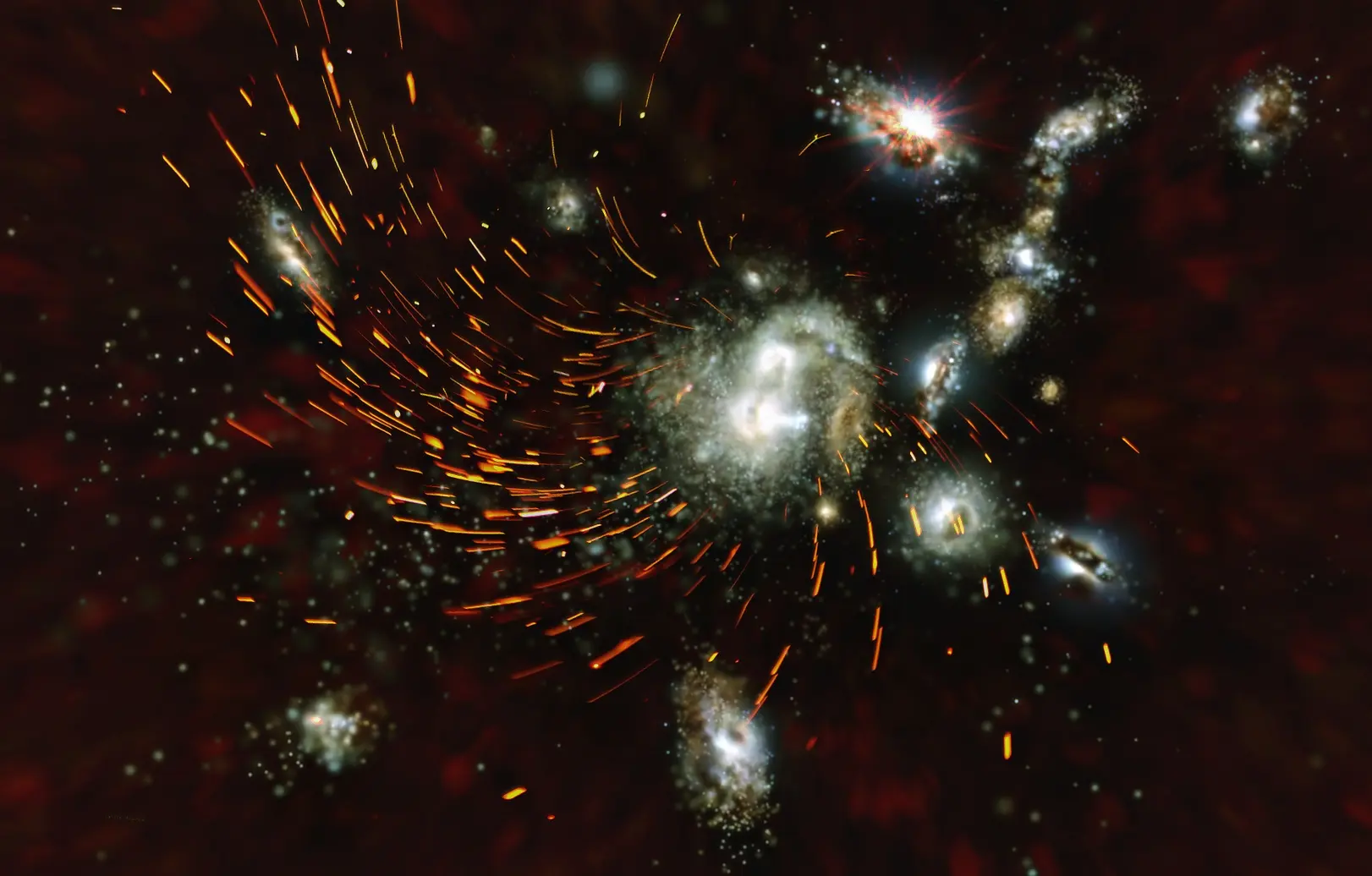
Galaxies That Shouldn't Exist
Since the James Webb Space Telescope began delivering its first deep-field observations, astronomers have been confronted with a persistent and unsettling puzzle: the early universe contains galaxies that are far too massive to fit standard cosmological models. New research is now offering potential explanations for how giant galaxies could have formed just 1.4 billion years after the Big Bang — a timeframe that was previously considered impossibly short for such large-scale structures to emerge.
According to the standard model of cosmology, galaxies form through a gradual process of hierarchical assembly. Small clumps of matter merge over billions of years to form progressively larger structures, with massive galaxies like our own Milky Way requiring many billions of years of mergers and accretion to reach their current size. A galaxy rivaling the Milky Way's mass existing less than 1.5 billion years after the Big Bang would be like finding a fully grown oak tree in a forest that was planted yesterday.
What the James Webb Telescope Revealed
The James Webb Space Telescope (JWST), launched in December 2021, was specifically designed to observe the most distant — and therefore oldest — objects in the universe. Its infrared cameras can detect light from galaxies that formed in the first few hundred million years of cosmic history, light that has been stretched to infrared wavelengths by the expansion of the universe over more than 13 billion years.
Within its first year of observations, JWST identified several candidate galaxies at extreme distances that appeared to contain far more stellar mass than expected. Subsequent observations with deeper exposures and spectroscopic confirmation have strengthened the case that these objects are genuinely massive and genuinely ancient, ruling out many of the alternative explanations that astronomers initially proposed.
The most recent analyses suggest that some of these early galaxies contain tens of billions of solar masses worth of stars — comparable to a substantial modern galaxy — at a time when the universe was barely a tenth of its current age. This represents a serious challenge to existing models of galaxy formation.

Proposed Explanations
Several mechanisms have been proposed to explain how such rapid galaxy formation could occur. One leading hypothesis involves unusually efficient star formation in the early universe. Standard models assume that only a small fraction of available gas is converted into stars at any given time, with the rest being heated and dispersed by stellar feedback processes like supernovae and radiation pressure. If the conditions in the early universe allowed for much higher star formation efficiency — perhaps due to higher gas densities or different feedback dynamics — then massive galaxies could have assembled faster than expected.
Another possibility involves the role of supermassive black holes. There is growing evidence that massive black holes existed very early in cosmic history, and these objects could have accelerated galaxy growth by drawing in enormous amounts of gas and triggering intense star formation in their host galaxies. The relationship between early supermassive black holes and their host galaxies is one of the most active areas of research in extragalactic astronomy.
A third explanation invokes modifications to the standard cosmological model itself. Some physicists have suggested that the abundance of massive early galaxies could be evidence for different dark matter properties or alternative models of cosmic expansion. While these proposals remain speculative, the tension between observations and theory is genuine enough to warrant serious investigation.
- JWST has identified galaxies with tens of billions of solar masses existing just 1.4 billion years after the Big Bang
- Standard hierarchical assembly models predict that such massive galaxies should take many billions of years to form
- Possible explanations include higher star formation efficiency, early supermassive black holes, or modifications to cosmological models
- Spectroscopic confirmation has ruled out many alternative explanations for the observations
Implications for Cosmology
The discovery of unexpectedly massive early galaxies has implications that extend well beyond the study of galaxy formation. If the standard model of cosmology cannot accommodate these observations, it could point to gaps in our understanding of fundamental physics — potentially involving the nature of dark matter, the behavior of dark energy, or the physics of the very early universe.
Cosmologists are generally cautious about declaring a crisis in the standard model based on a relatively small number of observations. Previous apparent tensions between JWST data and cosmological predictions have sometimes been resolved by more careful analysis of systematic uncertainties, such as the calibration of stellar mass estimates or the effects of dust obscuration.
However, the accumulation of evidence from multiple independent studies using different analysis techniques is making it increasingly difficult to dismiss the observations as artifacts. The scientific community is converging on the view that even if the standard cosmological model is not fundamentally wrong, it is at minimum incomplete in its description of how structure formed in the first billion years.
The Role of Next-Generation Observations
Resolving the puzzle of massive early galaxies will require both better observations and better theoretical models. On the observational side, ongoing JWST programs are building larger statistical samples of early galaxies, which will help distinguish between genuine anomalies and statistical flukes. Ground-based telescopes, including the upcoming Extremely Large Telescope in Chile, will provide complementary spectroscopic data.
On the theoretical side, astronomers are running increasingly sophisticated computer simulations of galaxy formation that incorporate more realistic physics. These simulations are beginning to explore whether tweaking assumptions about star formation efficiency, feedback processes, or the initial conditions of the universe can naturally produce the massive early galaxies that JWST has observed.
What began as a puzzling handful of observations has grown into one of the most compelling open questions in modern astronomy. The answer, when it comes, may reshape our understanding of how the cosmos assembled itself from the primordial darkness into the rich tapestry of galaxies we observe today.
This article is based on reporting by Universe Today. Read the original article.
Originally published on universetoday.com