A more violent picture of the infant universe
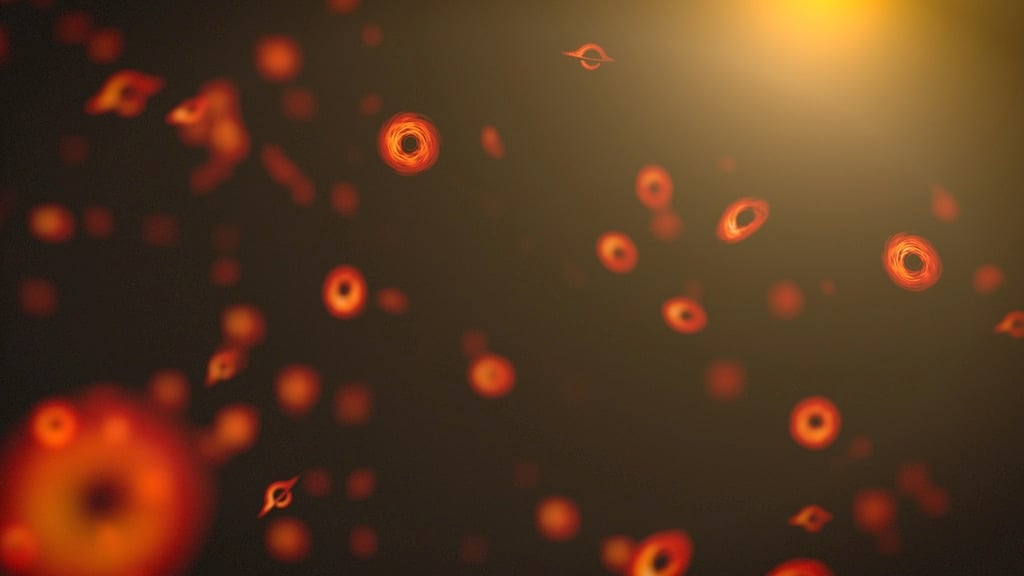
A new preprint from researchers at Vrije Universiteit Brussel and MIT suggests that low-mass primordial black holes may have died in a far more dramatic way than standard descriptions imply. Instead of simply leaking energy into the early universe’s plasma as steady hot spots, the study argues that evaporating primordial black holes could have created powerful pressure gradients and relativistic fireballs that launched shockwaves through the quark-gluon soup of the young cosmos.
As summarized by Universe Today, the work focuses on primordial black holes, hypothetical objects that may have formed in the first seconds after the Big Bang when exceptionally dense regions collapsed directly into black holes. These would differ sharply from the stellar-mass black holes produced by dying stars. In the new paper, the emphasis is on very small primordial black holes, the kind that, under Hawking radiation, would grow hotter as they lost mass and eventually evaporate completely.
That much follows familiar theoretical expectations. The novelty is in the proposed hydrodynamics of their final moments. According to the report, the authors modeled the plasma around a dying primordial black hole and found that the concentrated energy release could produce extreme pressure gradients. In fluid and plasma systems, such gradients can generate shockwaves. Here, that means a black hole’s death might have pushed outward as an expanding, relativistic fireball rather than a gentle diffusion of energy.
Why that would matter
The early universe was not empty space. It was an extremely dense and hot medium in which even small localized events could, in principle, have wider consequences. If primordial black hole evaporation did produce shockwaves, then these objects may have done more than add background heat. They may have physically reshaped surrounding plasma, altering conditions in ways that affected later cosmic development.
The article frames the hypothesis as potentially relevant to some of the biggest open questions in cosmology, including how matter came to dominate over antimatter. That is a striking implication, though at this stage it remains a theoretical proposal tied to a preprint rather than an established result. What the paper appears to offer is a mechanism by which primordial black holes could have had a more forceful and structured impact on the early universe than previously assumed.
That possibility is interesting because primordial black holes occupy an unusual place in modern cosmology. They are speculative, but not fringe. Researchers keep returning to them because they intersect with several unresolved puzzles, from dark matter to the physics of the early universe. A new way of modeling how they evaporate therefore has significance beyond one narrow calculation.

The boundaries of the claim
This is still a preprint, not a peer-reviewed observational confirmation. The article does not present direct evidence that primordial black holes existed or that they exploded in this way. It presents a theoretical scenario and argues that the standard picture of their death may be incomplete.
That distinction matters. Early-universe cosmology often works by exploring what different ingredients would do under extreme conditions and then asking what observable consequences might follow. The value of a paper like this is not that it settles the question, but that it opens a more detailed path for testing and debate.
If further work supports the shockwave scenario, researchers would then have to ask what signatures it might leave behind and whether existing cosmological data could constrain or support it. That is where speculative theory begins to become productive science.
What the preprint proposes
- Low-mass primordial black holes may have ended in explosive, shockwave-generating fireballs.
- The surrounding early-universe plasma may have responded dynamically, not just thermally.
- Those effects could have influenced broader cosmic evolution in ways standard models understate.
The appeal of the idea is that it adds texture to a period of cosmic history often described only in broad thermal terms. If the earliest universe included countless small black holes detonating into a dense plasma, then its evolution may have been shaped not just by smooth expansion, but by bursts, shocks, and local violence. That is a dramatic picture, but for now it remains a hypothesis waiting for deeper scrutiny.
This article is based on reporting by Universe Today. Read the original article.
Originally published on universetoday.com