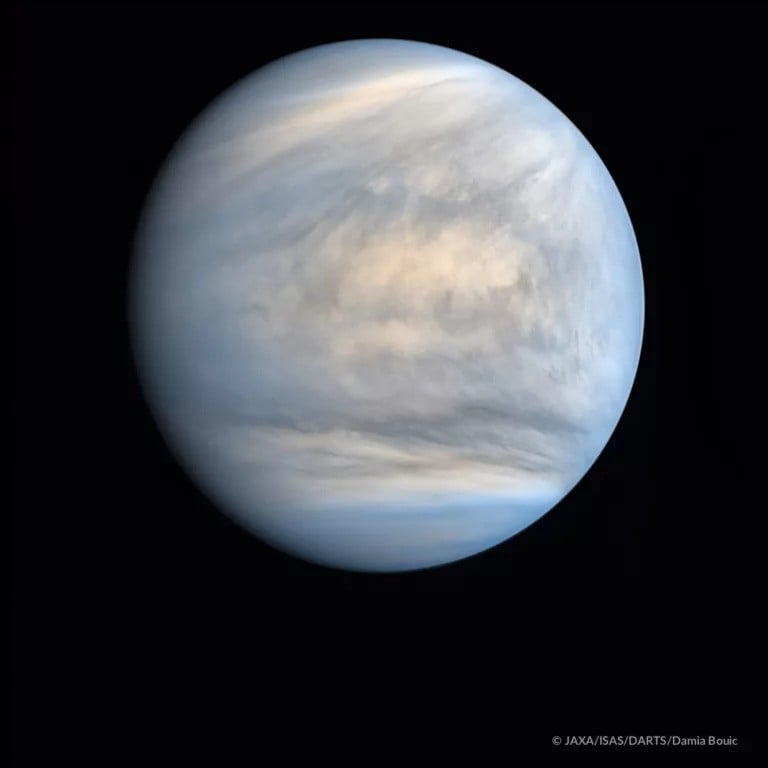
For decades, Venus has been the solar system's great tease. Seen from afar, it is a brilliant beacon; up close, its surface is a crushing, scorched underworld where lead would melt. Yet just above that hellish landscape, in the clouds of sulfuric acid that wrap the planet, conditions are more temperate—and perhaps more interesting to astrobiologists than the rocky surface below.
A new study, led by researchers at the Massachusetts Institute of Technology and published in the Proceedings of the National Academy of Sciences, suggests that the chemistry of life—at least the kind that could underpin biology—may be more durable than previously thought.
A World in Two Parts
Venus is often compared to Titan, Saturn's largest moon, because both are hidden beneath thick atmospheres that optical telescopes cannot penetrate. Radar is required to map what lies below. But unlike Titan's bland haze, Venus's atmosphere presents a dramatic, swirling spectacle. On the surface, the reality is far from pleasant: searing temperatures and crushing pressures make the planet among the most hostile places in the solar system.
The atmosphere is another story. At certain altitudes, temperatures and pressures approach Earth-like values, making the clouds a tempting potential refuge for microbial life. The question has always been whether biochemistry could operate in a cloud made of concentrated sulfuric acid rather than liquid water. Many astrobiologists have assumed that water is the essential solvent for life. The new study challenges that assumption.
Peptides: The Building Blocks of Life
Proteins are indispensable to life as we know it. But before a protein can function as an enzyme or structural component, its chain of amino acids must fold into a very specific three-dimensional shape. Fail to fold correctly, and a protein often becomes useless or even harmful.
Peptides, short chains of amino acids, are the simpler precursors to full proteins. Studying how peptides behave in Venus-like environments gives researchers a direct way to ask whether the chemistry needed for biology could survive conditions that would appear hostile to life on Earth.
Dr. Sara Seager, a professor of planetary science at MIT and co-author of the study, explains the significance of folding. “Life needs to have specially shaped proteins so that they have a specific target they can latch onto and perform their function,” she said.
If small peptides can remain intact and fold properly in sulfuric acid, then the core chemistry of life might be possible in places far beyond Earth's Goldilocks zone.
Testing the Chemistry of Venus's Clouds
To investigate, the research team designed a series of laboratory experiments using nuclear magnetic resonance spectroscopy. NMR spectroscopy allows scientists to observe the molecular structure and physical arrangement of chemical compounds in detail. The technique requires careful sample preparation, especially when working with a solvent as corrosive as 98 percent sulfuric acid.
The researchers put three different peptides into conditions meant to mimic Venus's clouds, where sulfuric acid is nearly pure and water is almost entirely absent. Previous thinking held that such an environment should break peptide bonds, destroying the chains before they could do anything biologically relevant.
The results defied that expectation. The team successfully observed all three peptides forming folded structures, and those structures remained stable for several weeks. The environment did not destroy them. Instead, the peptides seemed to adapt to an environment with no water, remaining intact long enough to function.
The team attributes this behavior to that very lack of water. On Earth, water is ubiquitous and generally supports life, but it is also a molecule that can attack and break peptide bonds, a process known as hydrolysis. In the concentrated sulfuric acid of Venus's upper atmosphere, water is almost completely unavailable. Without water to drive hydrolysis, the chemical bonds in these peptides stayed stable, allowing the chains to fold.

What This Means for the Search for Life
The study has implications far beyond Venus. Astrobiology has historically favored planets and moons where liquid water is present or likely. That search framework has guided missions to Mars, the icy moons of Jupiter and Saturn, and exoplanets orbiting in the habitable zones of their stars.
But the new findings suggest that non-Earth-like environments—those that are far more acidic than anything ecosystems on Earth can tolerate—might be just as viable for supporting the molecular machinery of life. As the study notes, planets with conditions that seem extreme by Earth standards could host life using solvents other than water, or at least life that can tolerate concentrated acids.
The Venusian clouds are not a gentle environment. Sulfuric acid is not something any known organism can ingest in significant quantities, although some microbes on Earth thrive in acidic environments, such as those found in volcanic hot springs or acid mine drainage. However, those environments are still water-based. The crucial difference on Venus is that the clouds are not merely acidic; they are desiccatingly acidic, with almost no water available.
That makes the peptide stability observed here all the more remarkable. It points to a chemical landscape where complex organic molecules can survive for weeks, perhaps long enough to participate in reactions that could support primitive biology.
Why This Study Matters
The work doesn't prove that life exists on Venus. It does something arguably more important: it broadens the set of places we should consider in the search for life. If the fundamental chemistry of life can survive in sulfuric acid, then habitability is not a simple question of temperature and presence of liquid water.
Future missions to Venus—such as proposed balloon-borne probes—could sample the cloud layers directly, searching for organic molecules and perhaps signs of biological processing. The MIT study gives these missions a stronger scientific rationale, because it shows the most basic biological building blocks might survive in that environment.
Peptides are just one component of life. Still, they are essential to the machinery of all known organisms. The ability of peptides to form stable structures in sulfuric acid suggests that at least some of the required molecular toolkit can operate under Venusian cloud conditions.
Of course, survival in a laboratory setting is not the same as originating in the wild. Venus's clouds may have existed for hundreds of millions of years, giving ample time for chemical evolution to occur if any stable compounds formed. But we do not yet know whether the planet's harsh environment and atmospheric circulation would allow molecules to persist long enough to assemble life.

The Road Ahead
The new PNAS study is the latest reminder that Venus should not be written off as a dead world just because its surface is hellish. The planet's clouds may be one of the most accessible places in the solar system to test whether terrestrial biochemistry is the only possible blueprint for life or merely one of many.
Especially intriguing is the role of water. The researchers highlight that the absence of water helps peptides stay stable, suggesting that water—the solvent of life on Earth—may not be a prerequisite for some key steps of life. Future work should explore the interaction of other biological molecules with sulfuric acid, as well as the chemical pathways that could produce peptides in the first place.
The implications are profound. If life can be built on molecules that fold and function in concentrated sulfuric acid, then the “habitable zone” concept—the narrow region around a star where liquid water can persist on a planet's surface—may be far too restrictive.
Instead of asking where water flows, we may need to ask where chemistry can remain stable and complex. Venus, exasperating as it is, may turn out to be one of the best natural laboratories for studying that possibility.
This article is based on reporting by Universe Today. Read the original article.
Originally published on universetoday.com