A Long-Awaited Arrival
BepiColombo, the European Space Agency's nearly $2 billion robotic mission to Mercury, is finally in the final stretch of a journey that began in 2018. After eight years of steady thrusting and a carefully choreographed set of planetary flybys, the spacecraft is now just months away from the moment mission planners have been working toward since the beginning: being captured into orbit around the Solar System's innermost planet.
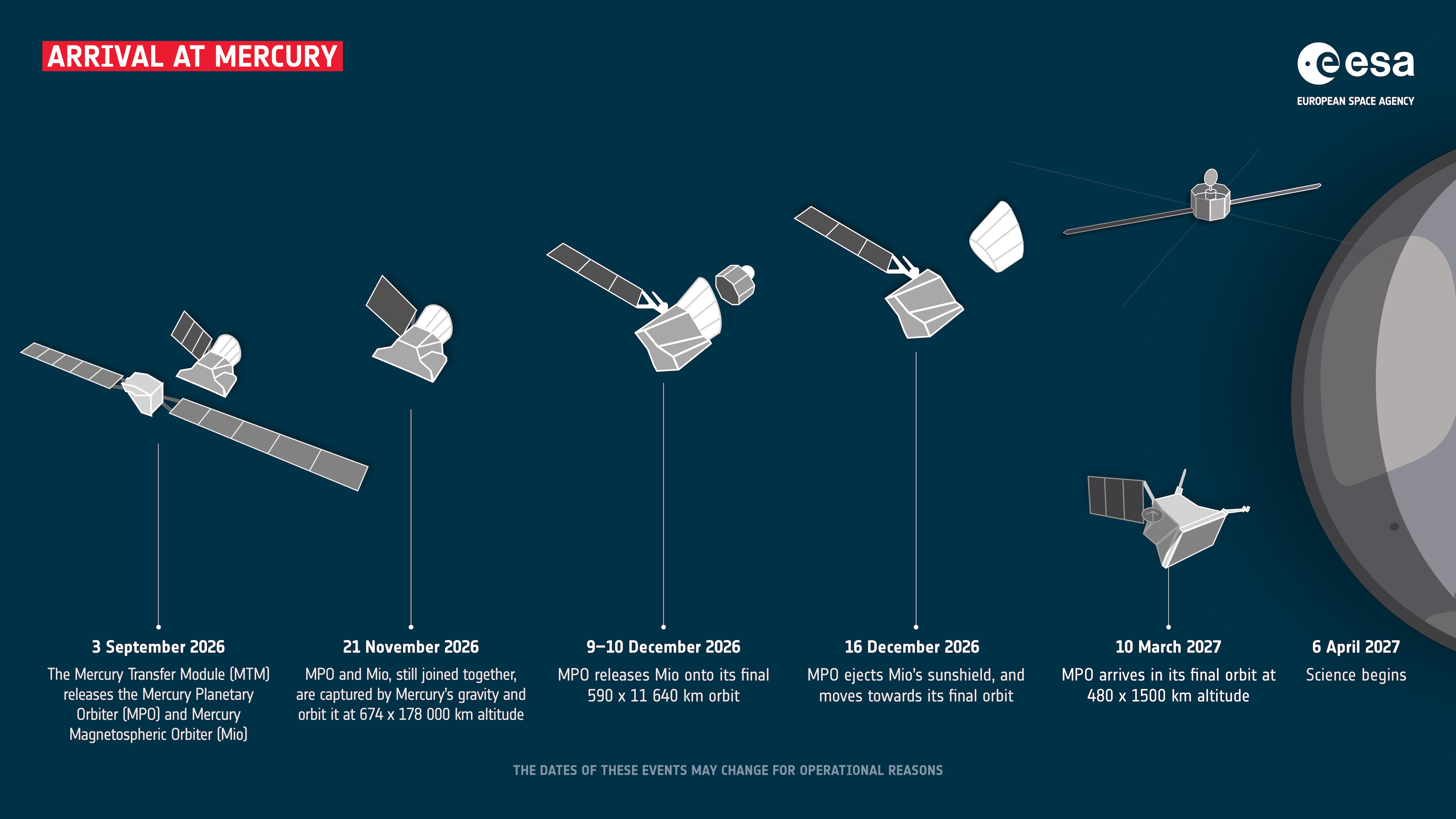
This week, the mission cleared an important milestone by discarding the large section that carried its ion thrusters. That hardware, known as the Mercury Transfer Module, powered the spacecraft through most of its long cruise. With the module now gone, the remaining science stack is ready for the final gravitational capture maneuver later this year.
Why Mercury Is So Hard to Reach
For planetary scientists, Mercury presents a unique and somewhat counterintuitive challenge. Although it is the closest planet to the Sun, a spacecraft launched from Earth cannot simply fall inward and expect to arrive. Reaching Mercury requires shedding a tremendous amount of orbital energy. In fact, the mission required more energy, or delta-v, than a flyby of Pluto, which is why NASA's New Horizons reached the distant dwarf planet in under a decade while BepiColombo has needed a more elaborate route.
To slow itself enough to enter a stable path around Mercury, BepiColombo relied on an unprecedented nine gravity assists. These carefully planned swing-bys used the gravitational pull of Earth, Venus, and Mercury itself to bend the spacecraft's trajectory and bleed off excess energy. Each encounter nudged the probe closer to the Sun and aligned it for the next stage of its spiral.
The mission also launched with the most powerful electric propulsion system ever used in deep space. Four gridded ion thrusters fired almost continuously during the cruise, providing a gentle but relentless push that reshaped the spacecraft's orbit over time. Between planetary flybys, this low-thrust plasma system allowed controllers to fine-tune the trajectory more efficiently than chemical rockets would have allowed.

A Three-in-One Spacecraft
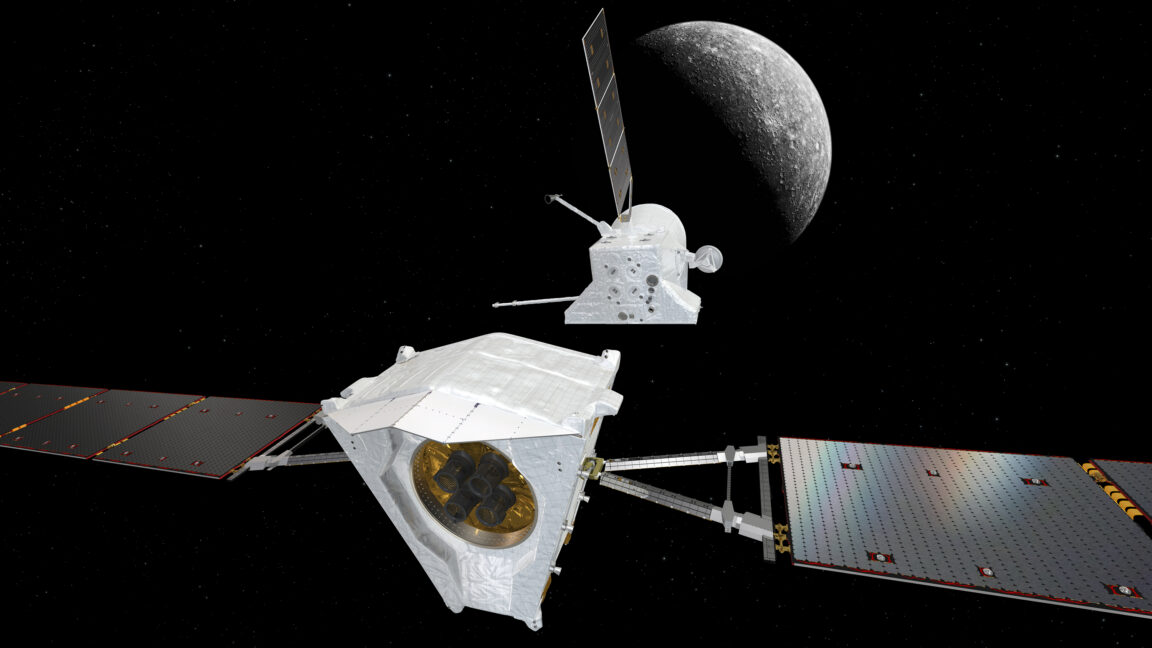
BepiColombo is unusual in that it was built as a stack of three distinct spacecraft. The largest piece, the Mercury Transfer Module, handled propulsion and power during the journey. Behind it rode two science orbiters designed to study Mercury from complementary perspectives once in orbit. The mission reflects an international partnership: ESA led the project, with significant contributions from Japan and the United States.
The dual-orbiter architecture is central to the science goals, which focus on understanding Mercury's origins and its unusual composition. Scientists want to know how the planet formed so close to the Sun and how it evolved into the hot, dense, iron-rich world seen today. As one mission scientist put it, looking at Mercury means learning about the origins of a planet and how it came to be the way it is.
Mercury has long been one of the least explored planets. Its proximity to the Sun makes observations from Earth difficult, and the intense heat and radiation environment around the planet challenges any spacecraft that gets too close. By placing two orbiters in complementary paths, BepiColombo aims to piece together a fuller picture of Mercury's surface, interior, and magnetic environment.
Shedding the Propulsion Module
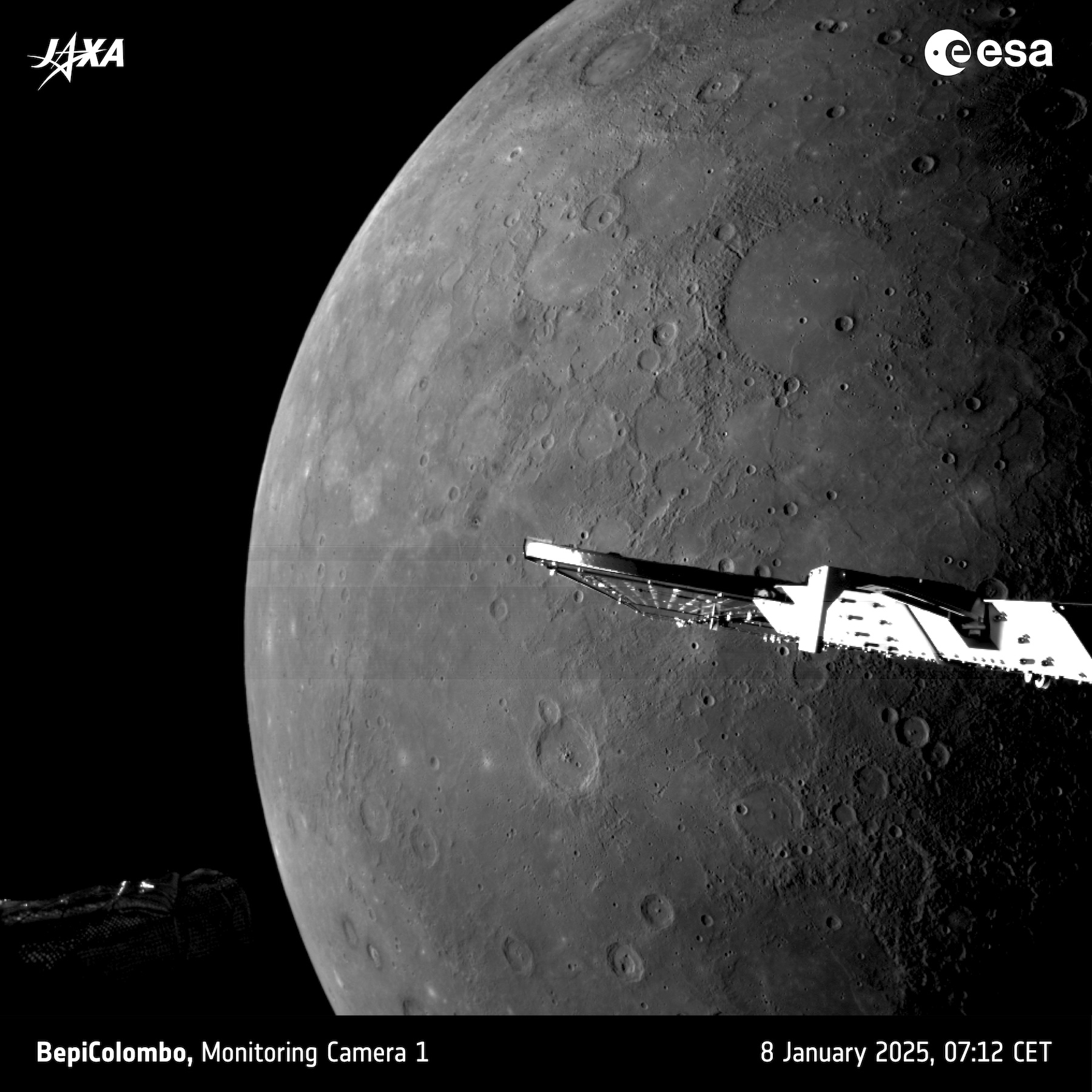
Thursday's separation of the Mercury Transfer Module was a dramatic step toward that goal. The module had served its purpose and would have been a liability during the final approach. Carrying it into orbit would add mass, complicate maneuvers, and potentially interfere with the sensitive science instruments. With the propulsion module gone, BepiColombo now consists only of the elements needed for the science mission.
The separation also marked a symbolic transition. For eight years, the spacecraft traveled as a complete, self-propelled stack. Now it is no longer a cruise vehicle but a pair of planetary science probes carrying their own smaller propulsion systems for final orbital adjustments.
What Happens Next
The next major event comes in November, when BepiColombo will encounter Mercury for what should be its final time. At that point, the spacecraft's velocity will be exactly right for Mercury's gravity to capture it into orbit. This will be a high-stakes maneuver, performed automatically by the spacecraft's onboard systems because the distance to Earth makes real-time commands impractical.
Once safely in orbit, BepiColombo will begin its primary scientific investigation. Its instruments will map the planet's surface, measure its magnetic field, probe its internal structure, and study its tenuous exosphere. The data are expected to help answer fundamental questions about the formation and evolution of rocky planets, both in our Solar System and around other stars.
For the engineers and scientists involved, the moment has been a long time coming. Interplanetary missions require patience; New Horizons needed almost ten years to reach Pluto, and BepiColombo's path has been even less direct. But the payout, as mission planners see it, will be worth the wait.
BepiColombo's final approach demonstrates just how complex modern planetary exploration has become. The mission combined solar-electric propulsion, repeated gravity assists, and a multinational team of designers, operators, and scientists to reach a world that remains stubbornly difficult to visit. When the spacecraft finally slips into orbit, it will become only the second mission ever to do so, after NASA's MESSENGER probe.
With the hard part of the cruise now behind it, BepiColombo is poised to deliver the most comprehensive view yet of the Solar System's most enigmatic planet.
This article is based on reporting by Ars Technica. Read the original article.

Originally published on arstechnica.com