A historic handoff in lunar communications
Artemis II is not only a major crewed mission to the Moon. It is also a milestone for the infrastructure that will keep astronauts connected once they leave near-Earth communications behind. According to NASA’s supplied mission note, the agency’s Deep Space Network, or DSN, acquired Artemis II’s signal after launch, marking the first time in more than 50 years that the network has communicated with a crewed spacecraft traveling through deep space.
That statement alone places the event in historic context. Crewed lunar exploration has always depended on far more than rockets and spacecraft. It also depends on the ability to track, command, and receive data from vehicles operating at distances that make routine communications far more complex than low-Earth orbit missions.
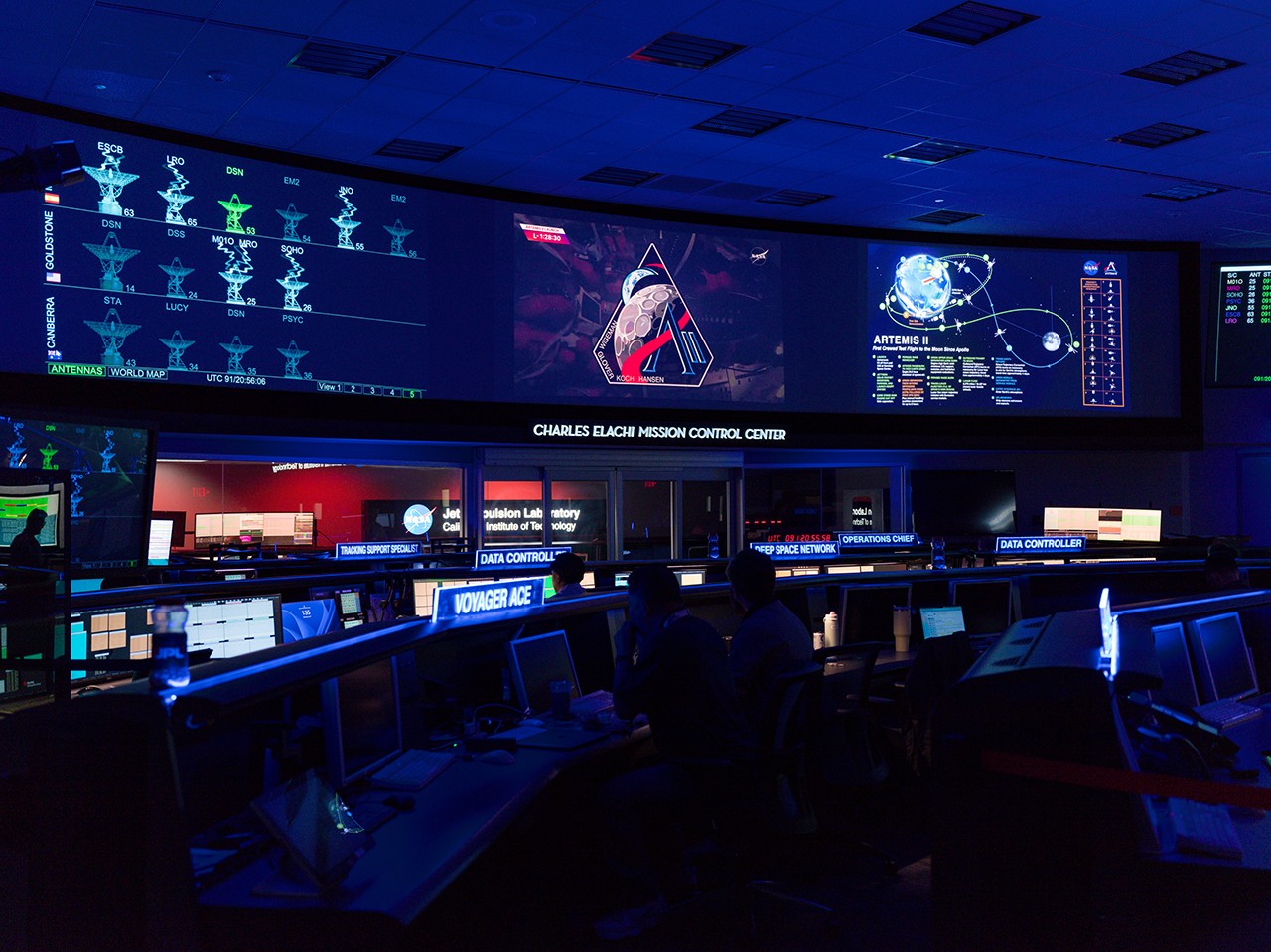
The image NASA released from the Space Flight Operations Facility at Jet Propulsion Laboratory captures that systems view. In the center screen sits the Artemis II mission patch, while the graphical display around it tracks which antennas are actively sending and receiving data. It is a reminder that modern exploration is sustained by an invisible but global network of ground assets.
From launch support to deep-space communications
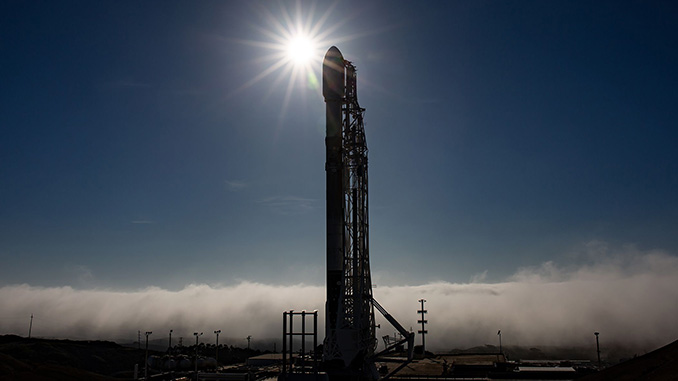
NASA says Artemis II launched at 6:35 p.m. EDT from Kennedy Space Center in Florida. Initial communications were handled by the agency’s Near Space Network, which is designed for missions operating closer to Earth. Shortly after liftoff, however, the Deep Space Network acquired the signal.
That transition is operationally important. It reflects the point at which Artemis II moved from the communications regime suited to near-Earth missions into the one used for spacecraft traveling much farther away. Deep-space missions require high-gain, highly reliable links capable of maintaining contact over immense distances and under demanding mission conditions.
The handoff also symbolizes the broader architecture NASA is rebuilding around lunar exploration. Artemis is not just a one-off mission series. It is an attempt to restore a durable human deep-space capability, and that means proving the supporting ground systems can handle crewed operations again.

Why the Deep Space Network matters
The DSN is one of NASA’s most important but least publicly visible assets. Managed by JPL for NASA’s Space Communications and Navigation program, it consists of three major complexes in Goldstone, California; Madrid, Spain; and Canberra, Australia. Each site hosts multiple radio-frequency antennas used to communicate with spacecraft across the solar system.
The reason for the three-site structure is straightforward: Earth rotates. By spacing the complexes roughly around the globe, NASA can maintain near-continuous coverage as one station rotates out of view and another rotates in. That is vital for missions that cannot afford prolonged communication gaps.
NASA’s supplied description emphasizes the DSN’s core functions: tracking spacecraft, sending commands, and receiving scientific data. Those roles apply across robotic exploration, but Artemis II adds a new dimension. Human missions raise the stakes for communication reliability, because the network is no longer supporting only instruments and automation. It is supporting a crew.
A return to crewed deep-space operations
The historical note in NASA’s description is striking: this is the first time in over 50 years that the Deep Space Network has communicated with a crewed spacecraft traveling through deep space. That makes Artemis II a bridge between the Apollo era and a new generation of human exploration.
The half-century gap matters because it reflects how long crewed deep-space infrastructure has been dormant. In the intervening decades, NASA and partner agencies mastered long-duration operations in low-Earth orbit and built extensive robotic deep-space programs. But crewed missions beyond that domain remained absent. Artemis II changes that operational reality.
Reactivating those capabilities is not just symbolic nostalgia. It means validating procedures, staffing, mission control interfaces, communications timing, and coordination among networks that have not supported a crewed lunar mission in modern times. Even when the core hardware has matured through robotic support, the human mission layer introduces different requirements.
The role of JPL’s Space Flight Operations Facility
The image cited in the source was captured at NASA’s Jet Propulsion Laboratory in Southern California, inside the Space Flight Operations Facility that operates the DSN. JPL is best known to the public for robotic missions, from Mars rovers to outer-planet exploration, but Artemis II highlights its continuing importance in crewed exploration infrastructure as well.
The facility’s role is not ceremonial. It is where the global communications backbone is monitored and managed. During a major mission, displays showing active antennas and network status become part of the operational heartbeat of the flight.
That view also reinforces a point often lost in public coverage of launch events: missions do not begin and end at the pad. Once the rocket leaves Earth, success depends on the synchronized work of tracking stations, mission controllers, communications engineers, and data systems spread around the world.
Why this matters for the broader Artemis program
Artemis II is a crewed mission, but it is also an end-to-end systems test for the future of lunar exploration. NASA is rebuilding not just launch capability but an entire ecosystem for travel beyond low-Earth orbit. Communications are central to that effort because they link astronauts, spacecraft, mission control, and scientific operations into a single functioning architecture.
If Artemis is meant to support repeated missions and eventually more ambitious operations around and on the Moon, then the DSN’s performance becomes strategically important. The network already supports dozens of robotic spacecraft. Adding crewed lunar operations increases both complexity and consequence.
NASA’s account does not describe problems or anomalies; instead, it presents the DSN acquisition as a milestone. That framing suggests the transition was expected and operationally meaningful, underscoring the readiness of the agency’s ground segment for the demands of deep-space human flight.
The quiet infrastructure behind exploration headlines
Public attention around space missions tends to focus on vehicles, astronauts, and dramatic visuals. Artemis II certainly delivers those. But the supplied NASA material points to a more technical achievement: the successful integration of a crewed lunar mission into the Deep Space Network’s global communications framework.
That is the sort of milestone that may not dominate headlines, yet it is essential to the future of crewed exploration. Without dependable long-range communications, there is no sustainable path to operating beyond Earth orbit.
In that sense, the Artemis II signal acquisition is more than a procedural handoff. It is evidence that a dormant capability has come back to life. After more than half a century, NASA’s deep-space communications network is once again talking to humans on their way into deep space.
This article is based on reporting by science.nasa.gov. Read the original article.
Originally published on science.nasa.gov