The Moon is still being remade
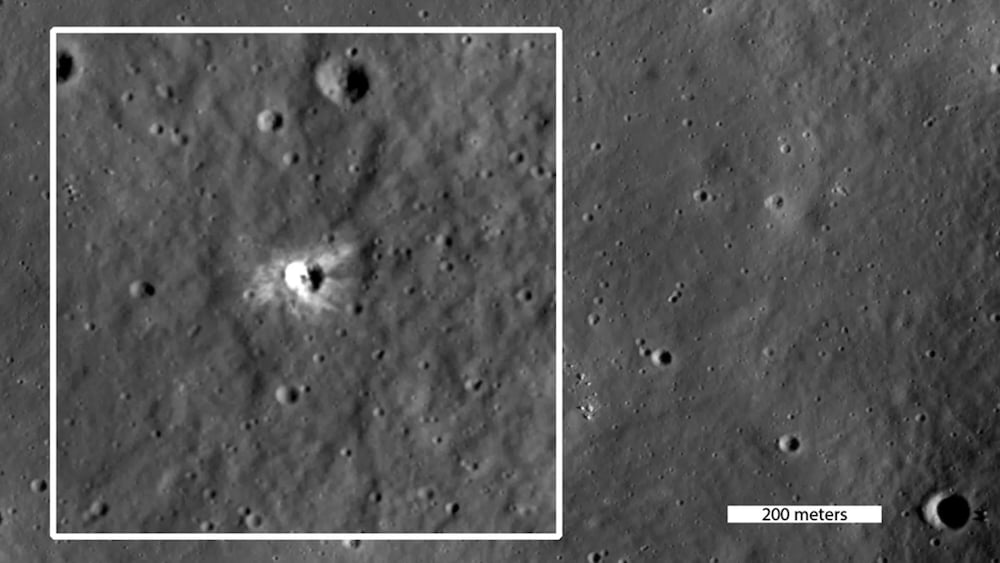
The Moon often looks static from Earth, a familiar surface of bright highlands and dark plains apparently frozen in time. In reality, it remains an active target in the Solar System’s shooting gallery. According to a report from Universe Today, NASA’s Lunar Reconnaissance Orbiter Camera team has identified a newly formed crater 225 meters across, created in late spring 2024 when a space rock slammed into the lunar surface at high speed. The discovery provides an unusually clear before-and-after record of a substantial modern impact.
That alone makes the crater notable. The Moon preserves impacts far better than Earth because it lacks the weather, flowing water, and active geology that erase many scars on our own planet. Fresh craters are still formed constantly, but catching a larger one soon after it appears is rare. In this case, scientists were able to compare images from before and after the event, allowing them to study the crater’s size, depth, ejecta pattern, and interior materials in remarkable detail.
A much larger event than previous new finds
The new crater stands out not just because it is fresh, but because it is large by the standards of modern observations. Universe Today reports that, before this find, the largest crater discovered to have formed during the entire Lunar Reconnaissance Orbiter mission was only 70 meters across. The newly identified crater, at 225 meters wide, is more than three times that diameter.
That scale matters scientifically. Models cited in the article suggest an impact of this size should happen only once every 139 years on any given patch of lunar ground. The implication is not that the Moon rarely gets hit, but that recording a crater of this size so soon after it formed is unusually fortunate. Orbital imaging has created a rare opportunity to move beyond theory and inspect the aftermath in detail.
Fresh impact studies can improve understanding of how often space rocks strike the Moon today, how debris spreads across the surface, and how impact energy reshapes local terrain. Because the Moon is such a clean recorder of collisions, every new crater is effectively a natural experiment in planetary geology.

What the impact left behind
The crater itself is described as funnel-shaped and about 43 meters deep. Its slopes are steep enough that, as the article notes, standing on them would be difficult. Around the rim lies a field of ejected blocks, with the largest measuring about 13 meters across. Those boulders are direct evidence of how violently the surface was excavated during the collision.
Beyond the crater’s basic dimensions, the ejecta pattern offers clues to the trajectory of the impactor. The debris appears to have been sprayed northward in a tongue-shaped pattern, leading researchers to infer that the incoming rock likely arrived from the south-southwest. This kind of directional reconstruction is valuable because it lets scientists read impact geometry from the shape of the scar itself.
The team also identified unusually dark material inside the crater. Universe Today says this is almost certainly glassy rock produced when the impact flash-melted lunar material and it then quickly solidified. That detail is especially important because it captures the enormous energy released in even a relatively small planetary collision. What looks like a simple hole in the ground is actually the product of intense pressure and heat acting in an instant.
Why lunar impacts still matter
The fresh crater is a reminder that the Moon is not just a museum of ancient impacts. It is being hit now, and has been continuously. Space rocks of many sizes strike its exposed surface every day. On Earth, atmospheric shielding burns up many smaller objects before they reach the ground, and erosion obscures many traces of those that do. On the Moon, there is no such protection and almost no cleanup process. What hits the surface stays visible.
That makes the Moon an unusually valuable laboratory for impact science. Craters preserve a running record of Solar System debris and collision processes. Studying new ones helps researchers calibrate models of impact frequency and crater formation. It also sharpens interpretations of older lunar terrain, where overlapping craters record billions of years of bombardment history.
There is also a practical angle. As space agencies and companies become more serious about lunar activity, understanding the modern impact environment becomes more relevant. Fresh crater detections can inform hazard assessments and refine expectations for how often the surface is disturbed by incoming objects. The article does not extend into engineering implications, but the scientific value of documenting active bombardment is clear.
The role of long-term orbital observation
This discovery also highlights the importance of sustained monitoring missions. The Lunar Reconnaissance Orbiter has been in lunar orbit long enough to give scientists a temporal record, not just a map. That is what made the find possible. By comparing earlier images with later ones, the team could identify a new feature, confirm that it formed during the mission era, and analyze changes in surrounding terrain.
Long-running observation programs often deliver their biggest value not through one spectacular snapshot, but through comparison over time. The Moon’s newest scar is an example of that. Without repeated imaging, the crater would still exist, but its formation window, freshness, and diagnostic features would be harder to interpret. With repeated coverage, researchers can treat the impact almost like a witnessed event.
The result is one of the clearest recent examples of the Moon’s ongoing evolution. Even a world often described as geologically dead is still being altered in visible ways by the environment around it. The surface may not have wind or rain, but it is far from untouched.
What scientists can learn from this crater
- How a relatively large modern lunar impact distributes debris around the impact site.
- How crater shape, depth, and ejecta direction reveal the angle and approach path of the incoming object.
- How impact melt and dark glassy material form during high-energy collisions.
- How current crater formation rates compare with long-term impact models.
For planetary scientists, the new crater is more than a dramatic mark on the Moon. It is a timestamped event, preserved in sharp detail on a world that keeps its scars. That combination makes it an unusually rich piece of evidence in the continuing effort to understand how impacts shape planetary surfaces across the Solar System.
This article is based on reporting by Universe Today. Read the original article.
Originally published on universetoday.com