A Discovery That Challenges the Timeline of the Cosmos
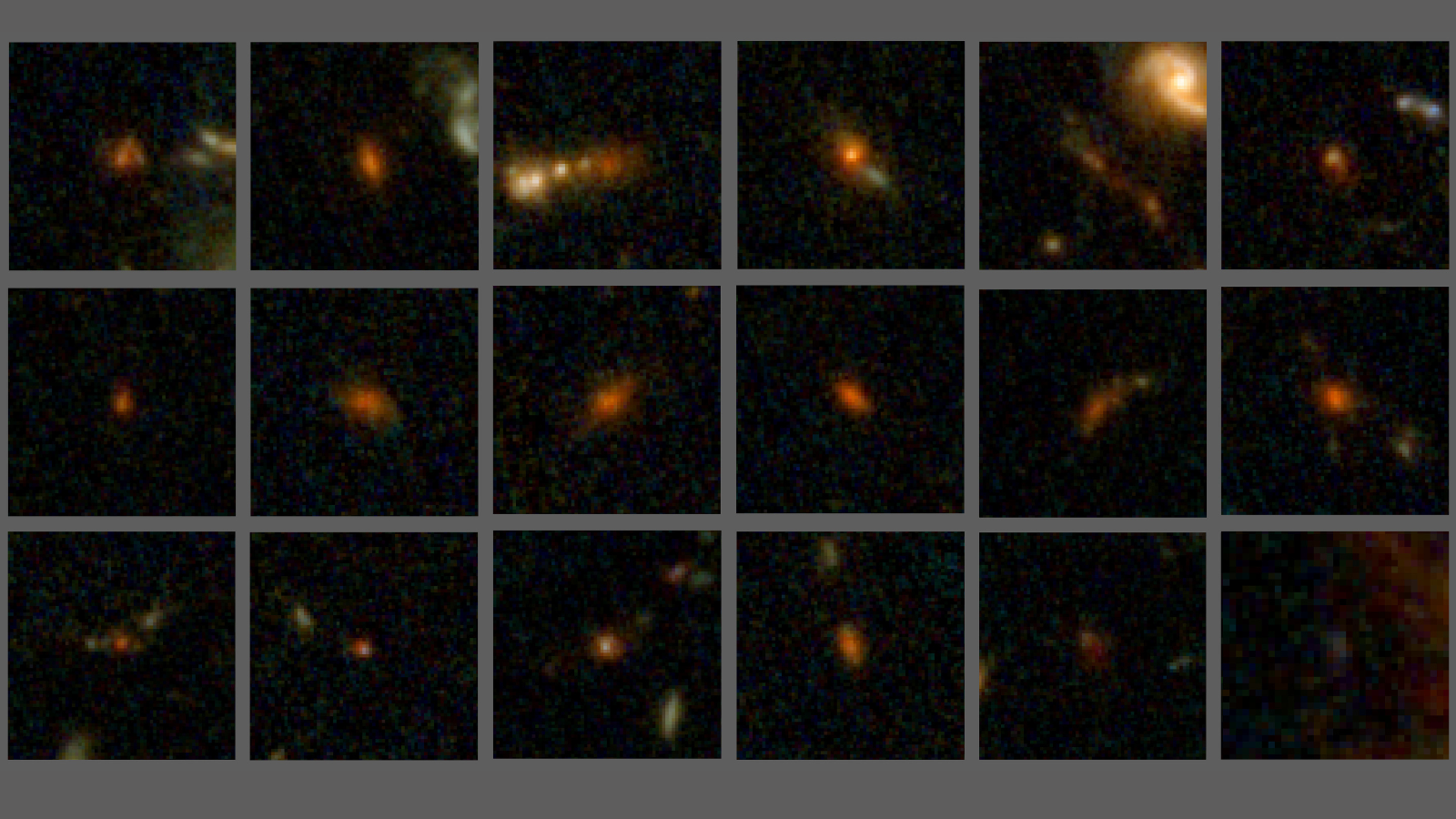
An international team of forty-eight astronomers from fourteen countries has unveiled a discovery that could reshape our understanding of how the universe assembled itself in its earliest epochs. Using observations from NASA's James Webb Space Telescope combined with data from the Atacama Large Millimeter/submillimeter Array in Chile, the researchers have identified approximately seventy dusty, star-forming galaxies at the very edge of the observable universe, most of which had never been detected before.
These galaxies are not merely old. They appear to have been actively forming stars during the first billion years after the Big Bang, a period when the universe was less than seven percent of its current age. Their existence, and particularly their dusty, metal-enriched nature, suggests that the processes of stellar birth and death were already well underway at a time when current theoretical models predict the cosmos should have been far more primitive.
The research, published in The Astrophysical Journal Letters on February 20, 2026, was led by the University of Massachusetts Amherst and represents one of the most significant observational challenges to the standard model of galaxy formation in recent years.
How JWST and ALMA Joined Forces
The discovery was made possible by combining the complementary strengths of two of the most powerful astronomical instruments ever built. ALMA, a network of sixty-six radio antennas spread across the Atacama Desert at an altitude of five thousand meters, excels at detecting the cold dust and gas that pervade star-forming galaxies. JWST, orbiting the sun at the second Lagrange point 1.5 million kilometers from Earth, provides unmatched sensitivity in near-infrared wavelengths, revealing the light of ancient stars that has been stretched by the expansion of the universe.
The research team began by using ALMA to identify a broader population of roughly four hundred bright, dusty galaxies. From this sample, they turned to JWST's near-infrared instruments to pinpoint approximately seventy faint candidates that appeared to lie at extreme distances. The team then returned to the ALMA data and employed a technique called stacking, combining multiple faint observations to build up a statistically significant signal that confirmed these objects are indeed dusty galaxies formed nearly thirteen billion years ago.
This iterative approach, bouncing between two telescopes operating in different wavelength regimes, exemplifies the kind of multi-facility science that is increasingly driving the most impactful discoveries in modern astronomy.

Why Dust Matters So Much
To a casual observer, dust might seem like an unremarkable feature of a galaxy. In astrophysics, however, dust is profoundly informative. Cosmic dust is composed of heavy elements, metals in astronomical parlance, that can only be produced inside stars through nuclear fusion and then dispersed into the surrounding gas when those stars die in supernova explosions.
The presence of significant dust in galaxies from the universe's first billion years carries a startling implication. It means that multiple generations of stars must have already been born, lived their lives, and died by that point. Stars massive enough to produce heavy elements and end in supernovae typically live for only a few million years, but the entire cycle of stellar birth, enrichment, and dust production still requires substantial time, particularly when repeated over several generations.
Current models of galaxy formation generally predict that this level of chemical enrichment should not have occurred so early. The standard picture envisions the first galaxies as relatively pristine collections of hydrogen and helium, gradually accumulating metals over billions of years. Finding seventy galaxies that had already completed multiple cycles of stellar evolution within the first billion years challenges this orderly timeline.
The Missing Link in Galaxy Evolution
The research team believes these dusty galaxies may represent a critical missing link in the story of galaxy evolution. In recent years, JWST has discovered two seemingly contradictory populations of early galaxies. One group consists of ultraviolet-bright galaxies that appear surprisingly luminous and massive for their young age, detected as far back as 13.3 billion years ago. The other comprises early quiescent galaxies, so-called dead galaxies that had already stopped forming stars roughly two billion years after the Big Bang.
The gap between these two populations has puzzled astronomers. How did bright, actively star-forming galaxies transition to dead, quiescent ones? The newly discovered dusty galaxies may fill this gap. Their heavy dust content would obscure their ultraviolet light, making them invisible to surveys focused on ultraviolet-bright objects, while their ongoing star formation distinguishes them from the quiescent population.
If this interpretation is correct, the evolutionary sequence would run from ultraviolet-bright galaxies to dusty star-forming galaxies to quiescent dead galaxies, with the dusty phase representing an intermediate stage during which intense star formation gradually exhausts the available gas supply while simultaneously producing the heavy elements that will persist long after the fires of stellar birth have gone out.
Implications for Cosmological Models
The discovery has implications that extend well beyond galaxy evolution. The standard Lambda Cold Dark Matter model, which describes the large-scale structure and evolution of the universe, makes specific predictions about how quickly matter should collapse into galaxies and how rapidly those galaxies should grow. An overabundance of massive, evolved galaxies in the early universe could indicate that the model's parameters need adjustment, or that fundamental physical processes operated differently in the young cosmos.
Several possible explanations are being explored. One is that the initial conditions of the universe, perhaps related to inflation or the nature of dark matter, were more conducive to rapid structure formation than currently modeled. Another is that the physics of star formation itself was different in the early universe, with the first generation of stars forming more efficiently or more massively than their modern counterparts.
A third possibility is that feedback mechanisms, the ways in which stars and black holes regulate their own formation by heating or expelling surrounding gas, were less effective in the early universe, allowing galaxies to accumulate mass more rapidly. Each of these explanations, if confirmed, would represent a significant revision to our understanding of cosmology.
The Power of Multi-Wavelength Astronomy
This discovery also underscores the critical importance of observing the universe across multiple wavelengths. Dusty galaxies are, by their very nature, difficult to detect in optical and near-infrared surveys because the dust absorbs and reradiates starlight at longer wavelengths. Without ALMA's millimeter-wavelength capabilities, these seventy galaxies would have remained invisible, their contributions to the cosmic census entirely unaccounted for.
The implication is sobering. If seventy such galaxies were found in the small patch of sky examined by this study, the total population across the full sky could be enormous. The early universe may have been significantly more active in forming stars and building galaxies than any current survey has revealed, simply because the most productive factories were shrouded in dust and invisible to the instruments that discovered their neighbors.
What Comes Next
The research team plans to pursue spectroscopic follow-up observations of the most promising candidates, using JWST's spectrographs to measure their exact distances, chemical compositions, and star formation rates. These measurements will determine whether the galaxies truly reside at the extreme distances implied by the photometric data, or whether some fraction might be closer objects masquerading as ancient ones.
If the distances are confirmed, this sample of seventy dusty galaxies will become a cornerstone dataset for understanding the first billion years of cosmic history. Theorists will need to explain how so many galaxies achieved such advanced evolutionary states so quickly, and observational astronomers will need to survey larger areas of sky to determine just how common these objects truly are.
The universe, it seems, was in far more of a hurry to build galaxies than anyone had predicted. Understanding why may require rethinking some of the most fundamental assumptions in modern cosmology.
This article is based on reporting by Space.com. Read the original article.
Originally published on space.com