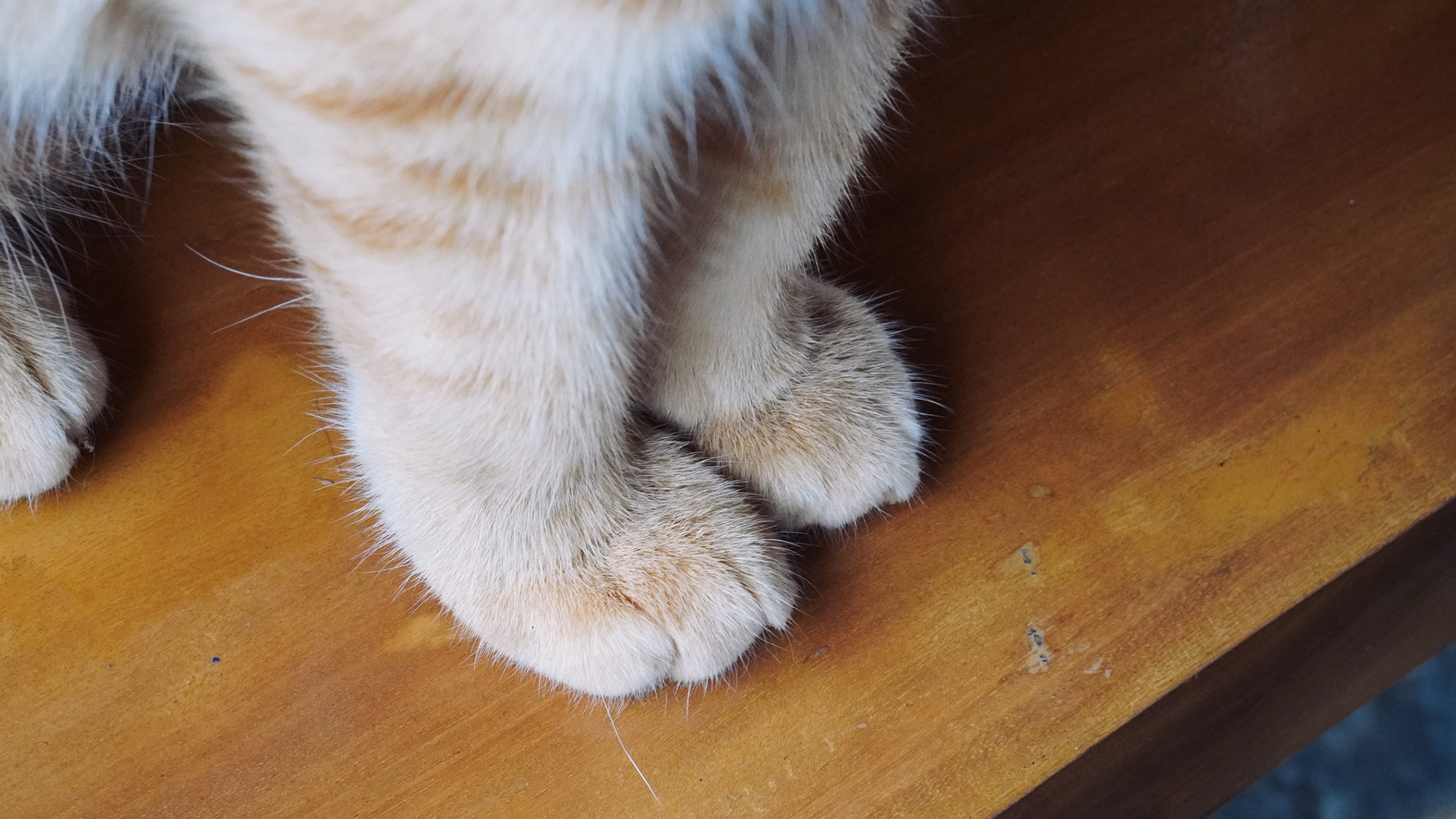
Cats’ “Leg Whiskers” Are Precision Tools for Close-Range Sensing
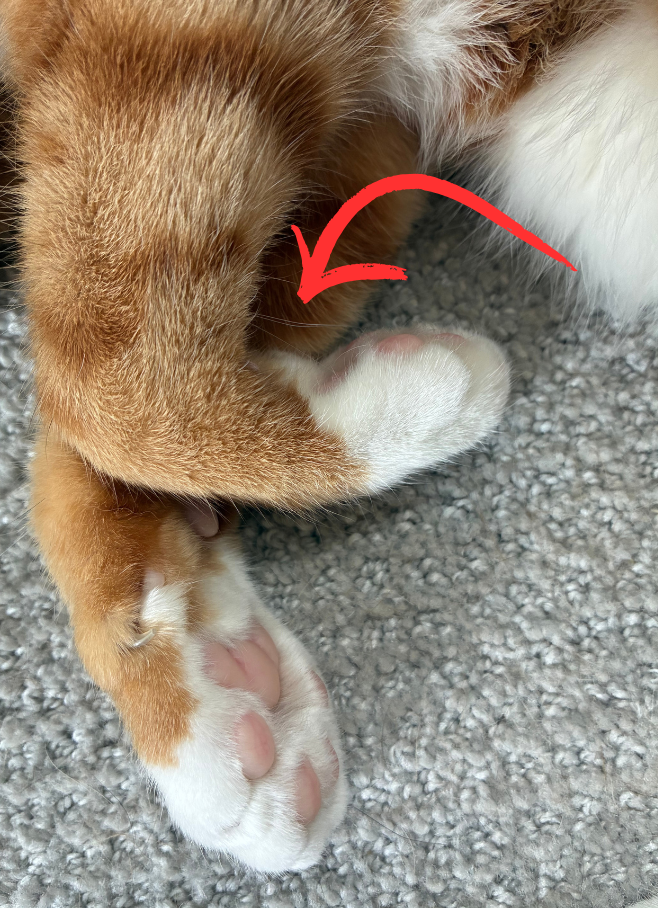
Most people associate a cat’s whiskers with the long, expressive hairs that fan out from its muzzle. But cats also carry another, less noticed set of sensory hairs on the backs of their front legs. These so-called leg whiskers are not decorative leftovers. They are part of the same highly tuned sensing system that helps cats navigate the world at distances where vision becomes less reliable.
The source identifies these whiskers as carpal vibrissae, a specialized type of hair attached to the forelegs. Like facial whiskers, they are thicker and stiffer than ordinary fur. More importantly, their bases sit in specialized structures rich in nerve endings, making them highly sensitive to movement and contact. The whisker itself does not contain nerves, but its root structure turns even small deflections into useful sensory information.
That basic anatomy explains why whiskers matter so much to cats. They are not simply hairs that happen to be longer or coarser. They are sensory instruments, effectively extending a cat’s ability to gather information from its surroundings through touch and vibration.
Whiskers Help Where Vision Falls Short
The source notes that cats are strong at seeing distant objects, but they are not equally good at focusing on things that are very close to their eyes. That gap creates a problem for a predator that often needs to track movement at the final stage of a chase or while manipulating prey with its paws.
Facial whiskers already help solve part of that problem. They can provide feedback about nearby obstacles, spatial boundaries, and movement when lighting is poor or when a target is too close for sharp visual focus. The leg whiskers appear to extend that sensing ability into a different zone: the area near the front limbs, where paw placement and prey handling happen in real time.
In effect, a cat’s whisker system is distributed. The face monitors the space ahead and around the muzzle, while the foreleg whiskers give feedback tied more directly to the motion and position of the front limbs. That makes sense for an animal that relies on quick, coordinated strikes and close-quarters control.

What Leg Whiskers Actually Do
According to the supplied text, cats have a tuft of four to six whiskers on the back of each front leg, with each whisker measuring about 2 to 3 centimeters. These are much shorter than the long whiskers on the muzzle, but their placement is the key point. Positioned on the forelegs, they can help the animal detect the presence and movement of prey or objects near the paws.
That role is especially useful during hunting. Cats often pin, bat, or reposition prey with their front feet. In those moments, the target may be partially hidden from view by the cat’s own limbs or may sit too close for precise visual tracking. A tactile sensory signal from the forelegs could provide immediate information about where the prey is shifting and how the cat should respond.
This is consistent with the broader biology of vibrissae across mammals. Sensory hairs are most useful where an animal benefits from rapid feedback about nearby surfaces, motion, or spatial constraints. On a cat’s forelegs, that means converting paw-level interactions into information the nervous system can use almost instantly.
A Predator Built for Short Distances
Domestic cats may spend much of their time indoors, but their bodies still reflect the requirements of a small predator. Their sensory systems are optimized not just for seeing and hearing but for integrating multiple forms of information while stalking and capturing moving targets.
The source includes the point that facial whiskers are as sensitive as human fingertips. That comparison helps explain why whiskers should be thought of less as passive ornamentation and more as active sensing equipment. A cat investigating a gap, approaching an object in dim light, or controlling prey near its chest is not relying on eyesight alone. It is combining visual information with touch-like input delivered through specialized hairs.
Leg whiskers fit neatly into that design. They give cats a way to sense what is happening in a zone where speed matters and visual certainty can drop. For an ambush predator, that is a practical adaptation, not a trivial anatomical detail.

Why Cats Need More Than One Set of Whiskers
It is tempting to ask why facial whiskers are not enough. The answer is that location changes function. Whiskers on the muzzle are ideal for judging openings, detecting nearby surfaces, and tracking the space immediately around the head. Whiskers on the forelegs collect different information because they move with different parts of the body and interact with different events.
A cat reaching forward with a paw needs localized feedback in that area, just as a person benefits from touch sensors in the hand rather than only on the face. The exact mechanics differ, but the principle is similar: sensory systems become more useful when they are placed where decisions and contact occur.
This arrangement also reflects how cats hunt and explore. They do not just bite prey; they probe, pin, bat, and adjust. They do not simply look at narrow spaces; they move through them, assessing fit and contact from several angles. Multiple whisker groups support those behaviors by creating a richer tactile map of the immediate environment.
An Everyday Feature With Evolutionary Logic
The presence of carpal vibrissae can seem surprising mainly because people rarely notice them. Facial whiskers are obvious and expressive. Leg whiskers are smaller, less prominent, and usually hidden unless someone looks closely. But their lower visibility does not mean they are biologically minor.
On the contrary, they illustrate how evolution often refines organisms through small, well-placed features rather than dramatic structural changes. A few stiff hairs anchored in sensory tissue can improve close-range awareness enough to matter for hunting, movement, and environmental interaction. For a predator operating at speed and at low light, that kind of refinement is valuable.
The larger lesson is that cats are equipped with a layered sensory toolkit. Sight, hearing, balance, smell, and tactile input all work together. Leg whiskers are one more reminder that much of animal intelligence is embodied in anatomy. The cat is not only seeing the world around it. It is feeling that world in specialized ways that begin before direct contact is obvious to us.
So the next time a cat crouches, stalks, or carefully manipulates an object with its front paws, those small whiskers on the backs of its legs are part of the story. They help turn motion into information, and information into action.
This article is based on reporting by Live Science. Read the original article.

Originally published on livescience.com