A remarkably preserved elephant tooth recovered in northern Israel is giving researchers a detailed new view of the environment in which early humans lived nearly 700,000 years ago. The fossil, found at the Gesher Benot Ya'aqov archaeological site in the Jordan Rift Valley, points to a landscape far greener and wetter than a simple picture of Ice Age wilderness might suggest.
Researchers say the tooth belonged to Palaeoloxodon antiquus, the straight-tusked elephant. The animal was among the largest land mammals of the Pleistocene. But the importance of the find is not confined to identifying a spectacular extinct animal: chemical and physical evidence preserved in teeth can help reconstruct diet and surroundings, turning a fossil into a record of an entire ecosystem.
A fossil beside early technology
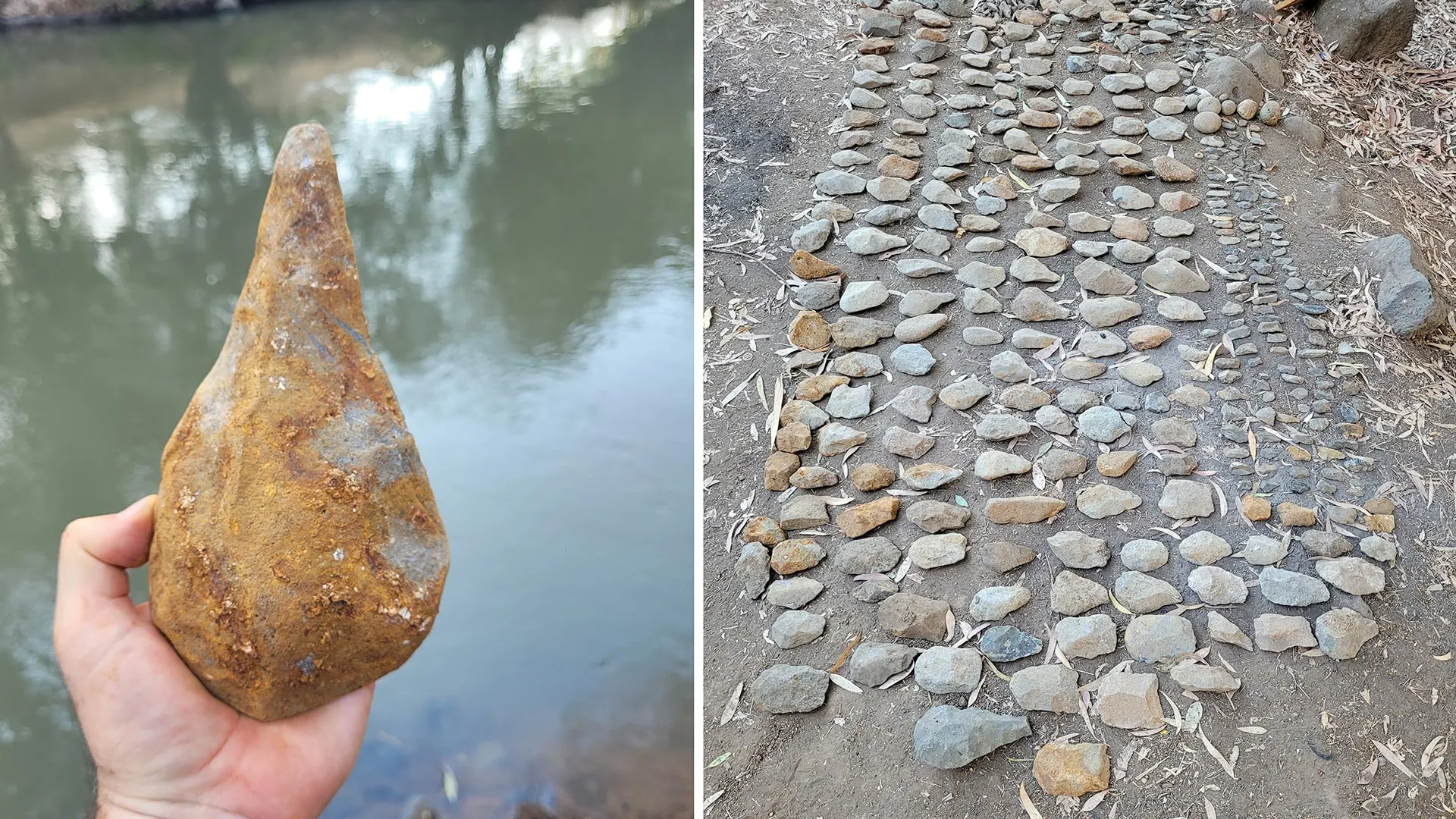
The elephant remains were discovered alongside basalt handaxes and cleavers associated with the Acheulian tradition, one of the earliest and most widespread stone-tool technologies. That pairing places the animal in a setting also used by early human populations, rather than treating the tooth as an isolated palaeontological find.
The research team examined a large molar and fragments of tusk from Gesher Benot Ya'aqov, also known as Daughters of Jacob Bridge. The site lies just south of the modern Hula Valley, in an area that formed part of the Jordan Rift Valley. It was excavated by Professor Gonen Sharon of Tel-Hai University of Kiryat Shmona in the Galilee and colleagues.
Hannah Farrell, a doctoral researcher at the University of Haifa, led the study, which was published in Quaternary Science Reviews. The work draws on the fact that a tooth can retain clues about the vegetation an animal consumed and the conditions in which it lived.

Forests, rivers and wetlands
The reconstruction presented by the researchers describes a lush setting of forests, rivers, wetlands and plentiful vegetation. Such an environment could support enormous herbivores while also providing water and other resources useful to human groups.
That matters because landscapes are central to understanding prehistoric movement and survival. The study suggests that access to water and natural resources may have helped early humans endure in the region and move between continents. Gesher Benot Ya'aqov therefore offers evidence not only about a single species, but about a potentially important ecological corridor.
The elephant itself helps make the case for abundance. Straight-tusked elephants were immense animals with substantial food requirements. Their presence indicates that the local environment could sustain large herbivores, while the associated stone tools show that humans were also active in the same broader landscape.
Why one tooth can matter
Archaeological finds often arrive as fragments: a tool, a bone, a sediment layer or a trace of ancient activity. A well-preserved tooth can connect several of those fragments because it carries evidence from an animal's life. In this case, researchers used the elephant remains to look beyond taxonomy and toward the conditions that made the animal's presence possible.
The result challenges any overly uniform view of the ancient Levant. Rather than a featureless route traversed by early people, the study describes a resource-rich world with varied habitats. Rivers and wetlands would have structured where plants and animals gathered; forests and open vegetation would have supplied different foods; and water would have been a fundamental constraint for both elephants and humans.
The nearby Acheulian tools add another layer. Handaxes and cleavers made from basalt are tangible evidence of technological activity at the site. They do not, on their own, establish every interaction between people and elephants, but their co-occurrence anchors the animal in a humanly occupied landscape.

A window onto deep time
The find also illustrates why long-studied archaeological sites can continue to yield fresh insights. New questions and analytical approaches can make a fossil useful in ways that extend far beyond its initial recovery. Here, the elephant tooth becomes a means of investigating climate, vegetation, water availability and the practical conditions facing early populations.
At nearly 700,000 years old, the remains reach back to a period far older than written history and even older than most familiar human narratives. Yet the underlying questions are recognizably ecological: where was water available, what food grew nearby, which animals could live there, and how did people navigate those opportunities?
For the researchers, the answer emerging from Gesher Benot Ya'aqov is a picture of a flourishing prehistoric environment in northern Israel. Giant elephants and early humans occupied a landscape shaped by water and rich vegetation, and one ancient molar has helped bring that lost world into sharper focus.
This article is based on reporting by Science Daily. Read the original article.
Originally published on sciencedaily.com