Meteorites do not simply burn away
The familiar explanation for a shooting star is simple: a rock from space enters Earth’s atmosphere, heats up and burns away. A new analysis of meteorite falls suggests the process is more complicated, and often more violent. Researchers examining video recordings and photographs from 75 falls identified seven stages in which melting and fragmentation play a central role in determining how an incoming object loses mass, slows down and ultimately scatters material on the ground.
The work, published in Meteoritics & Planetary Science, focuses on the uncommon objects that survive atmospheric entry well enough to become recoverable meteorites. Its practical insight is that the fate of a space rock is not controlled primarily by a straightforward evaporation process. Instead, molten material and breakups can reshape the object’s mass, brightness, speed and landing pattern.
That distinction matters for interpreting fireballs, locating fallen meteorites and understanding the atmospheric behavior of potentially hazardous asteroids. A body that fractures can spread fragments over a large area; a body that remains intact longer can follow a different trajectory and deliver a different mass distribution to the surface.
Observations from 75 falls reveal a sequence
Lead author Peter Jenniskens of the SETI Institute and NASA Ames Research Center said the research challenges the older mental model of solid rocks evaporating under the heat and light produced in the atmosphere. The researchers instead found that melting followed by fragmentation controls much of the mass loss.
The first stage begins high above Earth, when the atmosphere becomes dense enough for the incoming object to create a shock wave ahead of it. Collisions with air molecules heat both the object’s surface and the nearby gas. The result is the luminous streak seen from the ground: the meteor, often called a shooting star.
As the object descends into denser air, its brightness increases. This second stage can reveal details about its rotation. Repeating changes in brightness, for example, may indicate that the object is spinning. Such observations are useful because they connect a visible fireball’s changing appearance to the physical state of the body producing it.
The broader seven-stage framework tracks the transition from a fast incoming rock to fragments and, in some cases, meteorites that can be recovered. The analysis emphasizes that these stages are governed by different processes rather than one uninterrupted act of heating. The incoming object interacts with air, develops a shock wave, heats and melts, changes its motion, and can break apart in ways that alter where the surviving pieces go.
Melting changes the physics of descent
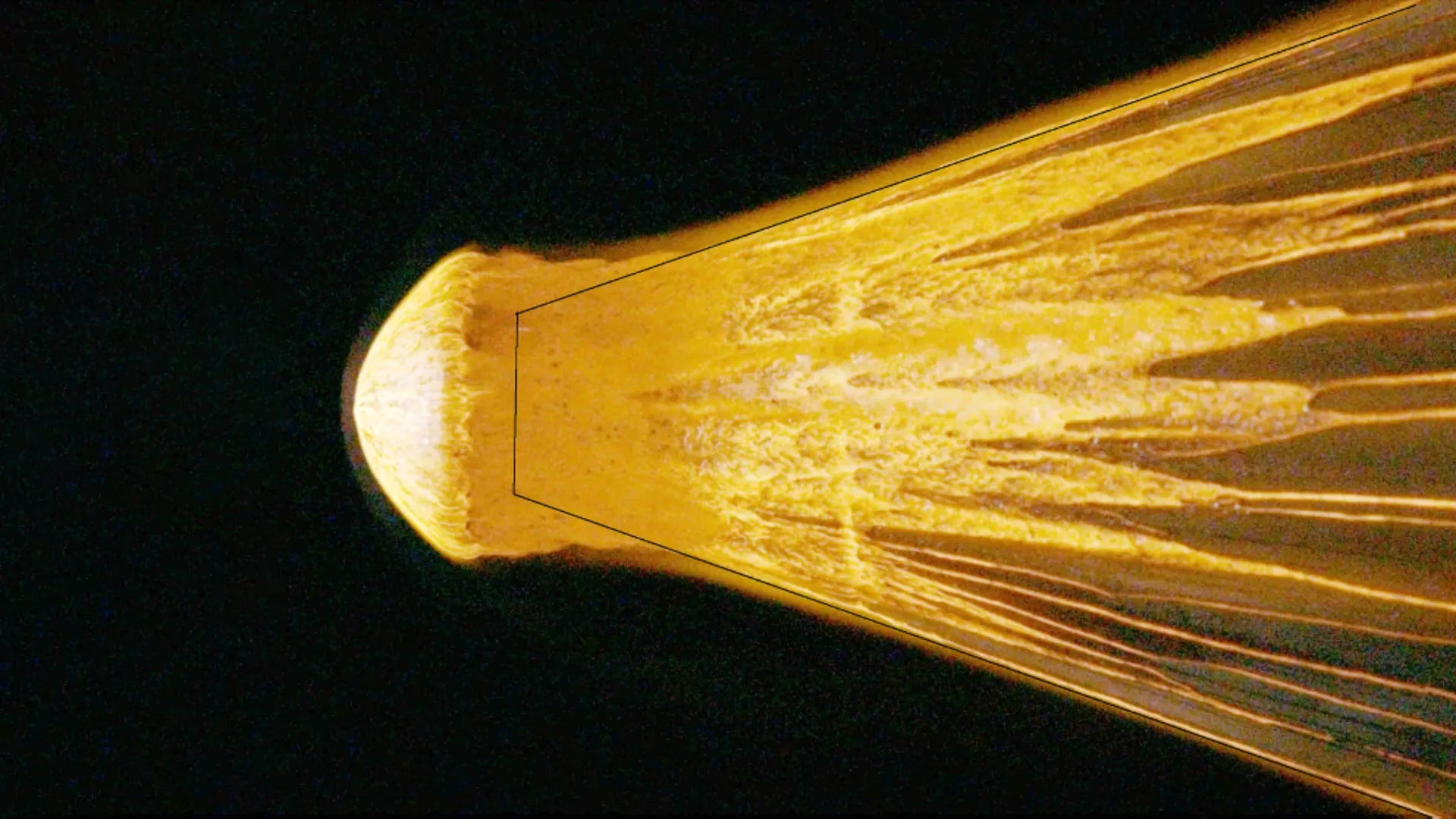
Melting is not just a cosmetic surface effect. The researchers found that it influences how a space rock loses material and decelerates. Images from NASA Ames’ Arcjet Interaction Heating Facility show melt flowing from the surface of a stony meteorite under simulated high-temperature airflow, with a thin shock wave visible in front of the stone.
That laboratory context helps make the atmospheric-entry problem tangible. The meteorite is not moving through an empty sky; it is compressing gas ahead of it, producing intense heating and undergoing rapid physical change. Once melt is present, material can be removed in a form different from simple vaporization. If the object also fractures, its exposed surface area and aerodynamic behavior can change suddenly.
The combination has direct consequences for what observers see. Brightness can vary, fragments can diverge and the final pieces can land in a broader or differently shaped area than would be expected from an intact object. The study’s aim is not merely to give names to seven phases, but to connect each phase with the physical mechanisms that affect survival.
Fragmentation helps explain scattered meteorites
When a meteoroid breaks apart, the resulting fragments no longer share exactly the same path through the atmosphere. Their masses, shapes and resistance to the air can differ, changing the way they slow down and fall. That is why meteorite recovery can become a search across a strewn field rather than a hunt for one intact stone.
The new analysis indicates that fragmentation has a larger role than previously appreciated. It affects how much original material remains, how fast pieces decelerate and where they reach the ground. For researchers using eyewitness reports, cameras and recovered specimens to reconstruct a fall, that means a better physical model can improve the interpretation of all three forms of evidence.
The findings also extend to planetary-defense questions. Large asteroids and smaller meteoroids are not identical cases, but both undergo severe atmospheric forces. Understanding how a stony object melts and fragments can help researchers explain why some bodies disperse high in the atmosphere while others retain enough mass to create meteorites or cause a more concentrated impact hazard.

Why a stage-by-stage model is useful
A seven-stage model gives scientists a shared structure for comparing events that initially look very different. Some fireballs are bright and short-lived; others produce a long trail of observations and recoverable material. Their outcomes depend on factors including the object’s properties, motion and interaction with the increasingly dense atmosphere.
By separating the journey into phases, the researchers can ask more precise questions: when did a shock wave become important, when did brightness intensify, when did melting change the object’s behavior, and when did fragmentation redirect the material? The answers can guide both future observations and efforts to predict likely fall zones after a well-recorded event.
- The analysis drew on video and photographs from 75 meteorite falls.
- It identifies seven stages during atmospheric entry and descent.
- Melting and fragmentation, not simple evaporation alone, control much of the mass loss.
- The model could help explain meteorite strewn fields and atmospheric asteroid breakups.
For skywatchers, the conclusion adds depth to a familiar flash of light. A meteor is not merely a stone disappearing in fire. In the cases that produce meteorites, it is a changing object passing through a sequence of aerodynamic and material transformations—one that can end with pieces of the solar system arriving on Earth.
This article is based on reporting by Science Daily. Read the original article.
Originally published on sciencedaily.com