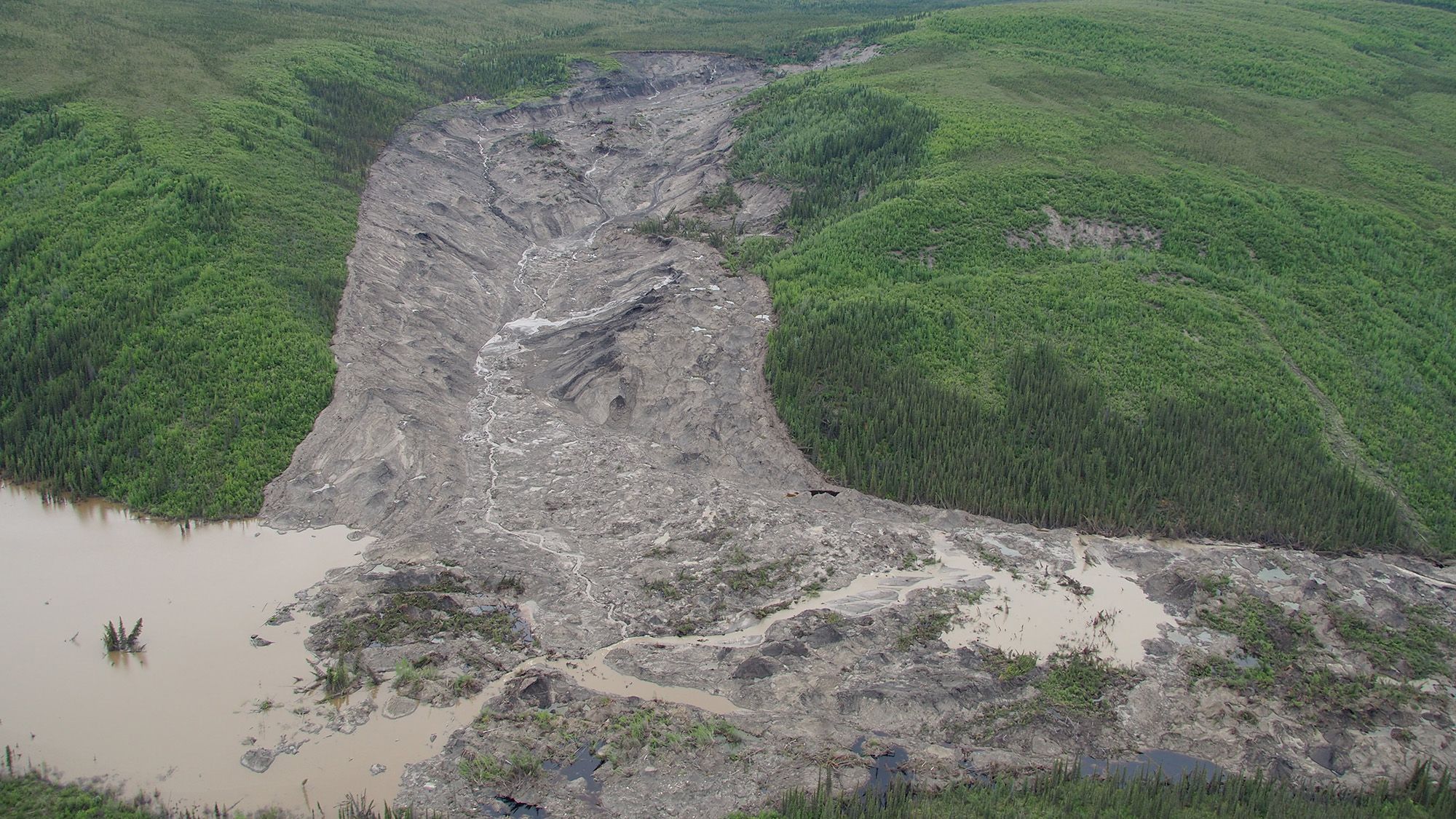
A newly identified type of landslide
Researchers have identified a new type of permafrost landslide in Canada’s Northwest Territories, a finding that may offer a warning about how northern landscapes could respond as the climate warms.
The events, described as permafrost detachment slides, occur where permafrost is relatively thin. The researchers concluded that they appear to be a long-term consequence of wildfire in these environments. Their findings were published Sept. 23 in the journal Geophysical Research Letters.
The slides were found in valleys that had long contained stable permafrost. Joseph Young, who led the work during his doctoral research at the University of Alberta, said the terrain had appeared stable before undergoing a sudden transition.
Frozen blocks distinguish the slides
Permafrost is ground that remains frozen year-round. In many familiar cases of thawing permafrost, sediment softens into a slurry and moves downhill as mud. The newly described slides behaved differently.
Field observations found large blocks of frozen material within the debris. Some were about 33 feet, or 10 meters, tall—roughly the height of a two-story house. That preserved ice-rich material is a defining feature of the newly identified landslide type.
The team first noticed broad landslide scars during fieldwork in the Northwest Territories. They then used satellite imagery to map the changes and conducted additional field investigations to establish that the failures were not ordinary examples of permafrost thaw.

Wildfire may set up delayed instability
The research points to wildfire as an important part of the sequence. The slides seem to be a delayed, long-term impact in places where the ground contains thin permafrost. A fire can alter the surface conditions that help keep soil and sediment frozen, leaving slopes vulnerable as temperatures and ground conditions change over time.
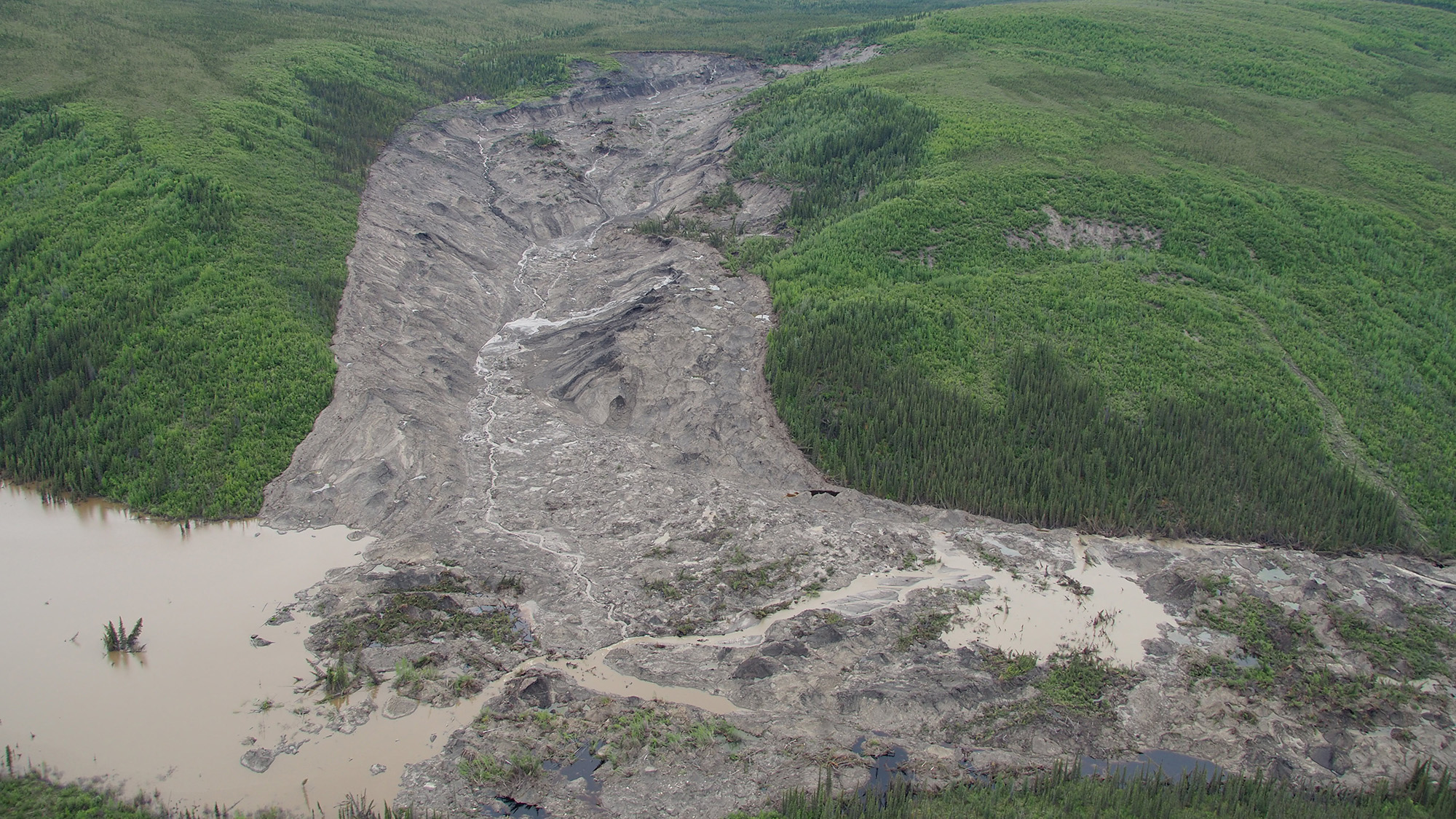
The researchers used electrical current measurements in the ground to assess the depth of permafrost on affected slopes. They focused on two landslides, including one in the Johnson River Valley that occurred in 2017.
The study’s authors said the phenomenon had not previously been observed in the region and may be unprecedented there over the past 10,000 years or more. That long historical context makes the discovery especially notable: it suggests a substantial departure from the landscape behavior recorded across much of the recent geological past.
Why the finding matters
Northern permafrost regions are already sensitive to rising temperatures, but the study highlights how climate effects can combine rather than operate alone. Warming, wildfire, ground-ice conditions and slope stability can interact in ways that produce hazards unlike the ones communities and land managers have previously encountered.
Permafrost detachment slides can reshape valleys, move large volumes of material and affect rivers and nearby terrain. The discovery does not establish that every wildfire-exposed northern slope will fail in this way. It does, however, identify a process that researchers may need to monitor in other areas with thin permafrost and changing fire regimes.
For scientists, the next task is to determine how widespread these slides are, which ground conditions make them more likely and how satellite observations can help identify early changes. For northern communities and infrastructure planners, the finding adds another reason to track landscapes after major fires, especially where slopes and ice-rich ground coincide.

A potential signal of future change
The work does not treat the Northwest Territories events as an isolated curiosity. Instead, the researchers see them as a potential indication of the kinds of abrupt changes that may become more important in a warming north.
As wildfire activity and permafrost disruption continue to alter high-latitude landscapes, the newly identified slides may become an important category of hazard. Their discovery underscores that climate change can reveal not only more frequent versions of known risks, but also physical processes that have not previously been documented in a region.
This article is based on reporting by Live Science. Read the original article.
Originally published on livescience.com