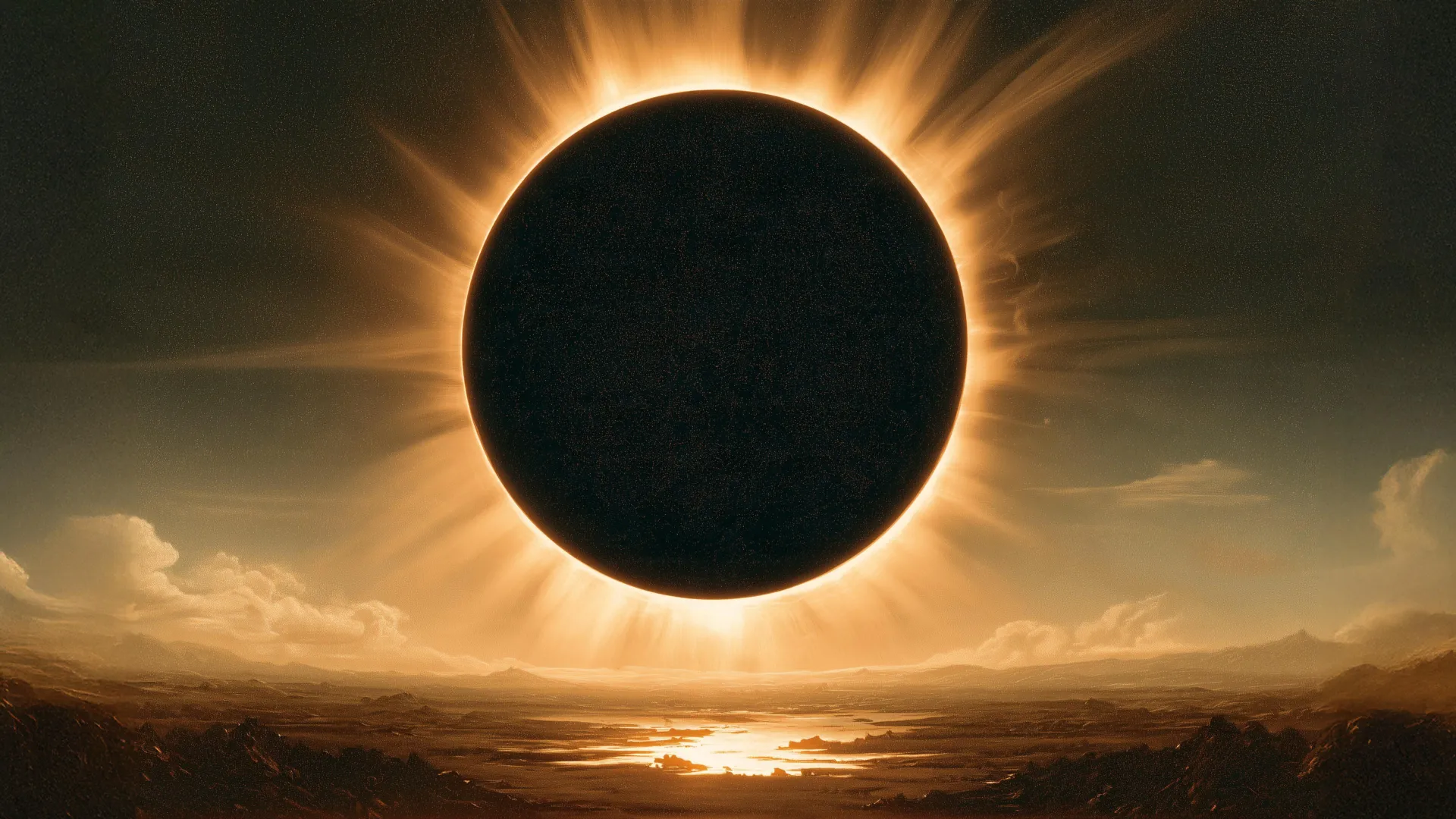
An eclipse recorded in ancient China more than 2,700 years ago is providing researchers with a more precise way to examine how Earth’s rotation has changed over time. An international team reconstructed the total solar eclipse of 709 BCE by combining historical geography with modern astronomical calculations.
The work, published in Astrophysical Journal Letters, focuses on an observation made at the court of the Lu Duchy. The eclipse is among the oldest precisely dated records of a total solar eclipse, making it useful for comparing historical testimony with calculations of the Earth-Moon-Sun system.
By revisiting the site from which the event was observed, the team also examined a later description that may be an early written account of the solar corona, the faint outer atmosphere of the Sun visible during totality.
Reconstructing an eclipse from 709 BCE
On July 17, 709 BCE, observers at the court of the Lu Duchy saw a total solar eclipse. The event was preserved in the Spring and Autumn Annals, a historical chronicle compiled roughly two to three centuries later. Its account states that the Sun was totally eclipsed.
The researchers determined how the eclipse would have appeared from Qufu, the ancient capital of the Lu Duchy. Their reconstruction depended on correcting an approximately eight-kilometer error in the location assigned to the ancient capital.
That geographic correction matters because the path of totality is narrow. A relatively small change in an observer’s assumed location can affect whether a calculation indicates a total eclipse, and how the event is used to constrain estimates of Earth’s past rotation.
With the revised location and modern astronomical calculations, the researchers obtained more accurate measurements relevant to how fast Earth was spinning at the time. The study adds more precise evidence that Earth’s rotation was faster in the distant past.

Why ancient eclipses matter
Earth does not rotate at a perfectly unchanging rate over long spans of time. Historical eclipse observations can provide a record against which astronomical models are tested, especially when an event can be dated and placed with unusual precision.
The 709 BCE observation is particularly valuable because it combines a specific date with a report of totality. The team’s reconstruction connects a historical record, an updated assessment of the observing location and present-day calculations of where the eclipse path would have fallen.
Rather than treating old accounts as simple anecdotes, the study uses historical geography as part of the scientific analysis. The correction to the ancient capital’s location changed the reconstruction enough to improve the rotational evidence derived from the eclipse.
The result illustrates a broader challenge in using very old astronomical reports: the wording of a record may survive for centuries, while the exact identity and location of the place named in it can require separate historical work. In this case, refining that context helped make the astronomical evidence more useful.
A possible observation of the corona
The researchers also considered an additional account preserved in the Hanshu, or Book of Han. The passage was written around seven centuries after the eclipse and includes an unusual description of the eclipsed Sun as appearing completely yellow above and below.
That description has traditionally been associated with a solar-corona observation. During a total solar eclipse, the Moon blocks the bright solar disk and can reveal the Sun’s much fainter outer atmosphere to the naked eye.
The team analyzed the possible shape implied by the account. If the interpretation is correct, the observation may indicate that the Sun was returning to a more active phase after an extended period of unusually low activity.
The source record cannot by itself settle the question of what ancient observers saw. The study presents the corona interpretation as a possibility, while noting its value if it can be linked to solar conditions independently inferred from radiocarbon measurements.

Two histories in one event
The reconstructed eclipse connects two long-running scientific questions. One concerns Earth’s rotation: the historical observation helps refine estimates of how the planet’s spin has changed over millennia. The other concerns solar activity: the possible corona description offers a potential historical clue about the Sun’s ancient behavior.
Both conclusions depend on careful treatment of uncertainty. The rotational result required an updated location for the ancient capital, while the solar interpretation depends on whether a much later text genuinely describes the corona. The value of the research lies in bringing those uncertainties into a reconstruction rather than overlooking them.
The study shows how an event witnessed in 709 BCE can still inform modern measurement. A brief eclipse record, reassessed with historical and astronomical tools, is now contributing evidence about a faster-spinning Earth and a possible change in the ancient Sun’s activity.
This article is based on reporting by Science Daily. Read the original article.
Originally published on sciencedaily.com