Curiosity has found one of its strangest landscapes yet on Mars
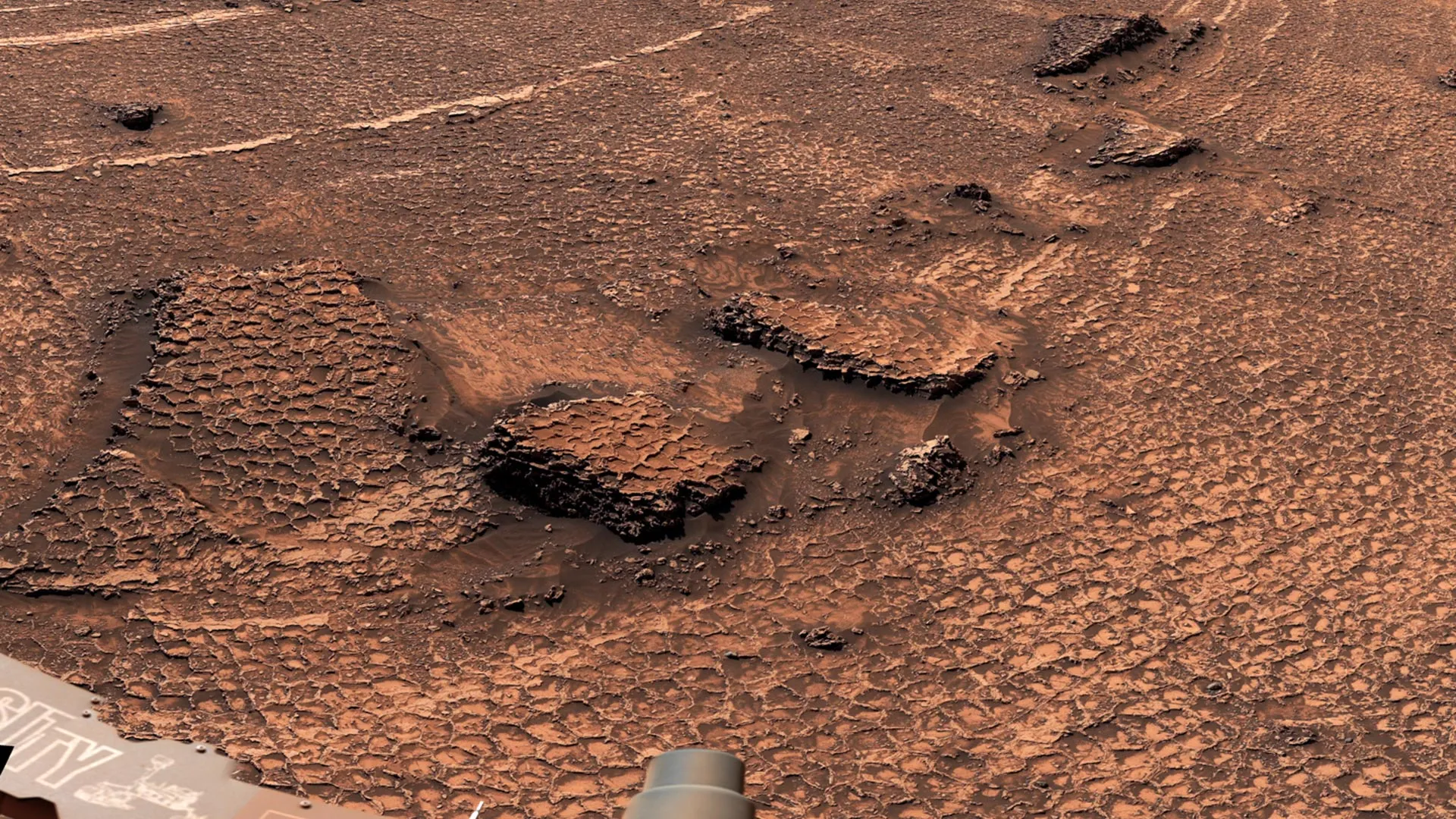
NASA’s Curiosity rover has encountered an unusually extensive field of honeycomb-like ground patterns while climbing through a Martian valley known as Valle Grande. The rover has seen polygonal fractures before, but not on anything like this scale. The newly imaged terrain appears to spread in every direction, covering the valley floor and even wrapping up the side of a nearby butte.
The discovery adds a fresh puzzle to a mission that has spent nearly 14 years reading Mars through its rocks. In this case, the striking geometry is visually obvious, but its origin is not. Scientists say several different processes can produce polygonal fracture patterns, and Curiosity’s latest measurements are now being used to determine which explanation best fits this newly exposed landscape.
A valley covered in tiny polygons
According to NASA’s Jet Propulsion Laboratory material, the fractures measure about 1.5 to 3 inches, or 4 to 8 centimeters, across. That makes them small in individual size but large in collective effect. A 360-degree panorama captured on June 19 and 20 during the mission’s 4,930th and 4,931st Martian sols shows a landscape so densely covered that the pattern reads almost like a textured skin across the valley.
The shapes do not stop at the flat ground. They continue up a nearby formation nicknamed Miraflores, a butte rising about 20 feet, or 6 meters, above the surrounding area and capped by a thick layer of sand. That continuity is one reason the formation stands out: whatever created the polygons appears to have affected the broader setting, not just a small isolated patch.
For a rover team accustomed to unusual terrain, this still registered as exceptional. The source material quotes project scientist Ashwin Vasavada describing the “sea of polygons” as a breathtaking scene and saying the team measured their shapes and chemistry carefully in hopes of identifying clues to their formation.

Why polygonal fractures matter
Polygonal ground patterns are not automatically mysterious on their own. On Earth, comparable geometries can emerge when wet sediments dry and crack, when repeated heating and cooling stresses the ground, or when buried sediments compact and expel water. Mars also preserves polygonal features in multiple settings, and Curiosity has previously examined examples that were clearly linked to ancient drying mud.
The problem is that similar-looking patterns do not always come from the same process. Shape alone rarely settles the issue. That is why Curiosity’s instruments matter so much here. The rover is not just taking scenic images. It is recording morphology and chemistry that may help determine whether Valle Grande preserves evidence of drying, temperature cycling, burial-related compression, or some combination of processes.
Each possibility would imply something different about the valley’s environmental history. Drying mud, for example, would point to conditions involving water-rich sediment exposed to evaporation. Repeated warming and cooling would emphasize mechanical stress from environmental cycles. Compression-driven fracturing would say more about what happened after the sediments were buried and altered underground.
A new clue in Mars’ long climate story
Curiosity’s broader mission has been to reconstruct how habitable ancient Mars may once have been, and much of that work depends on reading layered evidence rather than single dramatic finds. The honeycomb field fits that approach. By itself, it does not prove a specific climate scenario. But if scientists can tie the polygons to a known formation mechanism, they gain another constraint on how water, sediment, and surface conditions interacted in this part of Gale Crater.
That matters because Mars did not have one fixed past. Conditions shifted over time, and different local environments recorded those shifts differently. Valle Grande may preserve a chapter that is distinct from the mudstones, sulfate-bearing materials, and other deposits Curiosity has already studied on its climb.
The rover’s long lifespan increases the value of such discoveries. Instead of sampling one narrow setting, Curiosity has been able to compare many terrains across years of travel. When the mission team says this polygon field is unlike what the rover has seen before, that judgment is grounded in a long baseline of Martian fieldwork.

Fourteen years in, Mars is still surprising the mission
Curiosity landed on Mars on August 5, 2012. Since then, it has built a record defined less by one headline event than by steady accumulation: layered rocks, mineral transitions, unexpected chemistry, and landscapes that repeatedly complicate simple assumptions about the planet’s past. The Valle Grande polygons now join that sequence as another reminder that Mars remains geologically expressive even at small scales.
There is also a practical lesson in the find. Planetary exploration often advances through details that are easy to overlook from orbit. A distant view may identify broad landforms, but a rover on the ground can reveal centimeter-scale textures, how those textures connect across slopes, and whether a seemingly familiar feature is actually unusual in context. That is exactly what appears to have happened here.
The next step is interpretation. Scientists will need to compare the chemistry and geometry of these fractures with other known polygonal settings, on Mars and on Earth, and test which formation story best explains the field’s extent and placement. The answer may be simple, mixed, or unexpected. But the discovery already has value before that conclusion arrives: it opens a new line of questioning in a mission still producing novel geology nearly a decade and a half after landing.
Curiosity’s latest panorama shows that Mars can still surprise researchers with terrain that is at once orderly and enigmatic. A valley paved in tiny polygons may look decorative from a distance. Up close, it is a geological problem waiting to be solved.
This article is based on reporting by Science Daily. Read the original article.
Originally published on sciencedaily.com