Juno reveals a layered boundary around Jupiter
NASA’s Juno spacecraft has provided detailed observations of Jupiter’s bow shock, the invisible boundary where the solar wind encounters the giant planet’s magnetic environment. The observations indicate that Jupiter’s response to the solar wind is more complicated than the familiar picture at Earth.
The work, led by researchers at the University of Iowa, finds that Jupiter uses a series of plasma-wave regions and multiple shock structures to slow incoming solar particles before they meet the planet’s main bow shock. The findings were described as the most detailed observations yet of Jupiter’s bow shock.
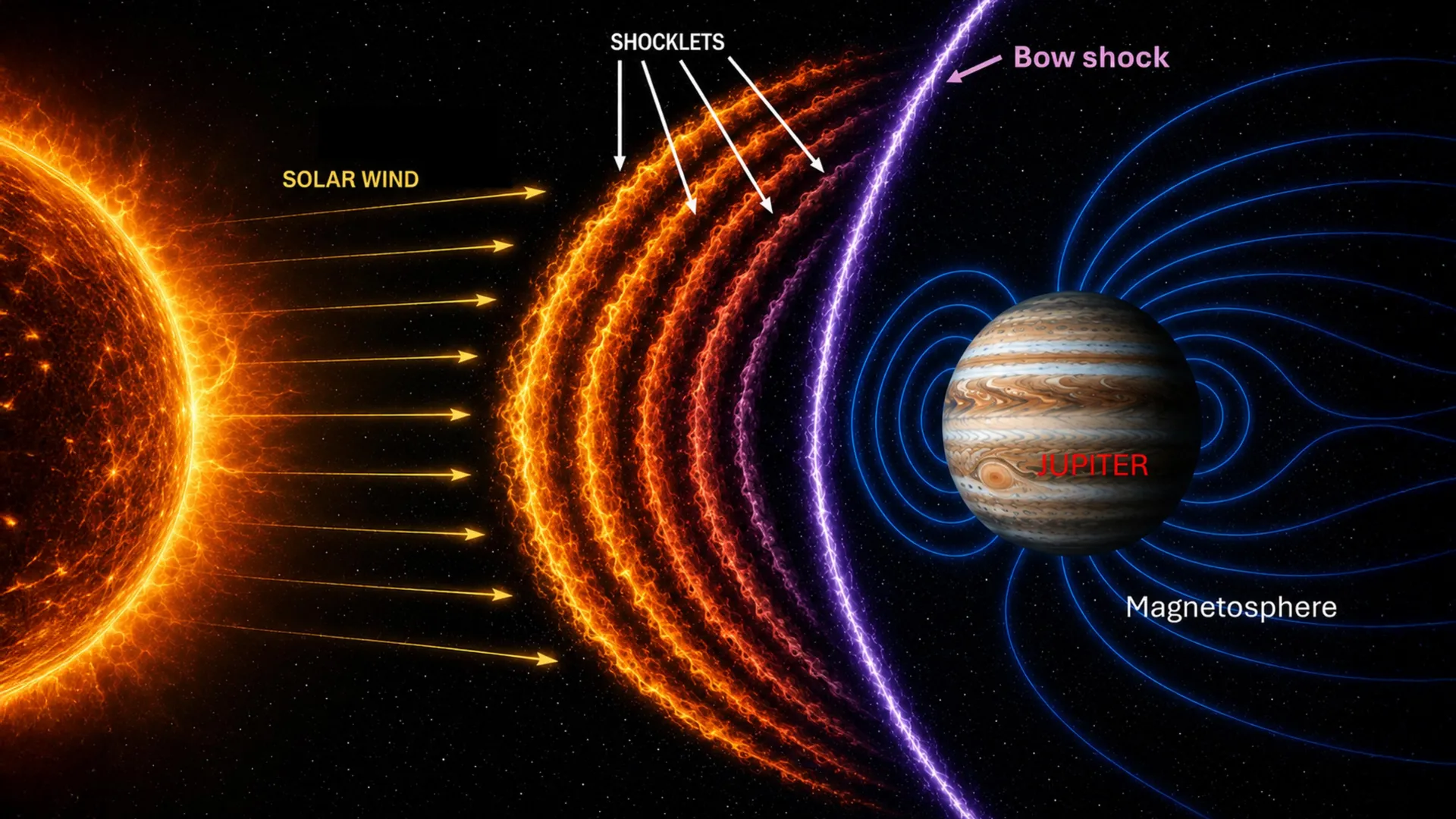
The solar wind is a continual flow of electrically charged particles released by the Sun. When it approaches a magnetic planet, it cannot simply travel unimpeded toward the atmosphere. It encounters magnetic fields and plasma, and the interaction can create a bow shock: a boundary that slows, heats and redirects some of the incoming flow.
At Earth, that process is an important part of the planet’s space-weather defense. Jupiter has the same basic kind of boundary, but its enormous scale, powerful magnetic field and gaseous composition make it a very different natural laboratory. Juno’s measurements suggest that the transition from solar wind to Jupiter’s magnetically controlled environment is not a single, simple barrier.
Shocklets add an earlier stage to the interaction
The new observations focus on regions called shocklets. These are plasma structures that form upstream of Jupiter’s principal bow shock. Rather than having the solar wind encounter one dominant boundary immediately, Jupiter appears to engage and slow the flow through a succession of wave-driven regions before the main shock is reached.
That behavior matters because bow shocks are not merely lines on a diagram. They are places where energy is redistributed among particles and fields. How efficiently a shock slows, heats and redirects plasma affects the conditions that develop farther downstream in a planet’s magnetic environment.
Jupiter’s bow shock forms where the solar wind meets the planet’s vast magnetosphere, the region dominated by Jupiter’s magnetic field. The scale of that field and the high-energy plasma conditions near the planet make the system especially useful for studying how collisionless shocks operate. In these environments, particle interactions are governed primarily by electromagnetic fields rather than ordinary particle-to-particle collisions.
The source material describes Jupiter’s system as relying on powerful plasma waves and multiple shock regions. That is a meaningful distinction from a simplified Earth comparison, in which the bow shock is often presented as the principal site for slowing the incoming solar wind. The Juno data show that at Jupiter, the flow can be reshaped before it arrives at the main boundary.

Why planetary shocks matter beyond Jupiter
Studying Jupiter is not only about understanding one planet. Plasma shocks occur throughout the universe, including in environments associated with some of the most energetic events known to astronomy. The University of Iowa researchers say the observations could help scientists understand extreme shock waves linked to exploding stars.
That connection comes from shared physics. In both planetary space and distant astrophysical settings, charged particles and magnetic fields can create shocks that accelerate particles and transform energy. Jupiter offers a nearby setting where spacecraft can measure those processes directly, rather than relying entirely on remote observations.
The research also underscores the continuing scientific value of long-duration planetary missions. Juno has allowed scientists to examine Jupiter not just as a large gas giant with striking clouds and a powerful magnetic field, but as an active plasma system interacting continuously with the Sun.
For Earth, the comparison is a reminder that magnetic shielding is not a uniform planetary phenomenon. A bow shock’s shape and behavior depend on the planet, its magnetic field, the surrounding plasma and the changing conditions in the solar wind. Jupiter’s layered shock structures show how much variety can exist even within our own solar system.
A closer look at a giant planet’s space environment
Juno’s results refine the picture of how the solar wind is processed at Jupiter. Instead of a single decisive encounter at the main bow shock, the spacecraft found evidence for a more extended and structured interaction, with shocklets and plasma waves acting before the solar wind reaches the primary boundary.
That finding gives researchers a more detailed framework for interpreting Jupiter’s magnetic environment and for comparing it with Earth’s. It may also improve the way scientists think about shock-driven processes in far more extreme cosmic environments.
Jupiter’s magnetic shield remains invisible to the eye, but the measurements show it is far from featureless. The giant planet appears to manage the solar wind through a complex chain of plasma interactions—one that begins before the solar wind reaches its main defensive boundary.
This article is based on reporting by Science Daily. Read the original article.

Originally published on sciencedaily.com