A Different Way to Read a Cell
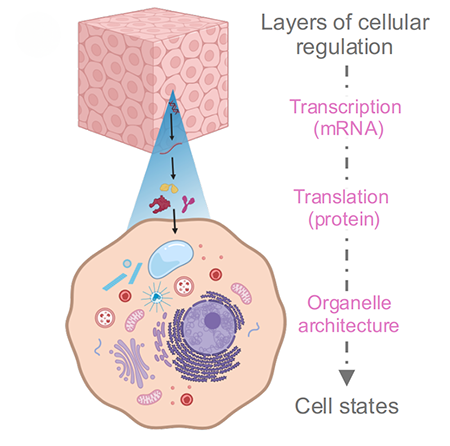
Cell biology has long relied on markers that describe identity from the outside in: surface proteins, transcription factors, a handful of metabolic readouts. A paper published in Science’s Volume 393, Issue 6817, under the title “Multi-organelle signatures map cell-state diversity and metabolic adaptation in tissues,” argues for a different organizing principle. Its framing treats organelles not as static cellular furniture but as reporters of state — features capable of separating one cell from its immediate neighbor inside the same tissue and of describing how that cell reshapes its metabolism.
That shift in emphasis is significant because tissues are rarely uniform. Two cells sitting microns apart can occupy different functional states, respond differently to the same signal, or survive a stress that kills the other. The study’s title places organelles at the center of that variability rather than at its margins.
Why Organelles Carry Information About Cell State
Every organelle in a eukaryotic cell is a compartment with its own protein complement, lipid environment, and dynamic behavior. Mitochondria fuse, divide, and rearrange their internal cristae; the endoplasmic reticulum expands and contracts; the Golgi and lysosomal network continuously re-sort cargo. These changes are not incidental. They track with what a cell is doing — whether it is proliferating, quiescent, secreting, stressed, or shifting between energy sources.
A signature built across several organelles at once therefore captures something a single marker cannot. Where a lone readout collapses a cell to one number, a multi-organelle profile describes the coordinated machinery underneath. The paper’s title suggests exactly this ambition: using the combined state of multiple organelles as a fingerprint of cell state, and doing so in the context of intact tissue rather than in cells stripped of their surroundings.
From Averaged Samples to Resolved Signatures
Most classic biochemistry works on bulk material — millions of cells ground together and measured as one. That approach will show that a tissue contains mitochondria, but it cannot say whether every cell’s mitochondria look the same. A multi-organelle signature framework is inherently more granular. It implies the ability to resolve differences that bulk methods average away, and to ask whether those differences are random noise or structured, repeatable properties of particular cell populations.
Placing that analysis in tissue, as the title specifies, adds a second dimension. Cells in culture are convenient but simplified; their environment is flat, uniform, and endlessly replenished. Cells in a tissue contend with neighbors, gradients, mechanical constraints, and uneven access to nutrients and oxygen. Organelle signatures measured in that setting describe biology as it is actually lived.
Metabolic Adaptation as the Connecting Thread
The second half of the paper’s title — metabolic adaptation — explains why organelles are the right vantage point. Metabolism is not an abstract flux diagram; it is physical. Fatty acid oxidation happens at mitochondria. Lipid synthesis and detoxification occupy the endoplasmic reticulum. Glycosylation, degradation, and recycling depend on the Golgi and the lysosomal system. When a cell changes how it makes energy or builds its components, those compartments must change shape, number, and composition accordingly.
Reading organelles as a signature therefore amounts to reading metabolic strategy. The work’s framing suggests that within a single tissue, cells may run meaningfully different metabolic programs, and that those programs can be inferred from organelle-level structure and molecular content rather than only from enzyme abundance or flux measurements. If that holds, metabolic adaptation becomes something visible and mappable rather than something inferred indirectly.
Where This Could Matter
Several lines of research would benefit from a method that connects organelle state to cell identity across tissues:
- Cancer biology. Tumors are notorious for heterogeneous metabolic strategies, with subpopulations that differ in how they use oxygen, glucose, and lipids. A signature that separates those subpopulations within an intact tissue could sharpen how resistance and vulnerability are described.
- Immunology. Immune cells undergo dramatic metabolic rewiring when they activate, differentiate, or become exhausted. Organelle signatures offer a way to resolve those transitions in the tissues where they occur.
- Developmental and stem cell research. As cells commit to lineages, their compartmental machinery is remodeled. Mapping that remodeling provides a physical counterpart to transcriptional atlases.
- Metabolic and neurodegenerative disease. Conditions rooted in mitochondrial or lysosomal dysfunction are, by definition, organelle diseases. Describing them across tissues rather than in isolated preparations is a natural extension.
Open Questions and the Work Ahead
As with any framework proposed in a high-profile venue, the value depends on execution. Key questions include how stable multi-organelle signatures are over time, how much of the observed variation reflects genuine cell state versus technical noise, and whether signatures remain comparable across tissues, preparations, and laboratories. Scaling matters too: the approach is only useful if it can be applied broadly enough to build reference maps, not just to describe a handful of hand-picked examples.
There is also the question of causal direction. Organelle changes may report on cell state, contribute to it, or both. Distinguishing a readout from a driver determines whether signatures are purely diagnostic tools or potential intervention points.
The Bottom Line
“Multi-organelle signatures map cell-state diversity and metabolic adaptation in tissues” appears in Science, Volume 393, Issue 6817. Its contribution is conceptual as much as technical: it proposes that the internal compartments of a cell, measured together and in their native context, form a readable record of what that cell is and how it fuels itself. For a field that has spent decades refining single markers, the prospect of a multi-organelle fingerprint — one that travels from structure to metabolic strategy inside real tissue — is a meaningful expansion of what cell-state mapping can mean.
This article is based on reporting by Science (AAAS). Read the original article.

Originally published on science.org