A Human-Made Seismic Source With Lasting Geological Effects
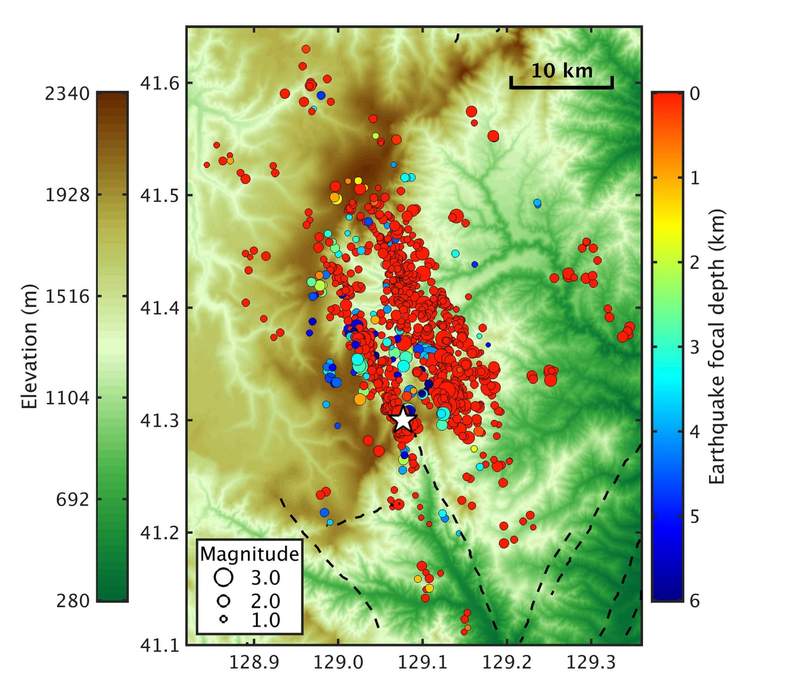
Underground nuclear explosions are usually discussed in terms of what they release into the atmosphere, what they reveal about a weapons program, or how far their seismic waves travel. A newly published study in the journal Science, appearing in Volume 393, Issue 6817, pages 1209 through 1212, shifts the focus to something slower and more structural: the faults beneath the test site itself. According to the paper, the nuclear tests carried out at Mount Mantap have reactivated intraplate faults — fractures in the Earth's crust that sit well away from the boundaries where tectonic plates grind against one another.
The distinction matters. When earthquakes occur along plate margins, the mechanics are relatively well understood: stress accumulates as plates converge, diverge, or slide past each other, and the rock eventually fails. Intraplate faults are a different problem. They lie in the comparatively quiet interior of a plate, where strain builds slowly and where the triggers for sudden slip are harder to pin down. The new findings suggest that a sufficiently large underground detonation can serve as exactly such a trigger.
Why Mount Mantap Draws Scientific Attention
Mount Mantap has been the site of a series of underground nuclear tests, and each detonation has produced seismic signals recorded by monitoring networks around the world. Because the explosions are deliberate, well-instrumented and precisely timed, they function as something close to a controlled experiment — a known source at a known location, with the resulting ground motion captured in detail.
That combination of a defined source and dense observation is rare in seismology. Natural earthquakes strike without warning and their rupture details must be inferred after the fact. Detonations, by contrast, allow researchers to separate the input from the response. The study's conclusion that intraplate faults were reactivated rests on that advantage: the explosions provided the impulse, and the faults provided the answer.

What Intraplate Faults Are — and Why They Are Overlooked
Plate Boundaries Versus Plate Interiors
Most of the world's seismic hazard maps are built around plate boundaries, and for good reason. The majority of large earthquakes cluster there. But a meaningful share of damaging events occurs far from those margins, in the stable interior of continents. These intraplate earthquakes are less frequent, which makes them harder to study statistically, and their causes remain an active area of research.
- They occur where stress accumulates slowly, often over long periods, without the continuous loading seen at plate edges.
- They can strike regions with little historical record of seismicity, leaving communities unprepared.
- Their recurrence intervals are typically long, so instrumental records capture only a snapshot.
- Faults in these settings are often ancient, buried, and poorly mapped from the surface.
Because intraplate faults are difficult to observe directly, any process that nudges them toward slip is worth understanding. The Mount Mantap findings add a human-driven mechanism to that list.
How an Underground Explosion Alters the Rock Around It
When a nuclear device is detonated underground, it vaporizes a cavity in the surrounding rock and sends a shock wave outward in all directions. The immediate effects are dramatic, but the study points toward something more enduring. The passage of that energy redistributes stress through the rock mass, and existing fractures — especially those already close to failure — can be pushed over the threshold.
The result is a fault that had been quiet for an unknown length of time moving again. "Reactivated" is the operative word here: the structures were not created by the explosions, but their behavior was changed by them. That framing places the Mount Mantap observations in the broader discussion of how large energy releases, whether from explosions or from earthquakes themselves, can perturb the state of stress in the crust and set off subsequent movement nearby.
The Monitoring Angle
For the international community, underground nuclear tests are tracked primarily through seismology. Networks of stations detect the ground motion, and analysts distinguish explosions from earthquakes using characteristics such as the relative strength of compressional and shear waves, depth estimates, and the ratio of body-wave to surface-wave energy.
If tests at a site can reactivate local faults, that complicates the picture in a useful way. Fault slip generates its own seismic signal, which means the recorded wavefield may contain a mixture of contributions: the explosion itself plus any triggered movement along nearby structures. Disentangling the two requires careful modeling, but the payoff is a more complete accounting of what actually happened underground — and, potentially, an additional diagnostic for identifying human-made events.
Open Questions the Study Raises
The paper establishes that reactivation occurred, but it also invites a set of follow-on questions that seismologists will need to address:
- How long do faults remain in an altered stress state after a detonation?
- Does repeated testing at the same site progressively change the surrounding fault network?
- Can reactivated slip be distinguished reliably from the explosion's own seismic signature at regional distances?
- What does the Mount Mantap case imply for other sites where large underground explosions have occurred?
- How should intraplate fault maps be updated in regions that host or have hosted such activity?
Each of these questions touches on a different discipline — rock mechanics, observational seismology, and hazard assessment — which is part of why the finding is likely to travel beyond the immediate community of researchers who study underground explosions.

The Larger Implication for Seismic Hazard
Perhaps the most consequential takeaway concerns how scientists think about triggers. If an explosion can reactivate a dormant intraplate fault, then the catalogue of processes capable of influencing fault behavior is broader than sometimes assumed. That does not mean every detonation produces damaging earthquakes, and the study does not suggest a simple one-to-one relationship between testing and regional seismicity. It does mean that the crust beneath a test site should be treated as a dynamic system rather than an inert medium.
For hazard analysts, the Mount Mantap result reinforces a familiar caution: faults that have not moved in recorded history are not necessarily faults that cannot move. For arms-control specialists, it adds a layer of complexity to the already difficult task of characterizing underground events. And for geophysicists, it offers a rare chance to watch stress transfer play out in a setting where the source is known.
The study, published in Science, will likely prompt renewed scrutiny of seismic records from test sites worldwide, as researchers look for signs that the same mechanism has operated elsewhere. The Mount Mantap case may turn out to be less an anomaly than a well-documented example of something that has happened before — and could happen again.
This article is based on reporting by Science (AAAS). Read the original article.
Originally published on science.org