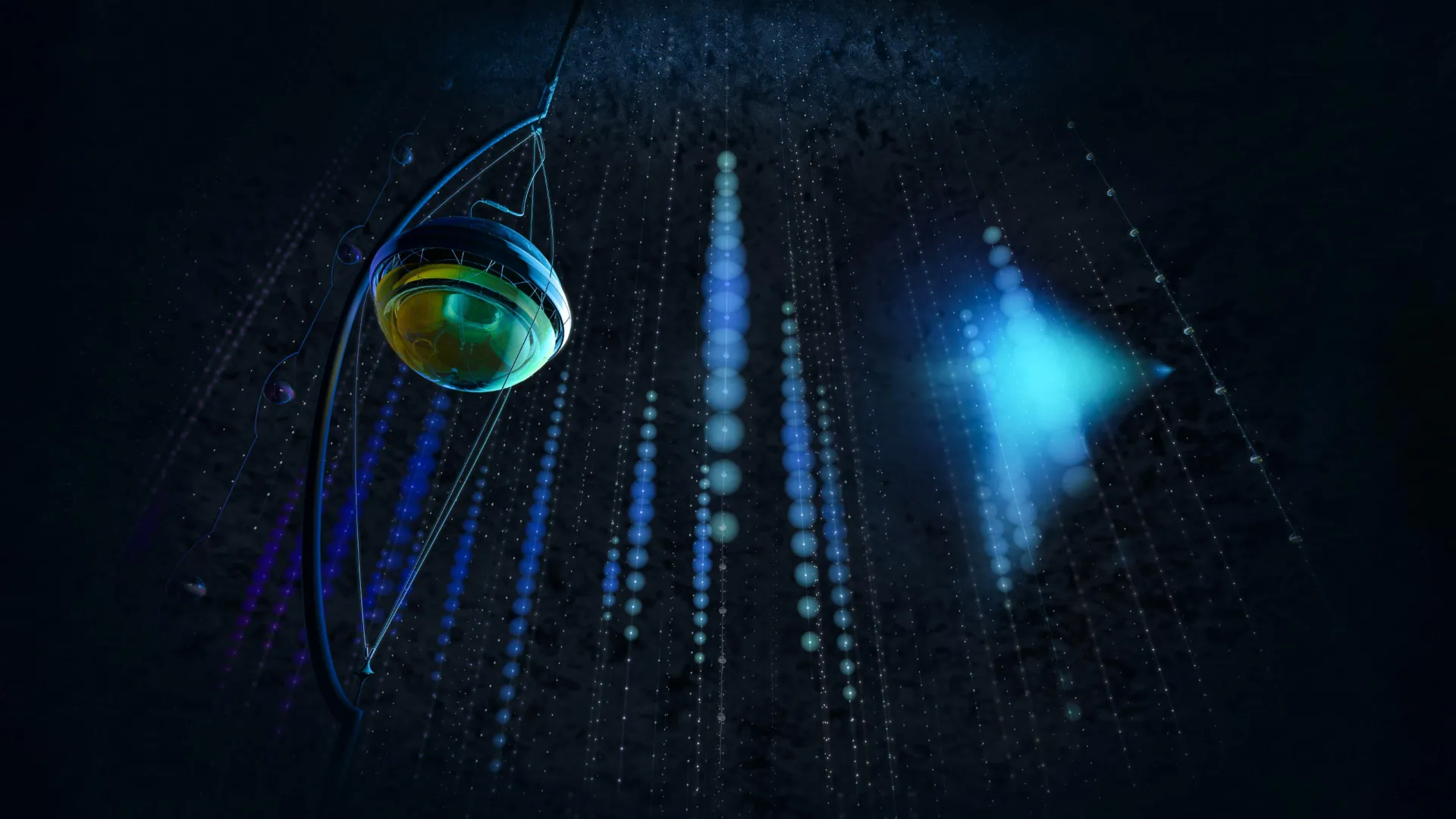
Scientists are using the IceCube Neutrino Observatory, a vast detector embedded in Antarctic ice, to detect extremely energetic neutrinos arriving from beyond Earth. These nearly massless, electrically neutral particles interact so rarely with matter that they can pass through the planet, including the human body, with little chance of leaving a trace.
That elusiveness is exactly what makes neutrinos scientifically valuable. Unlike charged particles, they are not deflected by magnetic fields as they travel through space. Their weak interaction with matter can also allow them to emerge from environments that may be difficult to observe with other messengers. Detecting them could help researchers investigate the universe’s most extreme events and conditions.
A detector built into Antarctic ice
IceCube is designed to capture the rare instances in which a neutrino does interact. The observatory is buried deep in Antarctic ice, using the ice as the medium in which evidence of those interactions can be observed.
The particles are often described as “ghost particles” because of their ability to travel through matter almost unhindered. Neutrinos come in three varieties: electron, muon, and tau neutrinos. They have no electric charge and do have mass, but their exact masses remain unknown. The source material describes their mass as potentially around 10 million times less than that of an electron.
These properties make neutrino experiments unusually challenging. A detector must monitor a very large volume to have a reasonable chance of observing an interaction, while researchers must also distinguish signals from backgrounds and reconstruct what an observed event can reveal about the incoming particle.

Energy far beyond solar neutrinos
The reported IceCube detections involve neutrinos with energies described as 10 billion times those of solar neutrinos. Solar neutrinos are produced in the Sun and pass continually through Earth. The much more energetic particles detected by IceCube are associated with distant cosmic sources and point toward processes operating at a vastly different scale.
High-energy neutrinos can provide evidence about the sources that accelerate particles to extraordinary energies. The source material says they may offer clues about the Big Bang, extreme cosmic events, and other major unanswered questions in astrophysics and cosmology.
Neutrino research has already had a major role in physics. Discoveries involving neutrinos have contributed to five Nobel Prizes in Physics, according to the report. Their study has helped establish that neutrinos have mass, while leaving open fundamental questions about how that mass arises and exactly how large it is.
Astrophysical messengers
Astronomers learn about the universe through more than visible light. Radio waves, X-rays, gamma rays, gravitational waves and cosmic particles can each reveal different aspects of an event. Neutrinos add another channel because they can travel enormous distances and, in some circumstances, pass through material that blocks or reshapes electromagnetic signals.
That does not make neutrinos simple messengers. Their reluctance to interact is a two-sided trait: it allows them to preserve information from remote environments, but it also means only a tiny fraction can be detected. IceCube’s scale is a response to that problem.
The observatory’s location is part of its scientific design. The clear Antarctic ice provides a large, stable detection medium deep below the surface. By monitoring rare interaction signatures in that ice, scientists can build evidence for neutrinos that have crossed astronomical distances.

Open questions remain
The new high-energy detections do not resolve all of the mysteries surrounding neutrinos. Their exact masses remain unknown, as does the mechanism responsible for producing their masses. Researchers are also working to identify and understand the distant environments that generate the most energetic astrophysical neutrinos.
Those uncertainties are central to the importance of the field. Neutrinos connect particle physics, nuclear physics, astrophysics and cosmology. A measurement that sheds light on their properties can affect how scientists describe matter at the smallest scales as well as how they reconstruct violent processes in the cosmos.
The report also highlights the role of physicist Francis Halzen, who received a prestigious award this year for contributions to the IceCube observatory and the discovery of high-energy neutrinos of astrophysical origin. George Fuller, a University of California San Diego physicist who has studied nuclear physics, particle astrophysics and cosmology, collaborated with Halzen on an early IceCube paper.
A growing cosmic toolkit
The significance of IceCube lies not only in detecting rare particles, but in establishing neutrinos as a practical tool for studying the high-energy universe. Every well-characterized detection helps researchers refine how they connect a particle’s arrival with a possible distant origin and physical process.
As IceCube and related research continue, high-energy neutrinos may help fill gaps left by conventional observations. Their weak interactions make them difficult to catch, but they also make them unusually direct travelers from some of the universe’s most energetic and inaccessible places.
For now, the Antarctic observatory demonstrates the scale of infrastructure required to study a particle that almost never stops. By turning a volume of polar ice into a detector, researchers are making those fleeting interactions count—and using them to probe phenomena far beyond Earth.
This article is based on reporting by Science Daily. Read the original article.

Originally published on sciencedaily.com