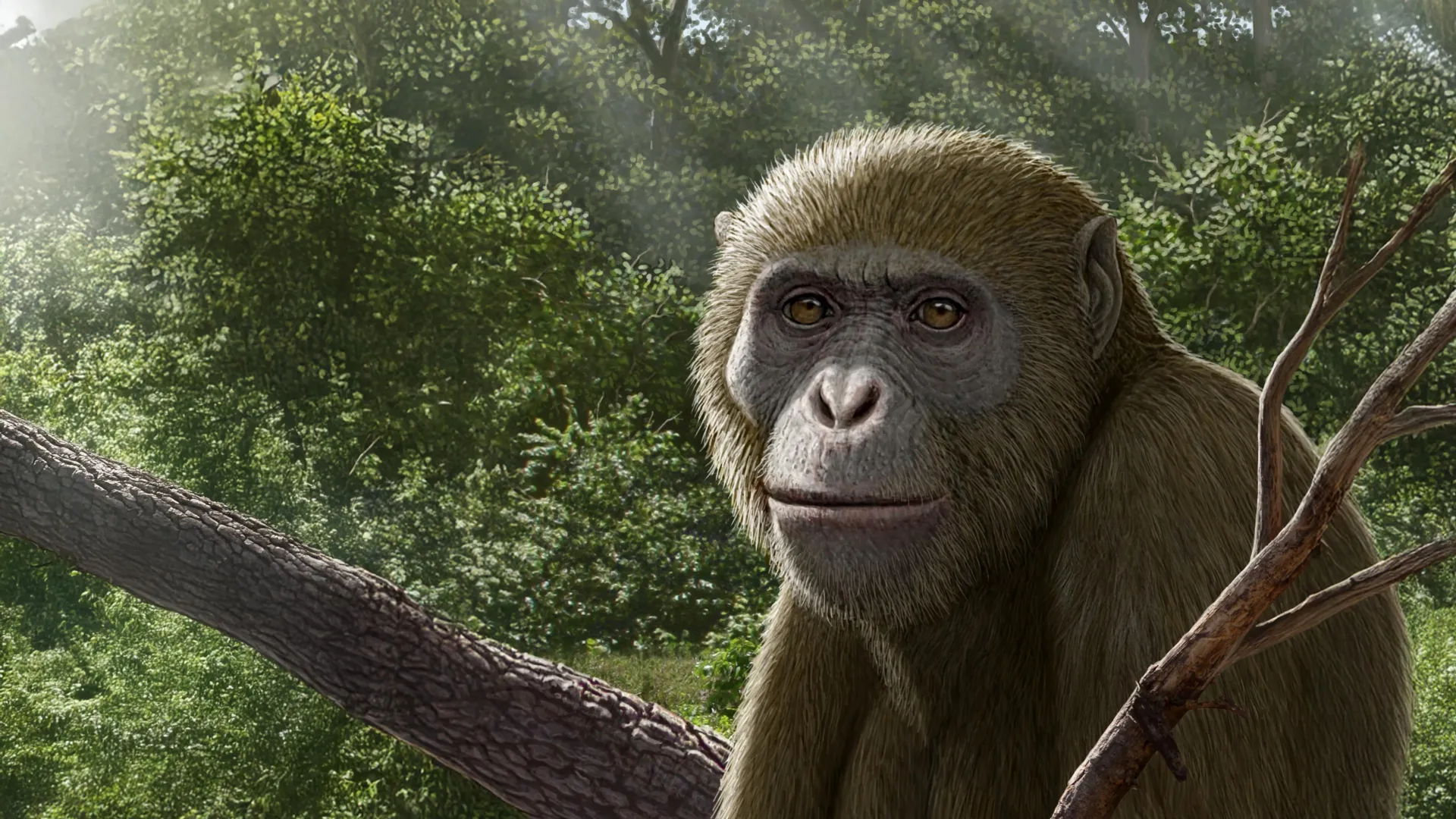
A northern African fossil challenges a familiar map of ape evolution
A fossil ape discovered at Wadi Moghra in northern Egypt is reopening a major question in evolutionary science: where did the lineage leading to living apes first take shape?
The newly identified species, Masripithecus moghraensis, lived roughly 17 to 18 million years ago in the Early Miocene. Researchers say it is the first definitive fossil ape found in North Africa. That alone makes it a consequential addition to a record that has long been uneven across the continent.
For decades, discussions of early ape evolution have often centered on eastern and southern parts of Africa, where influential fossil discoveries have been made. The Egyptian find does not settle the origin story of modern apes, and the researchers do not present it as doing so. But it provides evidence that northern Africa and the Middle East may have had a more important role in that story than prevailing narratives allowed.
Why the location matters
Living apes include humans, chimpanzees, gorillas, orangutans and gibbons. Reconstructing their deep evolutionary history depends on fossils that can show where earlier branches lived and how they were related. The available evidence is fragmentary: fossils of ancient primates are scattered across continents and geological periods, while their exact evolutionary relationships remain debated.
North Africa was a conspicuous gap in one part of that record. Early Miocene sites there had yielded ancient monkeys, but not definitive apes from the same era. That absence encouraged an image of early ape history concentrated farther south. Masripithecus now puts an ape in northern Africa during a period scientists consider important for understanding the rise and diversification of apes.
The discovery therefore changes the geography researchers need to consider. Rather than treating North Africa principally as a route between better-known fossil regions, scientists can examine it as a possible setting in which an important phase of ape evolution occurred.

A fossil found after a long search
The research was conducted by an international team associated with the Mansoura University Vertebrate Paleontology Center in Egypt and the University of Southern California in the United States. According to the researchers, the search for this type of fossil took five years.
That effort reflects a basic challenge in paleontology: a conclusion can be limited as much by where fossils have not been found as by where they have. Wadi Moghra, the site of the discovery, offers a new point of comparison for scientists examining early ape family trees. The species name, moghraensis, refers to that locality.
The team describes the fossil as a missing piece in the wider evolutionary puzzle. Such language should be read carefully. A single fossil cannot provide a complete family tree or identify a definitive birthplace for all living apes. What it can do is show that a previous absence was not necessarily biological. In this case, the lack of a North African fossil ape may have reflected the incompleteness of the fossil record rather than the absence of apes from the region.
What the finding changes—and what it does not
The most immediate implication is a shift in research priorities. Northern African and Middle Eastern fossil sites may deserve greater attention in studies of how the ape lineage emerged and spread. The discovery also creates new questions about the environments in which early apes lived, their relationships with other primates and the routes by which populations moved between Africa, Europe and Asia.
It does not replace the many discoveries that have made eastern and southern Africa central to human-origins research. Nor does it establish that modern apes originated in Egypt. The researchers instead argue that the evidence broadens the set of regions that may have been central to the evolutionary lineage eventually leading to all living apes.
That distinction matters because fossil discoveries are often interpreted through simplified maps: one place is described as the cradle, while all others become peripheral. The Egyptian fossil points toward a more complicated possibility, in which different regions contributed to different stages of ape evolution.

A reminder that the fossil record is still changing
Masripithecus moghraensis is especially notable because it comes from a time and location that had lacked definitive ape evidence. Its appearance will not end debates over ape origins, but it gives those debates a new data point with unusual geographic significance.
The larger lesson is that evolutionary history is continually revised as new material is recovered and compared. A region once treated as a blank space on the map can become central when a well-dated, carefully studied fossil is found there. For researchers investigating the ancestry of humans and other apes, northern Egypt has now become a place that cannot be overlooked.
This article is based on reporting by Science Daily. Read the original article.
Originally published on sciencedaily.com