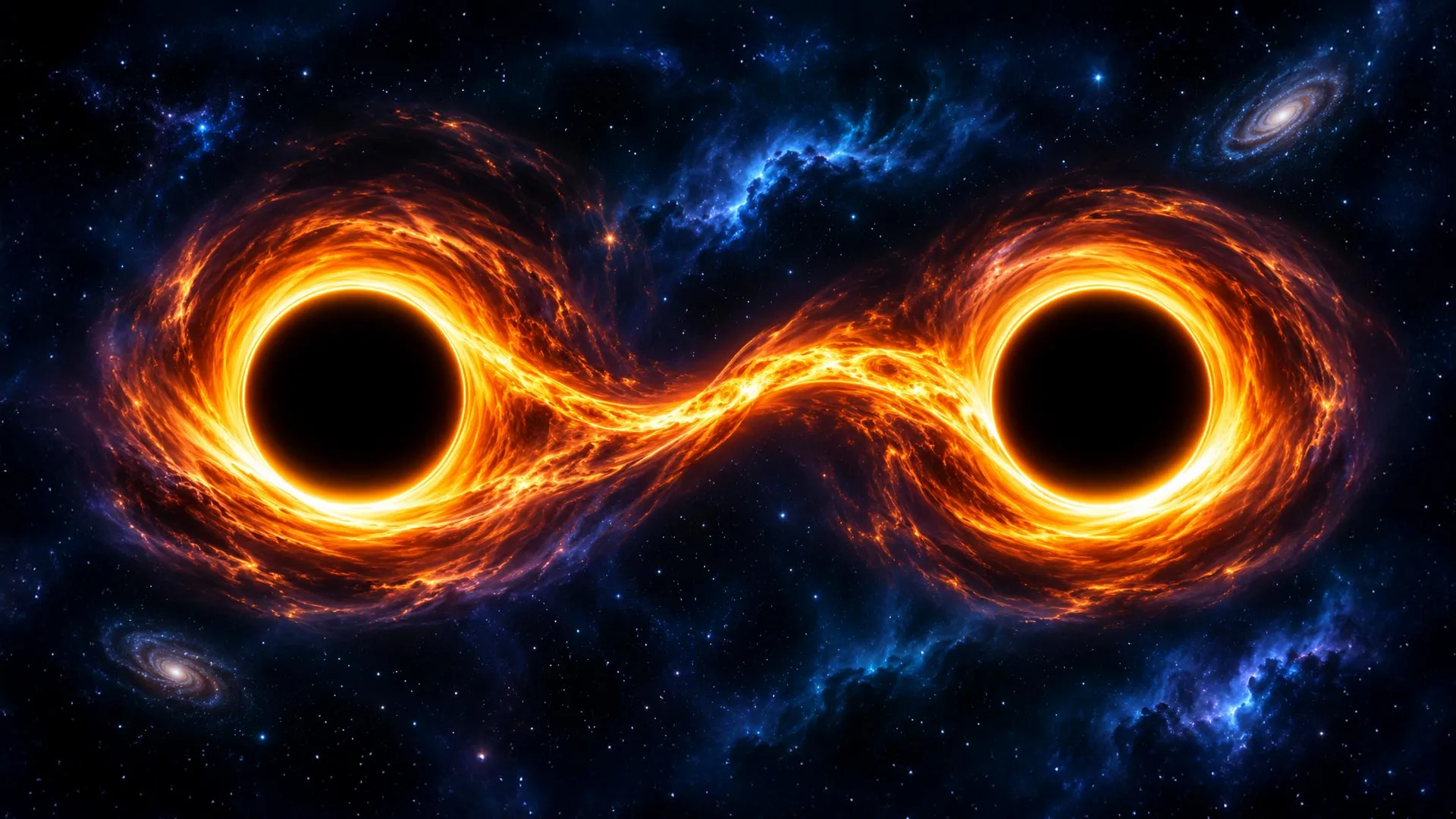
Black holes are commonly associated with collision and merger. When two black holes meet, gravitational-wave observatories have shown that they can combine into a larger object. A new theoretical study asks whether the reverse process could ever occur: could one black hole split into two?
The answer proposed by the researchers is not that ordinary black holes are expected to divide. Instead, their work identifies a possible loophole in the physical restrictions that normally make such a process thermodynamically unfavorable. The conditions would be extreme, involving black holes spinning at very high rates.
The study, published in
Physical Review D, is titled
When Black Holes Admit Pair-of-pants Topologies. It was carried out by researchers affiliated with the University of Naples Federico II, the University of Southern Denmark, CNRS and Sorbonne Université.
Why splitting is normally ruled out
The central obstacle is entropy, a thermodynamic quantity related to the number of microscopic arrangements compatible with a system’s observable state. Black holes have entropy, and that fact constrains which transformations are physically allowed.
For a non-rotating black hole, splitting into two smaller black holes would reduce the total entropy, according to the supplied report. A process that lowers total entropy is thermodynamically disfavored, offering a reason that black holes are not normally expected to fragment.
This is not simply a question of whether gravity could pull an object apart. The study examines the conditions under which the laws governing black-hole thermodynamics and geometry permit a change in the topology of the event horizon. In the researchers’ framing, the proposed geometry resembles a pair of pants: one connected horizon evolving into two.

Spin changes the calculation
The new analysis focuses on the role of rotation. A black hole can carry angular momentum, and a sufficiently rapid spin changes the balance of the thermodynamic terms relevant to a possible split. The researchers conclude that, in an extreme regime, the usual entropy-based prohibition may no longer apply in the same way.
That conclusion is intentionally narrow. It does not mean astronomers have observed a black hole splitting, and it does not establish that such events are common. The source describes the work as a theoretical study and emphasizes that the required conditions would be extreme.
Even so, the idea matters because it tests the boundaries of assumptions built into the standard picture of black-hole evolution. Physics has a well-developed account of black-hole mergers, supported by gravitational-wave observations. A credible path to fragmentation would introduce a qualitatively different phenomenon: a single compact object becoming two.
From mathematical possibility to observation
The study raises the prospect that future telescopes could potentially detect evidence of this kind of behavior. That is a long way from a prediction of a near-term discovery. The supplied material does not identify a specific black-hole candidate, an expected rate of events, or a unique observable signal.
Those missing pieces are important. A theoretical loophole must be connected to astrophysical environments before it can become a practical observing program. Researchers would need to establish whether nature produces black holes with the relevant spin and other required properties, whether a split can proceed dynamically, and what traces it would leave in gravitational waves or electromagnetic observations.
The work nevertheless helps define questions for future research. If a horizon can undergo the proposed transition, scientists will want to know how energy, angular momentum and entropy are distributed between the resulting black holes. They will also need to determine whether quantum effects, environmental interactions or instabilities alter the result.

A challenge to a familiar picture
Black holes are often described as simple in broad outline: characterized by mass, spin and electric charge. Yet their behavior under extreme conditions remains a fertile testing ground for gravity, quantum theory and thermodynamics. The possibility of splitting sits at the intersection of those fields because it concerns both the shape of spacetime and the directionality imposed by entropy.
The researchers are not discarding the thermodynamic principles that make fragmentation unlikely for a non-rotating black hole. Their result instead suggests that rotation can create a special case in which the argument must be reconsidered.
For now, the finding should be understood as an exploration of what fundamental theory allows, not a claim that black holes in the sky are routinely breaking apart. Its value is in mapping a boundary: a phenomenon once treated as categorically forbidden may have a narrowly defined route through the laws of physics.
What the study says—and does not say
- Non-rotating black holes are thermodynamically disfavored from splitting because total entropy would decrease.
- Extremely rapid rotation may create a loophole in that restriction.
- The work is theoretical and does not report an observed splitting black hole.
- Further research is needed to identify possible observational signatures and realistic astrophysical conditions.
If future work connects this mathematical possibility to measurable signals, black-hole fragmentation could become a new target for astronomy. Until then, the study is a provocative examination of how far black-hole physics can be pushed under the most extreme conditions nature may permit.
This article is based on reporting by Science Daily. Read the original article.
Originally published on sciencedaily.com