Evidence from an unexpectedly small collision system
Scientists working at CERN’s Large Hadron Collider have reported new evidence that quark-gluon plasma can emerge in collisions involving comparatively small atomic nuclei. The result comes from the collider’s first oxygen-ion collisions and from collisions involving neon nuclei, and it challenges a long-standing assumption that only the heaviest ion collisions could produce this extreme state of matter.
All four of the LHC’s major experiments—ALICE, ATLAS, CMS and LHCb—have now reported signs consistent with the formation of this primordial material in oxygen and neon collisions. The findings offer a new route for studying conditions thought to have existed in the earliest moments of the universe.
The announcement is significant because it is about the size of the physical system being studied, not simply the energy of a collision. Researchers have long used heavy lead nuclei to create the dense, hot environment needed to investigate quark-gluon plasma. Oxygen and neon are much lighter than lead, making their use a test of how small a collision system can be while still showing the collective behavior associated with this unusual phase of matter.
What quark-gluon plasma is
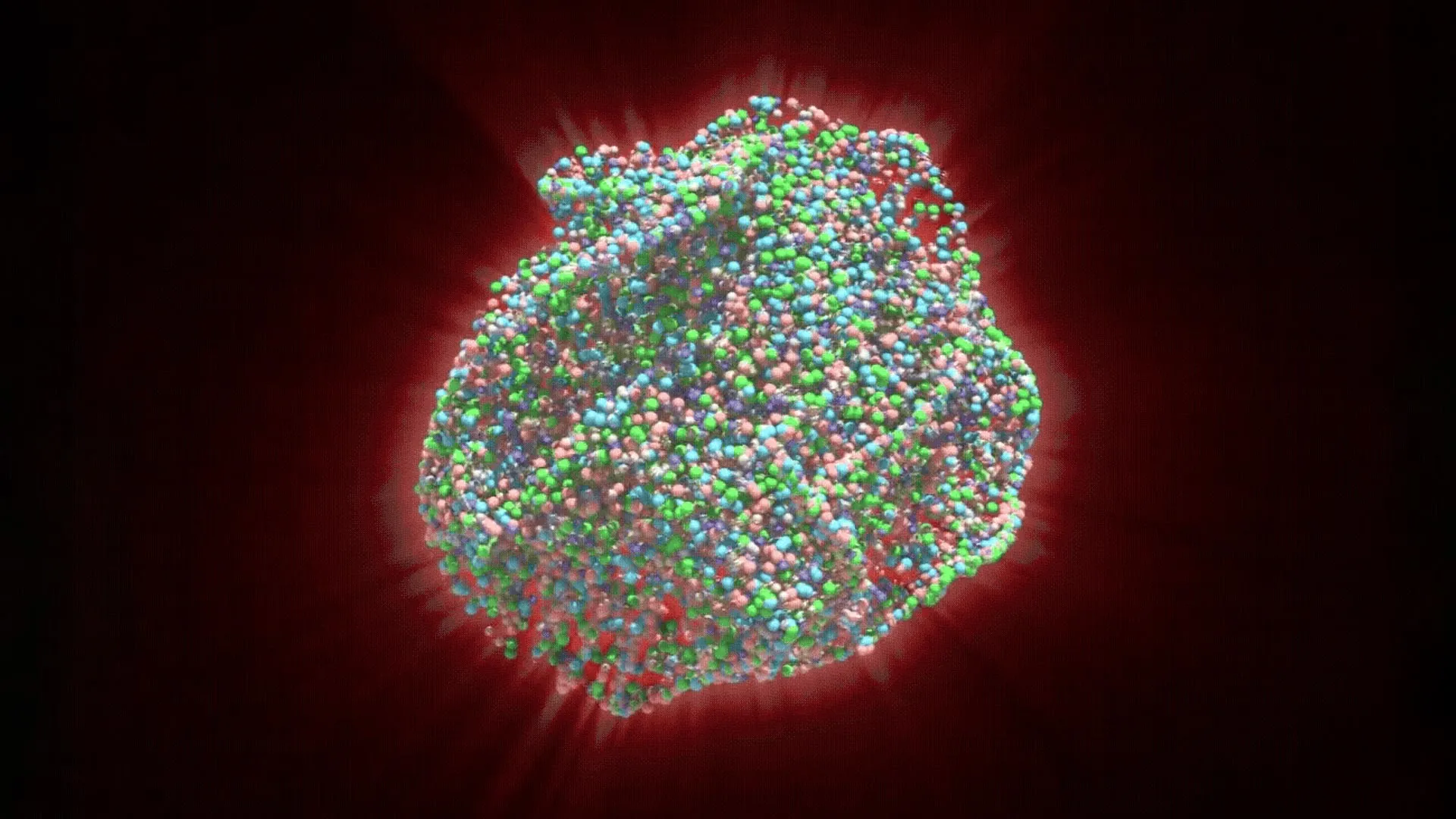
Quark-gluon plasma, often abbreviated QGP, is a state of matter produced at extraordinary temperatures and pressures. Under everyday conditions, quarks are bound together by gluons inside particles such as protons and neutrons. In a quark-gluon plasma, those ordinary structures do not remain intact in the same way: the matter consists of quarks and gluons in an extreme environment.
Physicists believe the universe was filled with this form of matter during the first millionths of a second after the Big Bang. Recreating it in a laboratory does not recreate the early universe in full, but it gives researchers brief access to matter under conditions that cannot be found naturally on Earth.
The temperatures involved are immense. The reported work describes quark-gluon plasma as forming at temperatures more than 100,000 times hotter than the center of the Sun. At that scale, the familiar components of ordinary nuclear matter behave very differently from the protons and neutrons found in everyday atoms.
Why heavy lead ions became the standard tool
For decades, the conventional approach to producing quark-gluon plasma at the LHC relied on collisions of very heavy nuclei, especially lead. Lead nuclei are more than 200 times heavier than individual protons. When two lead nuclei collide at very high energy, they can produce the dense and hot conditions expected to be favorable for plasma formation.
That history created a practical working assumption: a sufficiently large collision system was required to make the plasma. Smaller systems were expected to be less likely to generate enough energy density, or to persist long enough, for the characteristic collective effects of QGP to emerge.
Recent findings have increasingly questioned that simple picture. The new reports from oxygen and neon collisions add to the case that the threshold is lower, or at least more nuanced, than the earlier heavy-ion framework suggested. The key point is not that every small collision creates primordial matter, but that evidence now indicates it can arise in systems far smaller than those traditionally considered necessary.
Four experiments, one broader picture
The involvement of ALICE, ATLAS, CMS and LHCb gives the result a broad experimental foundation. Each collaboration has a distinct role and detector configuration at the LHC, and their reported signs point toward a shared conclusion about the behavior observed in small ion collisions.
ALICE specializes in studying heavy-ion collisions and the quark-gluon plasma they can create. ATLAS, CMS and LHCb are also major LHC collaborations with different experimental capabilities. Their collective reporting is important because the question of plasma formation is not resolved by a single measurement or a single detector. Physicists look for multiple, compatible indicators when evaluating whether a collision system has produced QGP-like behavior.
The supplied report does not describe every measurement underlying the collaborations’ conclusions. It does establish that the results have been reported across all four experiments and that the interpretation is evidence for the emergence of quark-gluon plasma in oxygen and neon collisions.

A new way to probe the early universe
Smaller ion systems could become a valuable complement to lead-ion collisions. By varying the nuclei used in collisions, researchers can compare how the signatures of quark-gluon plasma change as the size of the system changes. That may help them identify which conditions are essential for the plasma to form and which features depend on the scale of the collision.
This is a controlled experimental advantage. The early universe cannot be directly observed in its first millionths of a second, but particle collisions allow scientists to create fleeting high-energy environments and compare the resulting behavior across different conditions. Oxygen and neon collisions add new points to that experimental map.
The result also sharpens a foundational question in high-energy nuclear physics: how small can a system be and still exhibit the collective properties of quark-gluon plasma? Earlier expectations centered on very heavy nuclei. The latest evidence means that the boundary needs to be investigated with more care.
What the finding changes—and what it does not
The new evidence does not mean the LHC has discovered a new form of matter; quark-gluon plasma has been studied for years in heavy-ion collisions. Nor does it imply that small collisions are identical to lead-lead events. Instead, it expands the experimental conditions under which physicists have observed signs of this primordial state.
That expansion matters because scientific progress often comes from finding where an accepted rule stops being sufficient. The old expectation was useful: large, heavy nuclei clearly provide the conditions needed for QGP research. The oxygen and neon results suggest that the underlying physics is more flexible than a simple large-versus-small divide.
As the LHC collaborations continue studying these systems, their data may help refine models of how quarks and gluons behave under extreme heat and density. For now, the central result is already striking: matter resembling the substance that filled the early universe appears to be accessible in collisions much smaller than physicists once thought possible.
This article is based on reporting by Science Daily. Read the original article.
Originally published on sciencedaily.com