A New Entry in RNA-Guided DNA Recognition
A research report in the journal Science introduces a mechanism its authors call VIPR, described in the paper's title as RNA-guided DNA recognition through noncontiguous geometric triplex formation. The article appears in volume 393, issue 6817, spanning pages 1236 to 1240, with a publication date in September 2026. The title places the work at the meeting point of two durable research traditions: programmable nucleic acid targeting, familiar from RNA-guided systems, and triple-helical DNA structures, in which an additional strand pairs with the double helix.
The article is distributed behind a publisher paywall, so the public record currently available is limited largely to the title, journal placement, and pagination. The most honest way to cover it, then, is to explain the concepts its title invokes, the questions those concepts raise, and what will matter once the full text becomes widely accessible.
What "Noncontiguous Geometric Triplex Formation" Suggests
Two elements of the phrase carry the technical weight. "Triplex formation" refers to a third nucleic acid strand associating with the familiar Watson-Crick duplex, typically by reading chemical features exposed in the major groove rather than by unwinding the two existing strands. Triple-helical structures have been studied for decades, and their appeal lies in the promise of sequence-specific recognition without permanent disruption of the underlying duplex.
"Noncontiguous" implies that the recognition elements are not a single uninterrupted block. A targeting system that works across separated sites would be reading a pattern rather than a continuous string, which changes how specificity and geometry must be understood.
"Geometric" points to three-dimensional arrangement — the angles, spacing, and steric fit that allow a structured nucleic acid complex to contact its target. Coupling geometry to noncontiguous recognition suggests that shape complementarity, not just base identity, governs whether the interaction succeeds.
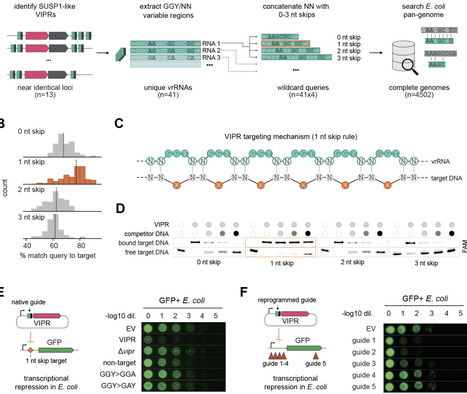
VIPR is described as RNA-guided, meaning the system's targeting information is carried by RNA. That is the architecture that made RNA-guided nucleases so adaptable: swapping the guide changes the destination without redesigning the protein. Whether VIPR uses a single guide, multiple guides, or a structured RNA scaffold is a detail only the full paper can settle.

Why Triple-Helix Recognition Still Draws Interest
Work on triplex-forming oligonucleotides grew out of a simple ambition: address DNA directly, by sequence, without cutting it. Such molecules could in principle block transcription, mark specific loci, or deliver chemistry to a chosen site. Practical obstacles — stability, cellular delivery, and the narrow sequence windows that favor triple-helix formation — kept the approach from dominating the field, particularly as protein-based editors matured.
A mechanism that broadens the range of sequences eligible for triplex-based recognition, or that uses RNA to organize the geometry, would address part of that historical limitation. It would also connect structure-driven targeting with the programmability that guide RNAs provide.
Where VIPR Sits Among Existing Targeting Tools
Modern genome targeting relies on several distinct strategies. Nucleases guided by RNA create breaks at chosen sites; base editors and prime editors use similar targeting logic to install changes without full double-strand breaks. All of them depend on a guide molecule locating a complementary sequence and on a protein or protein-RNA assembly doing the chemistry.
The VIPR title does not indicate that it replaces any of these tools, and readers should be cautious about assuming a therapeutic application. The published record describes DNA recognition, not editing, delivery, or outcomes in cells or organisms. Whether the mechanism is presented as a structural curiosity, a diagnostic principle, or a platform for future engineering remains an open question until the full text is examined.

What the Citation Record Confirms
The verifiable facts are narrow: the paper is titled "VIPR RNA-guided DNA recognition by noncontiguous geometric triplex formation," it is published by Science, a peer-reviewed journal from AAAS, it appears in volume 393, issue 6817, at pages 1236-1240, and its publication date is September 2026. A five-page footprint places it in the range of a standard research report rather than a lengthy review, which generally means the central claim rests on focused experiments and supporting figures rather than an exhaustive survey.
None of that establishes the results. Page count and venue speak to editorial review and scope, not to effect size, reproducibility, or generality.
Questions Readers Will Bring to the Full Text
- How many bases or structural features does VIPR read, and how far apart can recognition elements sit while the complex remains stable?
- What is the measured specificity — how does the system behave at near-match sites that differ by a single position?
- Does the mechanism require particular sequence composition, such as purine-rich tracts, that would limit where it can be applied?
- Is targeting reversible, and what controls assembly and disassembly of the triplex?
- Was the work demonstrated in a purified system, in cells, or in a living organism?
- How does the approach compare with established RNA-guided systems on sensitivity and on ease of reprogramming?
Why the Result Matters Regardless of Application
Even without immediate practical use, a new route to sequence-specific DNA recognition is scientifically notable. It would add to the catalogue of ways nucleic acids can be addressed — by strand invasion, by protein-guided search, and, per the title, by a geometry-dependent triplex arrangement with RNA supplying the address. Understanding the rules of such recognition could inform how researchers design probes, how they interpret unusual nucleic acid structures inside cells, and how they think about the physical limits of specificity.
How to Follow the Work
The paper's landing page is hosted at science.org under the DOI 10.1126/science.aei3472, where the abstract and, for subscribers, the full text are available. Readers without institutional access can typically find the abstract there and may watch for preprint versions, author presentations, or coverage from structural biology and nucleic acid chemistry communities.
Developments Today will revisit this story if the full text or follow-up reporting clarifies the mechanism's scope, its measured performance, and its relationship to the broader RNA-guided toolkit.
This article is based on reporting by Science (AAAS). Read the original article.
Originally published on science.org