New visibility into an emerging Russian weapon
Ukraine’s military intelligence directorate has released new details on Russia’s S-71K Kovyor, an air-launched missile that Kyiv says has been used in combat since late last year. The disclosures, reported by The War Zone, include an interactive 3D model and technical details that point to a clear design philosophy: build a weapon that is less expensive than Russia’s more established cruise missiles, but still survivable enough to function as a useful standoff strike option.
That tradeoff matters. Russia’s war in Ukraine has exposed the pressure that sustained, high-volume strike campaigns place on industrial capacity. When a country cannot easily replenish large numbers of complex missiles, a lower-cost design with some stealth features becomes strategically attractive, even if it lacks the full refinement of more premium systems.
What Ukraine says the missile is
According to the report, Ukraine’s Main Directorate of Intelligence says the missile was developed specifically for Russia’s Su-57 fighter. The S-71K appears to integrate a Cold War-era OFAB-250-270 high-explosive fragmentation bomb into a new low-observable airframe, creating a hybrid approach that reuses an established warhead while simplifying other parts of the weapon’s architecture.
The reported warhead weight is 551 pounds. That is significant enough to make the missile useful against a range of targets while still fitting the concept of a comparatively economical, producible standoff munition. The larger story here is not only the missile’s payload, but the use of older bomb infrastructure inside a more modern delivery shell. That kind of engineering shortcut can help accelerate output under wartime constraints.
A stealth shape without every stealth expense
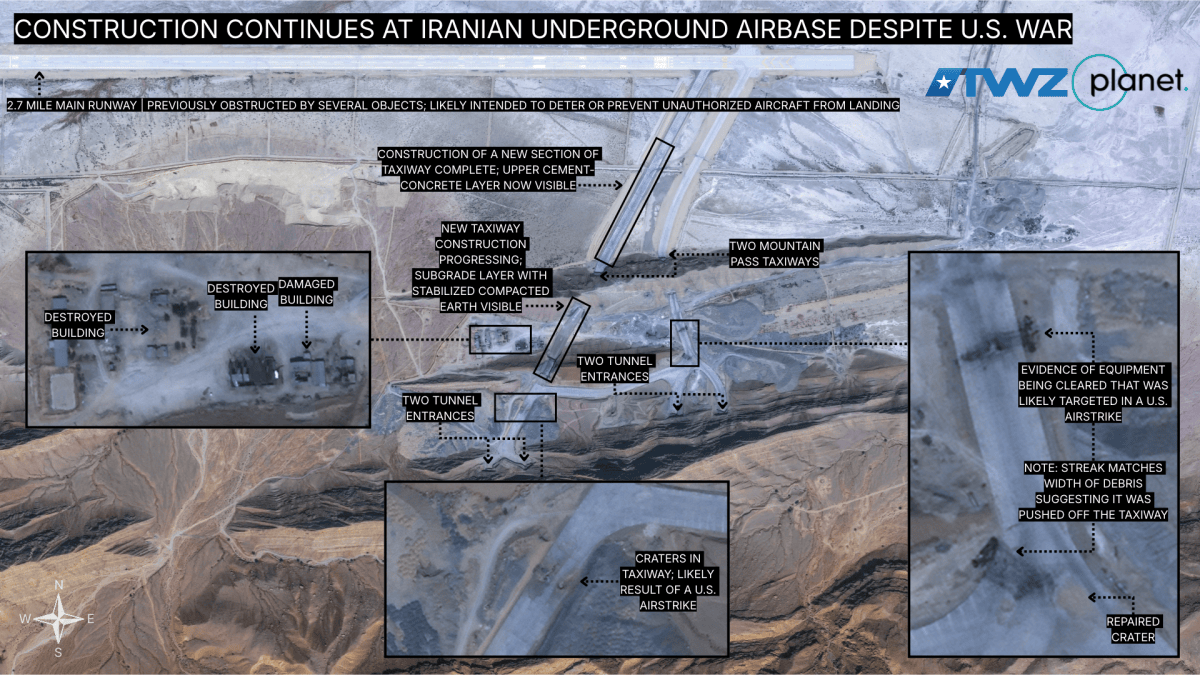
The design details released by Ukraine suggest a missile shaped for reduced detectability. The report describes a low-observable airframe with a trapezoidal cross section, chined nose, pop-out swept wings, and an inverted V-tail. Available imagery also shows a top-mounted conformal engine intake feeding a pentagon-shaped intake duct.
Just as notable is what the report says appears to be missing: no obvious signs of radar-absorbent material or other low-observable coatings. If accurate, that would fit the logic of a budget-conscious survivability approach. Shaping can reduce radar signature without the higher cost and manufacturing complexity associated with more sophisticated stealth treatments. In other words, Russia may be trying to build something stealthier than a conventional cruise missile, but cheaper and faster to field than a top-tier low-observable weapon.
The missile’s airframe is described as using multilayer fiberglass with additional reinforcement, while internal elements reportedly include aluminum alloys. Material choices matter because they affect both production cost and how scalable the design may be. If the goal is volume production under strain, material and manufacturing simplicity become strategic variables.
Why this class of weapon matters now
The broader significance of the S-71K lies in what it says about wartime adaptation. Russia has long relied on established air-launched cruise missiles for deep and standoff attack. But current production levels, according to the report’s framing, are struggling to meet wartime needs. That creates pressure to diversify the strike arsenal with weapons that are more affordable, more producible, or both.
A missile like the S-71K fits that environment. It does not need to be a perfect replacement for legacy systems to be operationally useful. If it can reach defended targets at range while being cheap enough to build in larger numbers, it could help sustain strike tempo even when industrial constraints tighten.
This is a recurring lesson in modern conflict: elegant, high-end systems attract attention, but wars of attrition often reward weapons that can be made at scale. A lower-cost missile with partial stealth features may be less impressive on paper than a premium cruise missile, yet more relevant to the realities of prolonged war.
Foreign components and industrial dependence
Another detail in the report is the sourcing of electronic components. Ukraine’s intelligence service says the “vast majority” are of foreign origin, including items manufactured in countries such as China, Germany, Ireland, Japan, Switzerland, South Korea, and Taiwan. If that assessment is accurate, it again underscores a persistent feature of Russian defense production during the war: continued dependence on external supply channels for critical subsystems.
That does not necessarily make the missile ineffective. It does, however, highlight how industrial resilience and sanctions enforcement remain part of the battlefield equation. A weapon designed for mass production still depends on access to components. The sustainability of output may therefore hinge as much on procurement networks as on engineering design.
What remains uncertain
As with many wartime weapons disclosures, important uncertainties remain. Independent verification of every technical detail is difficult, and performance in real combat can differ from design intent. Questions also remain about actual production numbers, launch profiles, guidance reliability, survivability against modern air defenses, and how frequently the missile is being used.
Still, even partial visibility is useful. The reported details help explain the niche the S-71K appears intended to fill: not a silver-bullet weapon, but a practical standoff missile optimized for wartime affordability and manufacturability.
A signal of industrial adaptation
The S-71K story is larger than one missile. It illustrates how Russia may be adapting its strike inventory under the pressure of a long war, turning to weapons that blend legacy payloads, moderate low-observable design, and potentially simpler production methods. If that interpretation holds, the missile represents a strategic industrial response as much as a technological one.
For Ukraine and its partners, that matters because defenses are not only challenged by the most advanced systems. They are also challenged by weapons that can be produced in enough quantity to keep coming. The S-71K appears to be aimed squarely at that problem.
This article is based on reporting by twz.com. Read the original article.
Originally published on twz.com