The Office of Naval Research is redefining its role in a private-capital defense boom
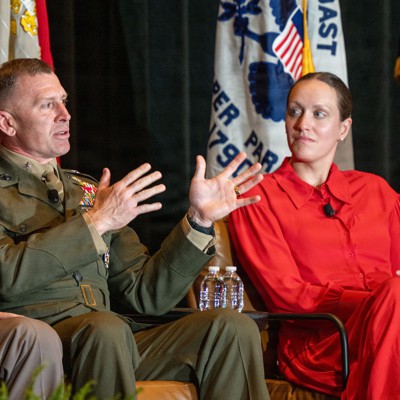
As venture money and commercial investment continue flowing into defense technology, the U.S. Navy’s chief science office says it is narrowing its focus to the problems companies are least likely to tackle on their own. At the Sea-Air-Space 2026 symposium, Office of Naval Research leader Rachel Riley described a strategy built around a simple screening question: what are the things industry cannot or will not solve?
That framing is a notable response to the changing innovation landscape. For years, federal defense R&D often occupied terrain that private capital either avoided or moved through slowly. Now the balance is shifting. With more commercial money targeting dual-use startups, autonomy, sensors and software, the Navy is under pressure to spend its roughly $3 billion annual research budget with more selectivity. ONR’s answer is to move further out on the timeline and deeper into areas with weak commercial incentives.
Riley said the office is trying to help stakeholders see not just what the Navy needs now, but what it will need across the next three future years defense program cycles. That is an explicit 15-year horizon, and it pushes ONR toward research that may be strategically important but commercially unattractive.
The technologies ONR says deserve attention
The areas Riley highlighted include new undersea technologies, novel forms of power and energy, and artificial intelligence that produces answers in ways humans can understand, especially military commanders. Those priorities reveal how the Navy is thinking about risk.
Undersea systems remain a classic example of a domain where military requirements can diverge sharply from commercial markets. Novel power and energy technologies carry a similar profile, particularly when the use cases involve endurance, resilience or operational environments that private-sector buyers do not define. The AI emphasis is equally telling. ONR is not just asking for more capable models. It is signaling a need for systems that are transparent and interpretable enough to support command decisions rather than merely generate outputs.
That matters because many of the strongest commercial incentives in AI reward performance, speed and deployability first. Military command environments impose a different burden. Decision-makers need to understand why a system produced an answer, not just whether it appears statistically strong. Riley’s emphasis suggests ONR sees explainability and human-legible reasoning as strategic requirements, not optional safety features.

A budget shift is driving the reprioritization
Defense One’s report ties Riley’s agenda to a broader change in federal spending priorities. The Trump administration, it notes, has chosen to spend less on military-led basic scientific research and more on applied research. ONR has long specialized in the former, which means the office is adjusting not only to market conditions but also to a budget environment that places a premium on nearer-term relevance.
That combination creates a difficult balancing act. Riley acknowledged that $3 billion is a large amount in taxpayer terms but still insufficient to cover every promising avenue. The implication is that ONR can no longer afford to duplicate efforts that a healthy commercial market is likely to fund anyway. If an area has a large addressable market, dual-use potential and a short path from concept to deployment, Riley indicated it is a strong candidate for private-sector investment rather than ONR leadership.
By contrast, ONR wants to reserve its attention for fields where commercial incentives are weak, timelines are long or military requirements are too specialized to attract sustained venture backing. This is not a retreat from innovation. It is an attempt to define a narrower, more defensible public role inside a much busier innovation ecosystem.
What ONR says it has done poorly
Riley also delivered a frank institutional critique: in the past, ONR has not done a good job of surveying private-sector research to determine where its own money would be most additive. That gap matters more now than it did when commercial defense investment was smaller and less organized. Without a sharper picture of what companies are already pursuing, government research offices risk spending public funds on crowded problems while more strategically important gaps go underserved.
The remedy, as Riley described it, is better awareness of market behavior. If ONR can identify where private industry is already likely to move, it can redirect resources toward technologies with long timelines, ambiguous business models or limited commercial spinout potential. That discipline is especially important in a period when defense-tech enthusiasm can create the impression that every important military problem will soon attract a startup.
ONR’s message is that this is not true. Some capabilities remain too specialized, too distant or too hard to monetize for private markets to solve reliably. In those cases, government research agencies still matter not because industry is inactive, but because industry is selective.
A more surgical public R&D role
The Navy’s emerging position reflects a broader question now facing governments in fast-moving technology sectors: when private capital is abundant, what should public research agencies do differently? ONR’s answer is to become more surgical. Instead of trying to lead everywhere, it wants to identify the neglected edges of the problem set and push there.
That approach could make the office more strategically coherent if it is executed well. It also raises the bar for internal market intelligence and program choice. Picking the wrong long-range bets can waste years. Picking the right ones can define capabilities that are unavailable any other way.
The significance of Riley’s comments is not simply that ONR has new priority areas. It is that the office is openly redefining its mission around the limits of the market. In an era of defense startup acceleration, that may be the most important role a military science agency can claim.
This article is based on reporting by Defense One. Read the original article.
Originally published on defenseone.com