Small vehicles now need protection from above as much as from the front
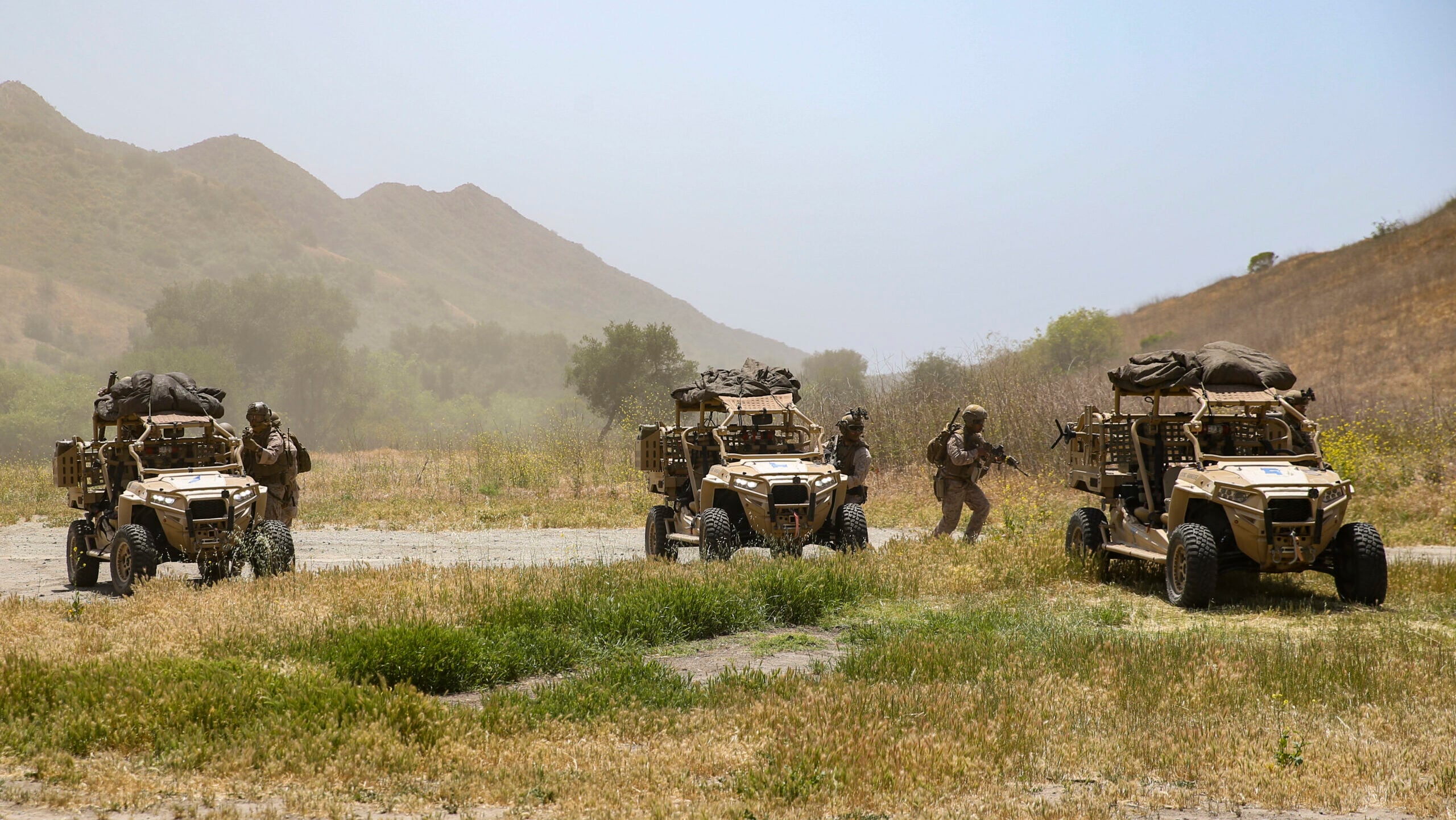
The battlefield logic behind light tactical vehicles is changing fast in Ukraine. Platforms once valued for speed, agility, and low profile now have to survive a threat that approaches from overhead with increasing precision: first-person-view drones and other one-way aerial attack systems. That shift is driving interest in a new protection kit for Polaris MRZR all-terrain vehicles being prepared for evaluation by Ukrainian special operations forces.
According to the source report, Australian company Andvare VI Defence Industries has teamed with Polaris Government and Defense to deliver prototype overhead ballistic protection kits to Ukrainian SOF through a requirement received via NATO partners in Bulgaria. The system is designed for the MRZR D2 and D4 vehicles and is expected to expand to the MRZR Alpha platform as well.
The concept is straightforward but timely. Rather than turning small off-road vehicles into heavily armored trucks, the kit adds lightweight protective structures to the roof area and rear section, attempting to preserve mobility while improving survivability against top-attack threats.
FPV drones are forcing a redesign of tactical assumptions
The source report makes the strategic context explicit: the war in Ukraine has shown the effectiveness and lethality of small FPV drones that can track down individual soldiers or vehicles. These are not marginal annoyances. They are now one of the defining hazards of movement near the front, particularly for exposed, lightly protected platforms.
That matters for vehicles like the MRZR because they fill roles traditional armored platforms often cannot. They are fast, compact, and useful for special operations, insertion, casualty movement, and terrain where larger vehicles are constrained. But those same strengths can become liabilities once overhead surveillance and attack are persistent. Speed is less decisive when a drone operator can observe, pursue, and strike with precision.
The result is a new design compromise. Militaries still want the mobility of light vehicles, but they increasingly need some degree of overhead resilience to keep them viable in drone-saturated zones.
The kit aims to preserve payload and flexibility
Andvare’s director told Breaking Defense that the roof solution provides up to two square meters of overhead protection while weighing less than competing systems. He also said the tiles use a ballistic core intended to disperse blast and are half as thin as some alternatives. The kit includes an armored ceramic drape over the back of the vehicle, which the company says can help protect operators from loitering munitions and other one-way effects traveling at around 200 kilometers per hour.
Those details matter because light tactical vehicles cannot absorb armor growth indefinitely. Every added kilogram affects payload, handling, range, and off-road performance. Protection that is too heavy defeats the purpose of the platform. Thin, modular armor therefore becomes strategically attractive even if it does not offer the all-around protection of larger armored vehicles.
That tradeoff reflects a broader reality of modern battlefield adaptation. Counter-drone measures do not always come as electronic warfare or active defenses. Sometimes they arrive as highly specific changes to vehicle geometry, material thickness, and crew exposure angles.
Operational evaluation will matter more than brochure claims
The most important next step is the stated plan for in-theater operational evaluation. Prototype armor can look compelling on a show floor, but battlefield usefulness depends on whether crews can install it easily, whether it interferes with access and visibility, and whether it actually improves survival without degrading the vehicle’s role.
Ukraine has become the place where many such ideas are tested under unforgiving conditions. Adaptations that work there tend to spread quickly because they are answering an immediate, well-defined problem rather than a hypothetical one. If lightweight overhead kits prove effective on MRZRs, it is easy to imagine similar solutions being adopted more broadly by special operations and light infantry forces elsewhere.
The source report hints at that larger market by noting that US and UK special operations communities are also exploring future high-mobility 4x4 vehicle concepts under efforts such as Project Willful. Technology areas of interest reportedly include alternative powertrains and silent approach, but survivability against aerial threats is likely to remain central as those concepts evolve.
Mobility is being redesigned around the drone era
The deeper significance of this story is not the specific supplier pairing, though that is notable in its own right. It is the way battlefield mobility is being redefined by small autonomous and remotely piloted threats. Vehicles that once optimized around blast from below, side fire, and terrain access must now account for vertical vulnerability in a much more direct way.
That does not mean every ATV becomes an armored box. It means protection is becoming more selective, modular, and threat-shaped. Overhead roofs, ceramic drapes, and lightweight inserts are a design language born of drone warfare, where the attack vector is often visible only at the last moment and the margin for survival is thin.
If Ukrainian evaluations validate the concept, the armored roof kit may end up representing a broader procurement lesson: in the FPV age, even the lightest combat vehicles need a plan for the sky above them.
This article is based on reporting by Breaking Defense. Read the original article.
Originally published on breakingdefense.com