A larger F-35 buy is on paper, but not fully in hand
The Pentagon’s fiscal 2027 budget request calls for 85 F-35 Lightning II fighters across the joint force, a sharp increase from the 47 requested in fiscal 2026. On its face, that looks like a major reversal after a period of reduced procurement and a renewed commitment to the fighter program. But the details show a more fragile picture. Only 32 of those aircraft are funded through the base discretionary budget. The remaining 53 depend on a separate $350 billion mandatory funding proposal the administration wants to pursue through a second reconciliation bill that has not yet been introduced.
That makes the headline number less a settled procurement decision than a conditional plan. If Congress does not pass the additional legislation, the buy could fall to 32 aircraft, below the fiscal 2026 baseline. In other words, the budget does not simply request more F-35s. It embeds the future of the buy inside a broader political and fiscal contest that is still unresolved.
Why the request is significant
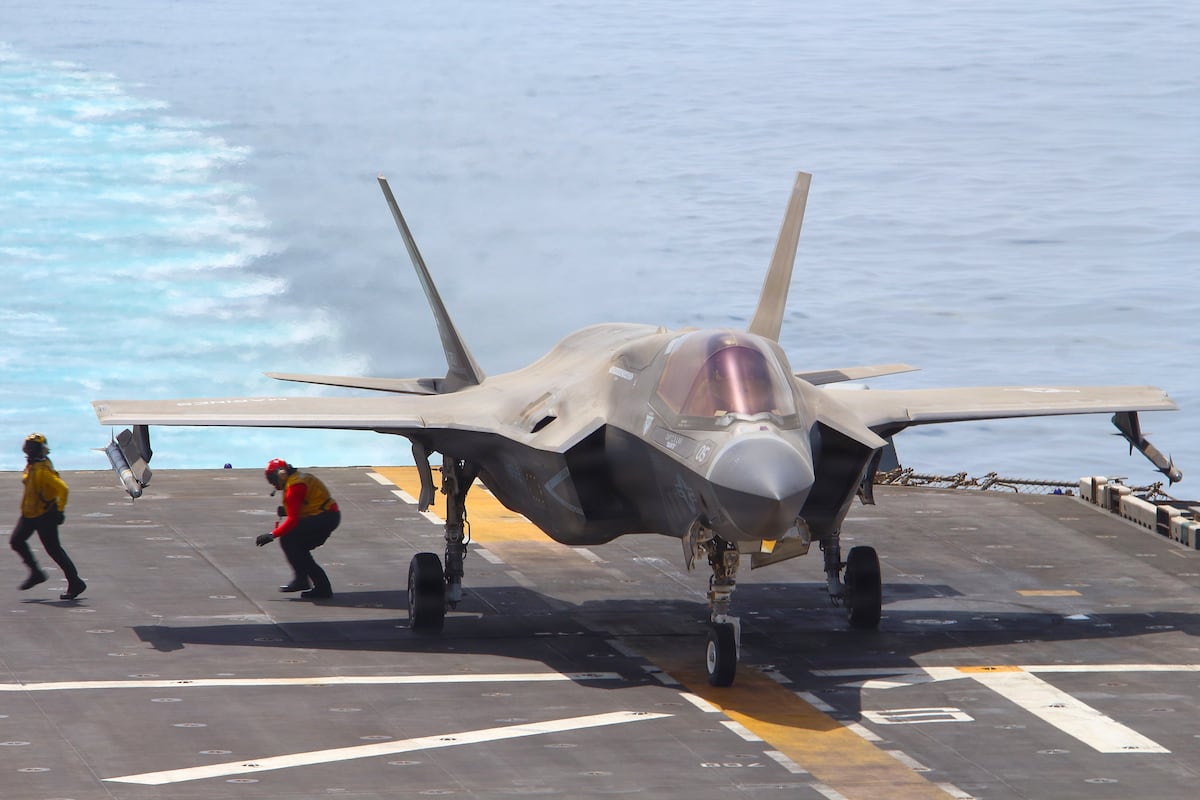
The proposed 85-aircraft purchase would be the Pentagon’s largest single-year F-35 buy since fiscal 2022. According to the source text, the planned mix includes 38 F-35As for the Air Force, 37 F-35Cs for the Navy and Marine Corps, and 10 F-35Bs for the Marine Corps. The combined cost across the three variants is roughly $21.4 billion, based on budget justification documents.
That scale matters because the F-35 remains the backbone of U.S. tactical airpower modernization across multiple services. A bigger buy would help replenish inventories, support industrial throughput and signal confidence in the aircraft’s long-term role despite years of delays, sustainment complaints and readiness problems. Yet the structure of the request also reveals how difficult it remains to fully fund that vision through the ordinary budget process alone.
Congress is the real near-term gatekeeper
The political risk is explicit. House Speaker Mike Johnson has acknowledged that a second reconciliation bill could be difficult to pass, and some House Republicans have already pushed back on the idea after the passage of the One Big Beautiful Bill Act last year. Because the supplemental mandatory funding bill has not even been introduced yet, the majority of the F-35 request currently rests on a mechanism that is not guaranteed to materialize.
For defense planners and industry alike, that creates uncertainty. Procurement plans influence supplier commitments, workforce expectations and production pacing. A request for 85 aircraft sends one signal to the industrial base. A final appropriation for 32 would send another. The gap between those outcomes is large enough to affect planning across the program.
The budget also tries to address longstanding program issues
The fiscal 2027 request is not only about buying more jets. It also includes money intended to accelerate upgrades and improve readiness. One budget line of $324 million in the mandatory funding request would speed procurement of 200 Block 4 modification kits, pulling the first fleet delivery forward from fiscal 2031 to fiscal 2030.
That is notable because Block 4 has become one of the program’s central problem areas. The upgrade package is supposed to add sensors, electronic warfare capability and weapons integration, but the schedule has slipped by roughly five years from its original timeline. Much of that delay has been tied to problems with the Technology Refresh 3 processor, the computing hardware needed to support the newer software baseline.
The budget therefore attempts to show that additional money would not simply buy more airframes. It would also address capability and modernization bottlenecks that have reduced confidence in the program’s pace.
Readiness remains a core weakness
The request further targets the F-35’s readiness shortfalls. The fleet averaged about a 50% mission-capable rate in fiscal 2024, according to the source text. That means fewer than half the aircraft were ready for combat at any given time, well below the program’s 65% availability target. Acting Pentagon Comptroller Jules Hurst said last week that the aircraft had been underfunded in prior budgets and that the fiscal 2027 structure is meant to raise that rate.
This is a critical point. Procurement totals can dominate headlines, but combat usefulness depends on how many aircraft can actually fly when needed. If sustainment, spare parts, maintenance cycles and upgrade timelines lag, larger fleet numbers alone do not fully solve the military problem. The Pentagon is effectively arguing that the new budget should be understood as a combined procurement and readiness repair package.
What it means for the services
The Air Force would receive the largest share of the planned buy with 38 F-35As, 14 more than the 24 funded in fiscal 2026. When combined with the 24 F-15EX fighters sought in the same request, the service’s total fighter buy would reach 62 aircraft. Even that figure, however, remains 10 short of the 72-aircraft annual minimum that National Guard generals told Congress this month is necessary for sustained force structure health.
That context matters because it shows the budget is trying to recover lost momentum without fully closing every capacity gap. The Navy and Marine Corps components of the F-35 request also reinforce the aircraft’s role across carrier aviation and expeditionary operations, but the credibility of the entire package depends on Congress accepting the administration’s more complicated financing plan.

The bottom line
The fiscal 2027 F-35 request is both ambitious and precarious. It promises a major expansion in procurement, faster Block 4 modifications and an effort to improve a fleet that is still falling short on mission-capable rates. But most of the increase is not secured inside the regular budget. It hinges on a second reconciliation bill that may prove politically difficult.
That leaves the program in a familiar position: strategically central, operationally necessary and still vulnerable to budget mechanics and execution risk. The Pentagon has drawn the outline of a larger F-35 recovery plan. Congress will decide whether that outline becomes a real procurement surge or another example of aspirations outrunning appropriations.
This article is based on reporting by Defense News. Read the original article.
Originally published on defensenews.com