From urgent workaround to formal requirement
The U.S. Marine Corps is preparing a formal requirement for lightweight, wearable counter-drone systems, according to comments made at the Modern Day Marine exposition and reported by Breaking Defense. Lt. Col. R.M. Barclay said the requirement should arrive within the next couple of months, marking a transition from improvised urgent fielding toward a more deliberate acquisition path.
The announcement is significant because it acknowledges two realities at once. First, small unmanned aerial systems have become a serious battlefield and force-protection problem. Second, the systems Marines are using right now were fielded quickly to meet immediate need rather than as part of a fully integrated long-term program.
That distinction matters. Emergency procurement can put useful tools in troops’ hands quickly, but it often produces fragmented fleets of devices that are difficult to connect, sustain, and scale. Barclay’s comments suggest the Corps now wants to move from stopgap capability to a more coherent architecture.
Why small-drone defense is a gap
Breaking Defense reports that Maj. Gen. Jason Morris described a shortfall in protecting Marine ground and logistics formations from drone threats. He argued that larger, more complex air-defense systems do not adequately solve the problem at the maneuver level, especially against smaller unmanned aircraft. In other words, capabilities optimized for larger targets are not enough when the threat is cheap, numerous, low-flying, and close to tactical units.
That challenge has been growing across modern conflict. Small drones can be used for reconnaissance, targeting, and attack. They compress the distance between observation and strike, and they are often available in large numbers. For forces operating in dispersed formations, the need for portable countermeasures becomes more urgent.
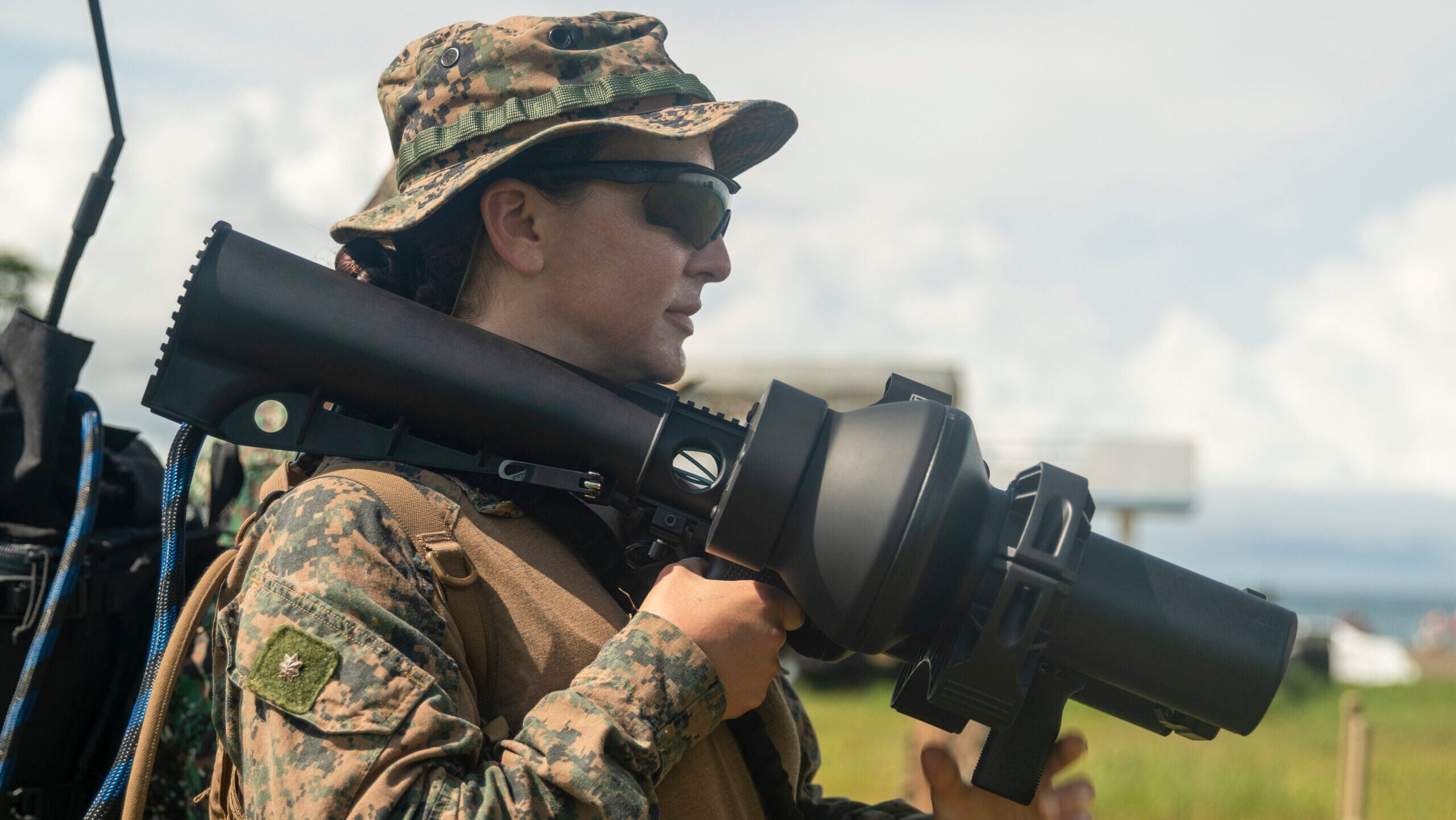
The Marine Corps response, according to the report, has included wearable systems that can be attached to an individual Marine. These tools are primarily non-kinetic, relying on handheld passive sensors or jamming rather than direct interception. That design logic makes sense for frontline use: portability, speed of deployment, and immediate local defense matter more than elaborate fixed-site setups.

The integration problem
The current weakness is not only what the systems do, but how isolated they are from one another. Barclay said today’s fielded systems are disparate and not integrated. That is more than a technical inconvenience. In modern air and missile defense, sensor fusion and networking are central. A device that detects or jams a drone has more value when its information can feed a broader defensive picture.
Barclay linked the future goal to integrated missile defense, arguing that the connective tissue matters. That phrasing is important. It implies the Marines do not want wearable counter-drone tools to remain a disconnected accessory category. They want them to become part of a larger command-and-control environment in which tactical detection and response can be tied into broader defensive systems.
The new requirement, if written that way, could shape not just procurement but system design across industry. Vendors would have a clearer signal that interoperability is not optional. They would be responding to a demand for devices that fit into a networked defensive ecosystem rather than operate as standalone gadgets.
What happens next
The report says the requirement document is currently at the O6/O7 review level, meaning it is still moving through senior review before final approval. That indicates the process is advanced enough to be concrete, but not complete. In acquisition terms, formalizing a requirement is a key step because it converts a recognized need into a documented demand that can anchor future budgeting, competition, and program structure.
It also creates a baseline against which future purchases can be judged. An urgent field need justifies speed. A requirement defines standards. If the Marines specify connectivity, portability, and suitability for small-drone defense at the ground-combat and logistics levels, those criteria will shape what the service buys next.
The wider defense significance is clear. Counter-drone technology is moving down the force structure. It is no longer just about protecting major installations or deploying larger systems against larger aircraft. It is becoming an individual and small-unit problem. That requires tools that are light enough to carry, simple enough to employ, and networked enough to contribute to the broader fight.
The Marine Corps appears to be acknowledging that reality explicitly. By moving toward a formal requirement for wearable counter-UAS systems, it is signaling that the gap is real, the urgent patches are insufficient, and the next phase must be integrated by design.
This article is based on reporting by Breaking Defense. Read the original article.
Originally published on breakingdefense.com