A Tiltrotor Concept With Teeth
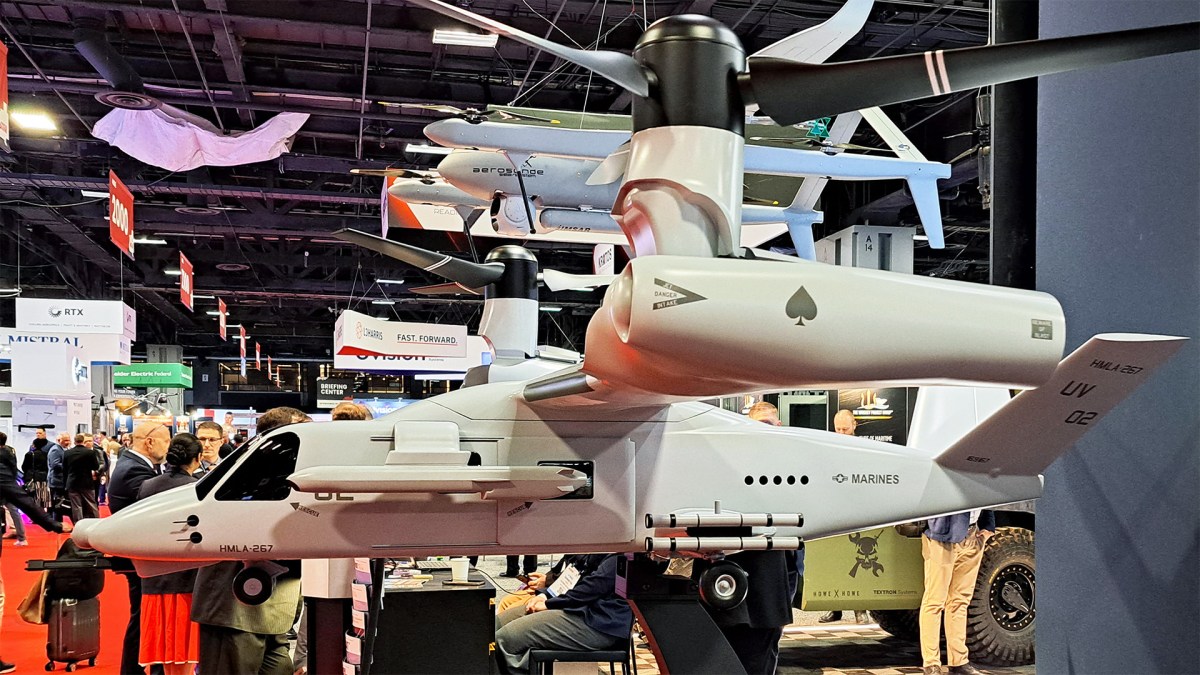
Bell has unveiled a new concept for a next-generation Marine Corps tiltrotor armed with cruise missiles and other munitions, according to the supplied source text from The War Zone. The design is based on what is now called the MV-75A Cheyenne II, which is in development for the U.S. Army, and it arrives as the Marine Corps says “everything is on the table” in shaping replacements for its AH-1Z Viper and UH-1Y Venom helicopters.
The concept is not subtle about its intended role. A model displayed at the Modern Day Marine conference in Washington, D.C., is painted for Marine Light Attack Helicopter Squadron 267, a unit associated today with the Corps’ current mix of attack and armed utility helicopters. But the visible point is not paint. It is payload.
Missiles, Stub Wings, and a New Mission Set
The most striking feature described in the source is the aircraft’s armament. The model carries two stub wings with pylons mounted high on the forward fuselage, between the main wing and the cockpit. On the left side sits a Naval Strike Missile, a stealthy anti-ship cruise missile with secondary land-attack capability. On the right side is a pair of smaller missiles intended to reflect the Marine Corps’ forthcoming Precision Attack Strike Munition capability, a version of L3Harris’ Red Wolf.
That combination matters because it suggests Bell is not simply proposing a transport-derived aircraft with add-on weapons. It is presenting a concept aligned with the Marine Corps’ wider shift toward distributed operations, stand-in forces, and maritime targeting. A tiltrotor with speed, range, and missile loadout begins to look less like a conventional helicopter replacement and more like a flexible node in a contested littoral fight.
The Marine Corps already fields the Naval Strike Missile in a ground-launched configuration, as the source notes. Putting such weapons onto an aircraft concept broadens the conversation from platform replacement to operational architecture. The question becomes not only what succeeds the Viper and Venom, but how future Marine aviation contributes to sea denial, expeditionary strike, and survivability inside a more heavily defended battlespace.

Why the Timing Matters
The source places the concept in the middle of a strategic opening. The Marine Corps has not locked itself into a single answer for what comes next. Its comment that “everything is on the table” leaves room for alternatives that blur old categories of assault support, armed reconnaissance, and attack aviation.
That openness is significant because the Corps’ legacy helicopter structure reflects older assumptions about how missions are divided across platforms. A next-generation tiltrotor could challenge those boundaries. If an aircraft can move faster and farther than a traditional helicopter while carrying stand-off weapons, planners may see value in combining roles that have historically been separated.
At the same time, a concept model is not a procurement decision. It is a signal. Bell is using a visible, armed design to shape the terms of debate early, before requirements fully harden. By tying the Marine concept to the Army’s MV-75A Cheyenne II, the company is also hinting at possible commonality benefits, though the source stops short of claiming a joint path.
The Operational Logic Behind the Concept
The Marine Corps has been moving toward smaller, more mobile, and more distributed force packages, particularly in maritime environments. In that context, range and speed are not luxuries. They are survivability attributes. A tiltrotor can offer both, and an armed version extends the argument further by suggesting the aircraft can arrive fast and hit hard without relying on older helicopter concepts optimized for shorter legs and different threat conditions.
The inclusion of the Naval Strike Missile is especially telling. It connects the aircraft to anti-ship warfare, one of the defining mission areas in a Pacific-focused planning environment. The PASM/Red Wolf tie-in suggests interest in lower-cost strike options as well. Together, those weapons imply a future in which Marine aircraft may be expected to contribute directly to distributed fires rather than only escort, transport, or close support missions.

More Than a Trade Show Mockup
Defense exhibitions are full of speculative hardware, but some models deserve more attention than others because of what they reveal about procurement thinking. This one matters because it aligns with a real capability transition question inside the Marine Corps. Bell is not inventing a problem to fit a product. It is presenting a product idea to match a problem the service has publicly acknowledged.
Whether the Corps ultimately embraces an armed tiltrotor, a more conventional successor, or a mix of systems, the concept underscores where the argument is heading. Future Marine aviation may be judged less by platform lineage and more by how effectively it supports distributed operations, stand-off strike, and maritime relevance. Bell’s missile-armed MV-75 concept is an early, very visible bid to define that future.
This article is based on reporting by twz.com. Read the original article.
Originally published on twz.com