The Navy moves its new autonomous vessel marketplace into testing
The US Navy has taken an important step in its effort to speed autonomous maritime acquisition, selecting seven medium unmanned surface vessel, or MUSV, submissions to move into a prototype evaluation phase. The decision narrows a field of more than two dozen designs submitted after the service launched its marketplace in March.
The names of the selected companies were not disclosed at the time of reporting, but the next requirement is clear: successful at-sea demonstrations. According to the Navy, industry partners chosen for this phase must prove the maturity of their systems before October 2026. If those demonstrations go well, the service plans to work with industry so vessels could be available for leasing or procurement in fiscal year 2027.
That timeline matters. It suggests the Navy is trying to compress the gap between concept selection and operational access, while avoiding a lengthy single-platform development cycle. Rather than committing early to one bespoke design, the service appears to be building a competitive pipeline of mature options that can be tested against real performance demands.
Why the marketplace model matters
The MUSV marketplace is notable not only for the systems involved but for the acquisition model behind it. The Navy first outlined the approach as part of a broader effort to create a foundation for acquiring other robotic and autonomous systems. In other words, this is not just a vessel competition. It is also an experiment in how the service wants to buy autonomy.
That is a consequential shift. Traditional defense procurement often struggles to keep pace with fast-moving commercial and dual-use technologies, especially in autonomy, where hardware, software, sensors, and mission payloads evolve quickly. A marketplace structure can let the Navy evaluate a wider range of industry offerings, refresh competition more frequently, and buy closer to demonstrated capability rather than distant promises.
The service has not publicly detailed the exact mission sets for these vessels. But earlier comments tied the effort to multiple operational needs as the Navy builds more tailored force packages under the guidance of Chief of Naval Operations Adm. Daryl Caudle’s Fighting Instructions. That framing implies flexibility is part of the objective. The vessels may be expected to fit different packages rather than one narrowly defined role.
From concept to proof at sea
The decisive phase now is no longer brochure-based. The Navy’s language puts emphasis on at-sea demonstrations, which is where autonomy programs often face their real test. Endurance, navigation, control resilience, communications, payload integration, and survivability all become harder to evaluate once systems leave a controlled environment.
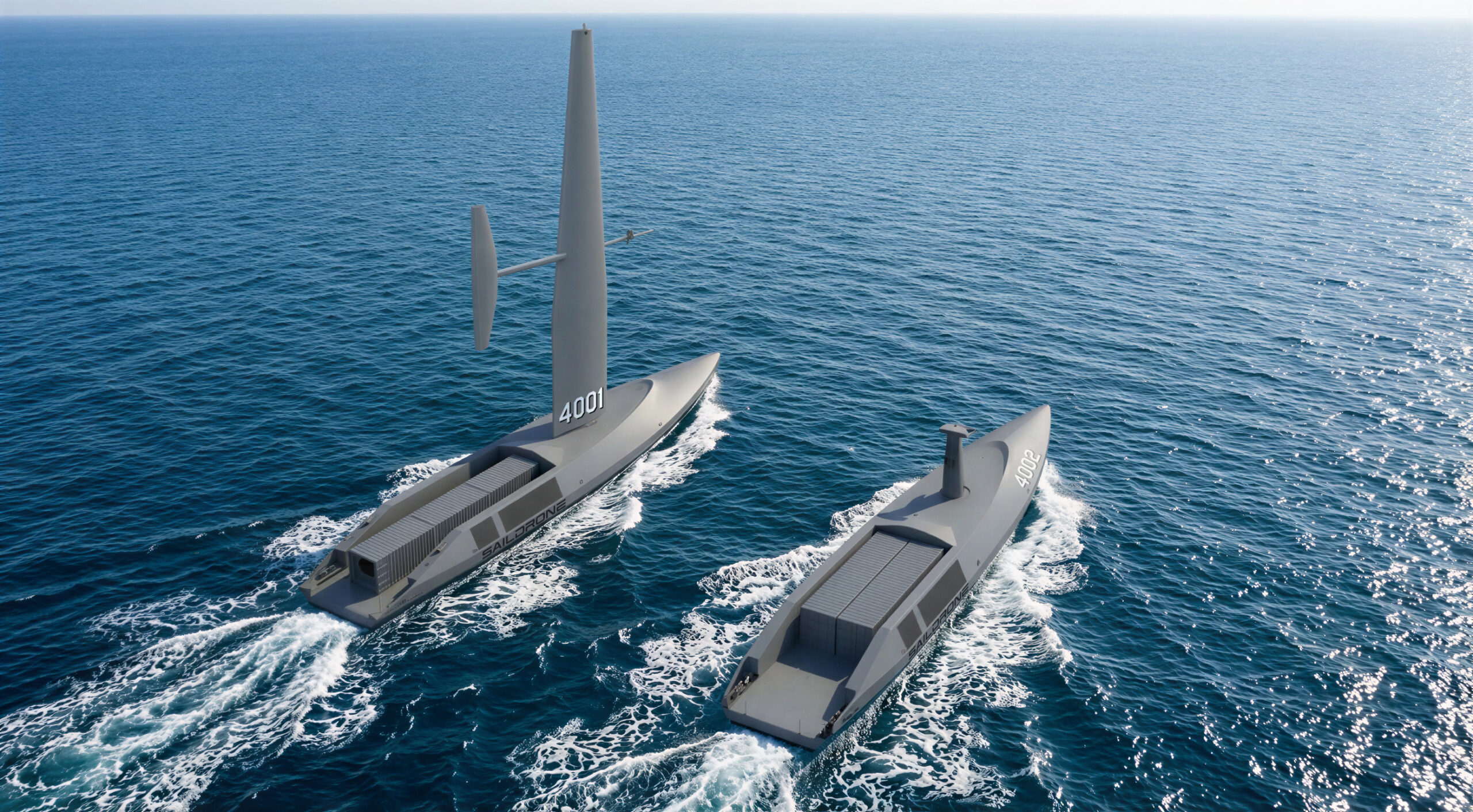
At least one company, Saildrone, had already disclosed that it submitted a proposal before the first marketplace iteration closed in April. The company had also shown its Spectre MUSV family publicly, including variants branded for endurance and stealth-oriented missions. Whether Saildrone is among the seven finalists was not confirmed in the report, but its participation illustrates the mix of established autonomy players now competing for naval roles.
For the Navy, the prototype stage is an opportunity to judge whether industry offerings are mature enough to reduce risk before wider procurement. For vendors, it is a chance to prove that unmanned surface vessels are ready to move from demonstrations and concept art into repeatable military utility.
What to watch next
The near-term milestone is the expected disclosure of which companies advanced. The more important milestone will come later, when the selected systems demonstrate how close they are to fieldable capability. A competitive list of seven is large enough to preserve choice but small enough to signal that the program is moving into a more serious down-select environment.
More broadly, the MUSV effort will be watched as a test of whether the Navy can turn interest in autonomous platforms into a workable acquisition rhythm. If the service succeeds, it could provide a template for other robotic programs that need faster feedback loops, more commercial participation, and clearer pathways from trial to procurement.
For now, the headline is straightforward: after an open marketplace draw of more than two dozen designs, the Navy has identified seven contenders it believes are ready to prove themselves on the water. In a sector where timelines often stretch and concepts linger, that is a meaningful sign of momentum.
This article is based on reporting by Breaking Defense. Read the original article.
Originally published on breakingdefense.com